Dairy processing lines · · 5 min read
How to Plan a Small-to-Mid Dairy Processing Plant
Plan a dairy plant step by step: milk reception to filling, sizing litres per day into L/h, yogurt, cheese and butter modules, utilities, layout and CIP.
By the process engineering team at Shanghai Mars Industrial Co., Ltd.
Key takeaways
- Convert daily milk intake into hourly flow using effective production hours after cleaning, then add 10–20% headroom.
- The core sequence is reception, cooling, separation and standardization, homogenization, pasteurization, product modules, filling and CIP.
- Hard cheese needs roughly 10 litres of milk per kilogram, so cheese capacity drives milk intake more than any other product.
- Utilities (steam, ice water, compressed air, power, water) and hygienic zoning must be designed with the process, not after it.
How do you plan a small-to-mid dairy processing plant?
Start with the product mix and daily milk volume, convert it into hourly flow rates for each process step, then design the process flow, utilities, building layout and cleaning system around those flows. A well-planned plant matches separator, homogenizer, pasteurizer and fillers so no single machine becomes the bottleneck.
This guide follows the milk from the tanker to the filled package and shows the numbers that matter at each stage, using parameters from the Tetra Pak Dairy Processing Handbook, FAO and Codex.
What is the standard process flow in a dairy plant?
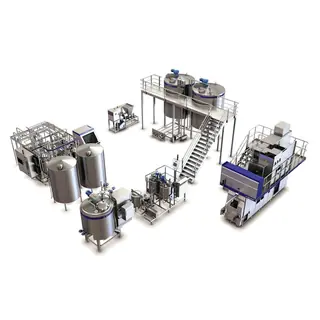
Raw milk is received, tested and chilled to about 4 °C, separated and standardized, homogenized, pasteurized and cooled, then either filled as market milk or routed to yogurt, cheese or butter modules. Every product-contact circuit is cleaned in place between runs.
- Reception: weigh or meter the milk, sample for antibiotics, fat, protein and bacteria, de-aerate, filter and chill. EU rules cap raw cow milk at 100,000 CFU/ml (plate count at 30 °C).
- Raw milk storage: insulated silos or tanks held at about 4 °C, with agitation and level control.
- Separation and standardization: warm separation at 62–64 °C splits cream and skim; in-line standardization recombines them to a set fat, commonly 3.0% for regular and 1.5% for low-fat milk.
- Homogenization: 10–25 MPa (100–250 bar) at 55–80 °C reduces average fat globules from about 3.5 µm to below 1 µm.
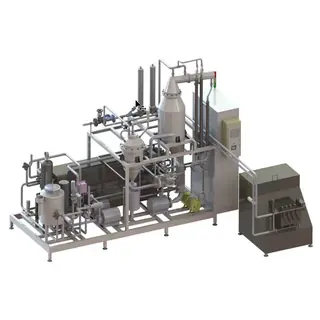
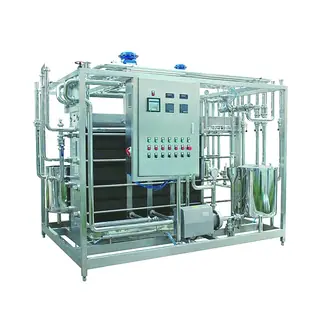
- Pasteurization: 72–75 °C for 15–20 seconds for market milk, then cooled to about 4 °C.
- Product modules: yogurt, cheese, butter or UHT, described below.
- Filling and cold storage: pouches, bottles, cups or cartons, then a cold room.
- CIP: automated cleaning of tanks, lines and heat exchangers.
How do you convert litres per day into equipment capacity?
Hourly capacity equals daily volume divided by effective production hours. For example, 30,000 litres per day over two shifts (16 hours) minus about 2 hours for CIP and changeovers gives 14 effective hours, or roughly 2,150 L/h; specify a 2,500 L/h pasteurizer for headroom.
| Daily milk intake | Required flow | Suggested pasteurizer | Raw milk storage (about 1 day) |
|---|---|---|---|
| 5,000 L/day | about 360 L/h | 500 L/h HTST or batch vats | 2 × 3,000 L |
| 20,000 L/day | about 1,430 L/h | 2,000 L/h HTST | 2 × 10,000 L |
| 50,000 L/day | about 3,570 L/h | 5,000 L/h HTST | 2 × 25,000 L silos |
| 100,000 L/day | about 7,140 L/h | 8,000–10,000 L/h HTST | 3 × 35,000 L silos |
Size storage so that milk can be received while the line is cleaning, and split it into at least two tanks so one can be cleaned while the other is in use. Size the separator and homogenizer to the pasteurizer flow; partial homogenization of only the cream stream, described in the handbook, can cut homogenizer size to about one-fifth of line capacity and power use by about 70%.
What do yogurt, cheese and butter modules require?
Each product adds its own heat treatment, fermentation or separation steps and changes how much raw milk you need. Yogurt needs intense heat treatment and incubation tanks, cheese needs vats and pressing with about 10 litres of milk per kilogram, and butter needs cream ripening and churning.
| Product | Heat treatment | Key process step | Milk or cream requirement |
|---|---|---|---|
| Pasteurized milk | 72–75 °C, 15–20 s | Cool to about 4 °C, fill | About 1 L milk per L product |
| Yogurt | 90–95 °C, about 5 min | Homogenize at 200–250 bar, ferment at 42–43 °C to pH 4.2–4.5 | About 1 L milk per kg, plus any solids fortification |
| Hard / semi-hard cheese | 72–73 °C, 15–20 s (or thermization) | Renneting at about 30–32 °C, cutting, pressing, brining, ripening | About 10 L milk per kg cheese |
| Butter | Cream at 85 °C, 15 s or higher | Cream ageing (often 12–15 h), churning, working | Butter must contain at least 80% milk fat |
FAO's village milk processing manual uses about 10 litres of milk per kilogram of cheese for costing, and estimates about 11 kg of Gouda-type cheese from 100 litres. Because cheese is so milk-intensive, a plant planning 1 tonne of cheese per day needs around 10,000 litres of cheese milk on top of its liquid milk volume, and must plan for whey handling.
Which utilities does a dairy plant need?
A dairy plant needs steam or hot water for heating and CIP, chilled or ice water for cooling, refrigeration for cold rooms, compressed air for valves and fillers, potable water, electrical power and wastewater treatment. Size each from the peak simultaneous load, not the daily average.
| Utility | Main users | Sizing basis |
|---|---|---|
| Steam / hot water | Pasteurizer, yogurt heat treatment, CIP tanks, cheese vats | Peak heating duty while CIP runs in parallel with production |
| Ice water / chilled water | Reception cooler, pasteurizer cooling section, yogurt cooling, cream ripening | Heat load to bring milk from regeneration outlet to about 4 °C at full flow |
| Refrigeration | Cold rooms, raw milk silos, butter and cheese ripening rooms | Product throughput, room volume, door openings |
| Compressed air | Pneumatic valves, filling machines, butter equipment | Sum of consumers plus leakage allowance; oil-free, dried air |
| Electrical power | Homogenizer, separator, pumps, compressors, chillers | Connected load with diversity factor |
| Water and effluent | CIP, rinsing, floor washing | Volume per CIP cycle × cycles per day |
Heat recovery makes a large difference: regeneration in a modern plate pasteurizer can recycle 94–95% of heat, which cuts both steam and ice-water demand.
How should the layout and hygiene zones be arranged?
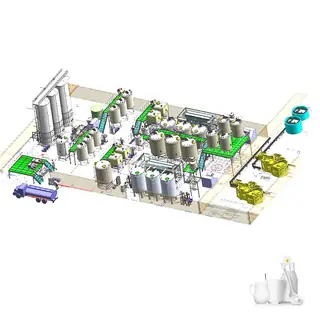
Arrange the building so product moves in one direction, from raw reception to finished-goods dispatch, with physical separation between raw and pasteurized zones. Keep packaging material, chemicals and utilities in separate rooms, and slope floors to drains.
- Raw zone: tanker bay, reception, raw silos.
- Process zone: separator, homogenizer, pasteurizer, product tanks.
- High-care zone: fillers and cup or bottle lines, with controlled air and personnel hygiene entry.
- Cold zone: finished-goods cold rooms and dispatch.
- Technical zone: boiler, chillers, compressors, CIP station, electrical room.
Cleaning-in-place design
The Dairy Processing Handbook describes two typical programmes. For cold surfaces such as tanks and pipes: rinse about 3 minutes, alkaline detergent at 0.5–1.5% and 75 °C for about 10 minutes, rinse, then hot-water disinfection at 90–95 °C. For heated surfaces such as pasteurizers: rinse about 10 minutes, 0.5–2% alkali at 75 °C for about 30 minutes, rinse, then 0.5–1.5% acid at 70 °C for about 20 minutes. Design pipe CIP flow for 1.5–3.0 m/s so the detergent scours the surface.
What are the steps to plan the project?
- Define products, pack formats and daily volumes for year one and year five.
- Draw the process flow diagram and mass balance.
- Size equipment and buffer tanks from hourly flows.
- Calculate utilities at peak load.
- Develop the layout with hygienic zoning and expansion space.
- Specify automation, recording and CIP.
- Plan installation, commissioning, staff training and spare parts.
When we engineer a dairy line, we deliberately leave floor space and pipe connections for the next product module, because most plants add yogurt or cheese within a few years. If you share your milk volume and product plan, our team can prepare a preliminary flow diagram and equipment list.
Frequently asked questions
How much milk do I need to make 1 kg of cheese?
For hard and semi-hard cheeses, about 10 litres of milk per kilogram is a practical planning figure; FAO estimates about 11 kg of Gouda-type cheese from 100 litres. Soft, high-moisture cheeses yield more per litre, and actual yield depends on milk fat and protein.
How many hours per day should a small dairy plant run?
Many small-to-mid plants run one or two shifts. Plan on effective production hours after subtracting CIP, start-up and changeovers, often 1.5–2 hours per day, and size equipment so the daily volume fits comfortably within that time.
What temperature should raw milk be stored at?
Raw milk should be chilled and held at about 4 °C from reception until processing. Silos should be insulated, agitated and cleaned regularly, and storage capacity should allow milk to be received while the processing line is being cleaned.
Do I need a homogenizer for a small dairy?
A homogenizer is needed for homogenized market milk, UHT milk, yogurt and many cream products, because it prevents cream separation and improves texture. Batch cheese and butter plants can operate without one, and partial homogenization can reduce homogenizer size substantially.
Sources
- Tetra Pak Dairy Processing Handbook – Pasteurized and ESL dairy products
- Tetra Pak Dairy Processing Handbook – Homogenizers
- Tetra Pak Dairy Processing Handbook – Fermented milk products
- Tetra Pak Dairy Processing Handbook – Butter and dairy spreads
- Tetra Pak Dairy Processing Handbook – Cleaning of dairy equipment
- FAO – Village milk processing (accounting and equipment costs)