Fruit & vegetable processing · · 10 min read
Tomato Paste Factory Cost: Capacity, Equipment and Investment
Tomato paste factory cost explained: raw tomato supply and season, capacity tiers, product formats, utilities, cost drivers and why many plants underperform.
By the process engineering team at Shanghai Mars Industrial Co., Ltd.

Key takeaways
- Tomato paste factory cost is driven by fresh-tomato capacity, evaporator design, packaging format, buildings, utilities and the working capital needed to buy a season of tomatoes.
- A 500 tonnes-per-day plant running a 90-day season needs about 45,000 t of processing tomatoes; at 25 t/ha that is roughly 1,800 ha of dedicated fields.
- With 5 °Brix fruit, about 6 t of fresh tomatoes make 1 t of 28–30 °Brix paste, so a 10,000 t/year paste plant needs roughly 60,000 t of tomatoes.
- Published studies from Ghana, Nigeria and Senegal link underperforming tomato plants mainly to short seasons, low yields, unsuitable varieties, high fresh-market prices and cheaper imported paste.
- Public project figures, such as US$5 million for a 10,000 t/year paste project in Zambia's investment profile, are indicative only because scopes differ widely.
What does it take to start a tomato paste factory?
A viable tomato paste factory needs a secured supply of processing-type tomatoes for a defined season, a capacity matched to that supply, a product mix your buyers want (bulk drums, cans, sachets or ketchup), reliable steam, water and power, and working capital to buy the crop. Tomato paste factory cost depends more on these choices than on the machines alone.
Many investors start with the tomato processing equipment quotation. Experience across Africa and elsewhere shows that the harder questions are agricultural and commercial: how many tonnes of suitable tomatoes will arrive each day, for how many weeks, and at what price compared with imported paste. This guide covers raw material planning, capacity tiers, product formats, buildings and utilities, cost drivers and the reasons many tomato processing plants underperform. The process itself (washing, break, refining, evaporation and filling) is explained in our tomato paste processing line guide, so it is only summarized here.
How much tomato supply and season length does a factory need?
Work backwards from the season: daily intake multiplied by processing days gives the annual tonnage you must contract. A 500 tonnes-per-day (TPD) plant running 90 days needs about 45,000 t of processing tomatoes, which at 25 t/ha means roughly 1,800 ha of dedicated fields.
Processing tomatoes ripen in a concentrated window, and a paste plant can only run while fresh fruit arrives. Season length varies widely by region:
| Region | Season reported | Yield reported | Source |
|---|---|---|---|
| California, USA | Harvest from early July to mid-October | Not stated | California Foundation for Agriculture in the Classroom |
| Northern Ghana | Short season of about three months (January–March) | Most farmers well below 10 t/ha | IFPRI, Robinson and Kolavalli (2010) |
| Senegal River valley | Industrial tomatoes grown December to July | Average below 23 t/ha, against 60–70 t/ha in intensive producing countries | COLEACP market profile (2021) |
| Nigeria (national average) | Varies by zone | About 5.5 t/ha, against a world average of 38.1 t/ha | PwC Nigeria (2018) |
Field yield changes the land you must secure dramatically. Using the 45,000 t example above, land needed is about 8,200 ha at 5.5 t/ha, about 2,000 ha at 23 t/ha, and only about 650–750 ha at 60–70 t/ha. That is why serious projects invest in seedlings, irrigation and agronomy support alongside the factory.
Why fruit quality matters as much as volume
Processing varieties have firm flesh, high soluble solids and uniform ripening, and they tolerate mechanical handling. IFPRI's Ghana study found that the seasonal glut came mainly from local varieties that processors would not buy, while improved varieties earned a premium in the fresh market. Our tomato line guide shows that every 0.5 °Brix difference in fruit changes paste output by roughly 10%, so low-brix fruit raises the cost of every tonne of paste.
Which capacity tier fits a new tomato processing plant?
Small plants process roughly 50–150 TPD of fresh tomatoes, mid-size plants 200–600 TPD, and large export plants 1,000 TPD or more. A fourth model, re-processing imported drum paste into cans and sachets, needs no fresh intake at all. Choose the tier your contracted supply can fill on most days of the season.
Paste output follows a soluble-solids mass balance. With 5 °Brix fruit and normal losses, about 6 t of fresh tomatoes make 1 t of 28–30 °Brix paste, and about 7.5–8 t make 1 t of 36–38 °Brix paste, as shown in our process guide.
| Tier | Fresh tomatoes | Paste per day | Paste per 90-day season | Typical market |
|---|---|---|---|---|
| Small | 50–150 TPD | About 8–25 t | About 750–2,250 t | Local cans, sachets, sauces |
| Mid-size | 200–600 TPD | About 33–100 t | About 3,000–9,000 t | National market, regional bulk |
| Large | 1,000–1,500 TPD | About 165–250 t | About 15,000–22,500 t | Bulk aseptic export |
| Re-processing (no fresh intake) | Imported 28–30 or 36–38 °Brix paste | Set by filling speed | Year-round | Retail cans and sachets |
For example, a public investment profile from the Zambia Development Agency describes a plant producing about 10,000 t of paste a year; at 6:1 that implies around 60,000 t of fresh tomatoes, or roughly 670 TPD over 90 days. Our 100–1500 TPD tomato paste processing line covers the fresh-tomato tiers, while smaller projects often start with a 2–5 T/H tomato paste production line. Use our line planner to test different intake and season scenarios.
Which break type and product formats should you sell?
Choose hot break for thick paste destined for ketchup and sauces, and cold break for juice, soups and better colour. Then choose formats by customer: aseptic bags in drums for industrial buyers, cans for retail and food service, small sachets for price-sensitive retail, and ketchup or sauces for higher value per kilogram of tomato.
The technical difference between hot break (above about 80 °C) and cold break (around 60–70 °C) is covered in our process guide. Commercially, it decides which buyers of processed tomatoes will take your paste: re-packers and ketchup makers specify hot break for viscosity, while beverage and soup makers often specify cold break. The Zambia Development Agency profile, for example, plans both hot and cold break paste.
| Format | Typical buyers | Equipment implications |
|---|---|---|
| Aseptic bags in drums or bins (for example 50 kg bags for export, 2–25 kg for domestic sale in the Zambian profile) | Ketchup, sauce and re-packing industries | Sterilizer and aseptic filler; largest volumes, lowest margin per tonne |
| Cans (800 g and 2 kg cans reported in Senegal) | Retail, restaurants, institutions | Can filler, seamer, retort or hot-fill cooling tunnel |
| Small sachets (70 g bags reported in Senegal) | Price-sensitive retail in West Africa and elsewhere | Form-fill-seal machine, pasteurizer; high packaging cost per kg |
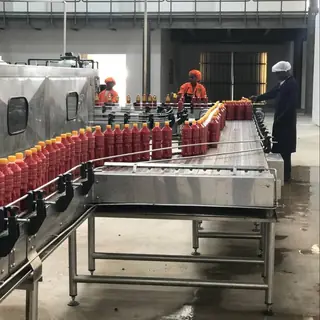
| Ketchup and sauces | Retail and food service | Mixing and cooking tanks, homogenizer or colloid mill, bottle filler |
Ketchup has its own rules. Under the US standard for catsup (21 CFR 155.194), the finished product must flow no more than 14 cm in 30 seconds at 20 °C on a Bostwick consistometer, which in practice favours hot break paste. A sachet tomato paste and sauce processing line or a tomato ketchup, paste and sauce processing line can turn bulk paste into these retail formats.
What equipment does a tomato paste factory need?
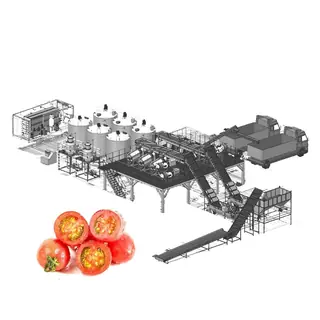
A fresh-tomato paste factory needs reception and washing, sorting, a chopping and break system, pulper-refiners, a multi-effect evaporator, a sterilizer and aseptic or can filling, plus CIP, a boiler, cooling tower and water treatment. A re-processing plant needs only drum handling, dilution and mixing tanks, heat treatment and fillers.
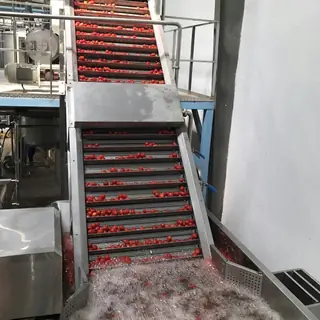
- Reception and washing: unloading flumes, roller or bubble washers and sorting tables.
- Break system: chopper pumps and a hot or cold break tank with fast heating.
- Extraction: pulper and refiner with screens matched to the target texture.
- Concentration: a multi-effect forced circulation tomato paste evaporator; selection is explained in our evaporator selection guide.
- Sterilization and filling: tubular sterilizer with aseptic bag filler, as in our tomato paste line with aseptic drum filling, or can and sachet fillers.
- Utilities and cleaning: boiler, cooling tower, vacuum system, water treatment, CIP station and laboratory.
When comparing tomato processing machinery offers, check stainless grades, evaporator effects, steam consumption guarantees and the spare-parts package, not only the price.
What buildings and utilities does a tomato processing plant need?
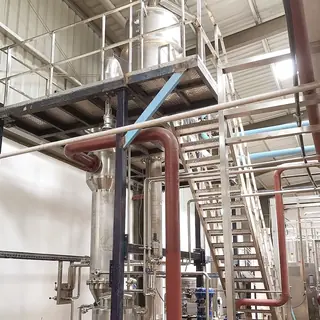
Plan a covered reception area for trucks, a hygienic process hall with high roof for the evaporator, a filling and warehouse area for a whole season of output, a boiler house, cooling towers, water treatment and wastewater treatment. Steam for evaporation is usually the largest utility load.
The evaporator removes most of the incoming water. In the mass balance from our process guide, a 500 TPD line making 28–30 °Brix paste evaporates about 393 t of water per day, which is why multi-effect designs that reuse vapour are standard. Practical points:
- Steam: size the boiler for break heating, evaporation and sterilization at peak; fuel choice (gas, heavy oil, biomass) changes operating cost more than equipment price.
- Water: flumes and washers need large volumes of clean water; recirculation and filtration reduce intake.
- Cooling: evaporator condensers need cooling water; hot climates need larger cooling towers.
- Power: motors and drives must match 50 or 60 Hz and local voltage; plan standby generation where the grid is unstable.
- Storage: a seasonal plant produces a year of stock in a few months, so warehouse space and working capital are significant.
- Wastewater: skins, seeds and wash water need screening and treatment before discharge.
Unsure how big your boiler, cooling tower or warehouse should be? Our engineers can size this for you from your intake and season; send us your project data.
What drives tomato paste factory cost?
The main tomato paste factory cost drivers are fresh-tomato capacity, evaporator effects and steam economy, aseptic versus can or sachet filling, degree of automation, buildings and utilities, and working capital for a season of tomatoes. Publicly reported projects range from a few million US dollars upwards, but scopes differ widely.
| Cost driver | Why it matters |
|---|---|
| Fresh intake (TPD) | Sets the size of every machine, the boiler and the building |
| Evaporator design | More effects cost more to buy but use less steam every season |
| Packaging format | Aseptic filling and sachet machines change both capital and per-kg packaging cost |
| Automation level | Automatic brix and temperature control reduces labour and improves grade consistency |
| Buildings and utilities | Civil works, boiler, cooling, water and wastewater treatment can rival equipment cost |
| Agricultural programme | Collection depots, seedlings, contract-farming support and transport |
| Working capital | Cash to buy a whole season of tomatoes before paste is sold |
Two public figures give an indicative sense of scale only. The Zambia Development Agency's investment profile estimates US$5 million to set up a plant of about 10,000 t of paste a year, including construction, collection depots, equipment, vehicles and working capital. In Burkina Faso, Food Business Africa reported in December 2024 that a new plant with 5 t/h of tomato capacity cost US$8.9 million. These figures are indicative, from different years and scopes, and should not be used as quotations.
Why do many African tomato paste plants underperform?
Published studies point mainly to raw material: short seasons, low field yields, local varieties unsuited to processing, fresh-market prices above what processors can pay against imported paste, and post-harvest losses. Breakdowns and missing spare parts add to the problem in some tomato concentrate factories.
- Price gap with the fresh market: IFPRI's 2010 Ghana study found processors needed fresh tomatoes at no more than about GH¢150 per tonne to compete with imports, while fresh-market prices often exceeded GH¢400–500 per tonne; in one northern area, prices fell below that level in only one month of a year.
- Short season and side-selling: the same study reports a roughly three-month season in northern Ghana and contract farmers selling to fresh traders when prices rose.
- Losses and low yields: PwC Nigeria estimated that about 45% of fresh tomatoes produced in 2017 were lost, with average yields of 5.47 t/ha, and noted that many industrial processors exited mainly because of difficulty sourcing local tomatoes.
- Under-utilization: Tomato News reported in 2020 that one large northern Nigerian plant rated at 1,200 t per day had never used more than about 20% of its capacity, citing raw material shortages, dual-purpose varieties, pests and heat above 38 °C.
- Imports and declining throughput: COLEACP's 2021 Senegal profile shows processed volumes falling from more than 93,000 t of tomatoes per campaign to less than 37,000 t, with imported triple concentrate cheaper than local supply.
- Maintenance: IFPRI links the closure of earlier state-run plants in Ghana partly to frequent breakdowns from lack of spare parts and obsolete machinery.
Checklist to de-risk a tomato paste project
- Contract supply with seedlings, inputs and agronomy support, and a price formula farmers trust.
- Size capacity to the realistic supply, not the theoretical maximum.
- Add a re-processing or ketchup line so the plant earns outside the season.
- Consider multi-product use of the evaporator and sterilizer for fruit pulps; see our fruit processing plant guide.
- Budget spare parts, operator training and CIP from the start.
- Model costs against landed import prices of drum paste.
What information do you need for a quotation?
For an accurate tomato paste plant proposal, send your expected daily tomato intake and season length, fruit brix, target paste grade and break type, packaging formats, utilities and voltage, and site details. With these, our engineers prepare a mass balance, equipment list, layout and utility estimate.
- Fresh tomato intake (TPD), season months and expected field brix.
- Target products: 28–30 or 36–38 °Brix paste, hot or cold break, ketchup, sauces, puree.
- Packaging: aseptic bag size, can sizes, sachet weights, bottles.
- Whether you will also re-process imported drum paste outside the season.
- Utilities: fuel for steam, water source and quality, voltage and frequency (50/60 Hz).
- Site: plot size, climate and any existing buildings.
When we engineer a tomato processing line, we balance the break system, refiner and evaporator to the same hourly solids flow and plan the utilities around them. Request a quotation or browse all fruit and vegetable processing equipment.
Frequently asked questions
How much does a tomato paste factory cost?
There is no single figure, because cost depends on fresh-tomato capacity, evaporator effects, packaging, buildings, utilities and working capital. As indicative public examples, the Zambia Development Agency profile estimates US$5 million for about 10,000 t of paste a year, and a Burkina Faso plant with 5 t/h capacity was reported in 2024 at US$8.9 million. Request a project-specific quotation.
How many tomatoes does a tomato processing plant need per season?
Multiply daily intake by processing days. A 500 TPD plant running 90 days needs about 45,000 t of fresh processing tomatoes. Land needed depends on yield: roughly 1,800 ha at 25 t/ha, but over 8,000 ha at the 5.5 t/ha average reported for Nigeria. Secure contracts before finalizing capacity.
Why do tomato paste factories in Africa often run below capacity?
Studies by IFPRI, PwC Nigeria and COLEACP point to short seasons, low yields, local varieties unsuited to processing, high post-harvest losses and fresh-market prices above what processors can pay when imported paste is cheaper. Maintenance problems and lack of spare parts have also contributed. Supply planning matters as much as the processing line.
Should a new factory make paste from fresh tomatoes or re-process imported paste?
Fresh-tomato processing adds the most local value but depends on a secure seasonal supply. Re-processing imported 28–30 or 36–38 °Brix drum paste into cans, sachets and ketchup needs less capital and runs year-round. Many projects combine both: fresh tomatoes in season and imported concentrate off-season to keep fillers and staff busy.
What tomato products can a tomato cannery make besides paste?
A tomato cannery can make diluted paste in cans and sachets, puree, ketchup, pizza and pasta sauces, diced or peeled tomatoes and tomato juice. Ketchup and sauces earn more per kilogram of tomato but need mixing, cooking and bottle-filling equipment. Bulk aseptic paste remains the base product for most industrial buyers.
What is the biggest utility cost in tomato processing?
Steam for evaporation is usually the largest utility load, because the evaporator removes most of the water in the fresh tomatoes. A 500 TPD line making 28–30 °Brix paste evaporates roughly 393 t of water per day. Multi-effect evaporators that reuse vapour, good insulation and efficient boilers keep this cost down.
Sources
- IFPRI – The Case of Tomato in Ghana: Processing (GSSP Working Paper 21, Robinson and Kolavalli, 2010)
- PwC Nigeria – X-raying the Nigerian tomato industry: Focus on reducing tomato wastage (2018)
- COLEACP – Market profile of the processed tomato in Senegal (2021)
- Tomato News – Africa: the difficult match between agriculture and industry (2020)
- Zambia Development Agency – Zambia Tomato Processing investment profile
- Food Business Africa – US$8.9M tomato processing plant inaugurated in Burkina Faso (2024)
- eCFR – 21 CFR 155.194 Catsup
- California Foundation for Agriculture in the Classroom – Tomatoes fact sheet