Fruit & vegetable processing · · 12 min read
Fruit Processing Plant Guide: Pulp, Jam, Juice and Dried Fruit
Plan a fruit processing plant: choose pulp, jam, juice or dried fruit, match equipment and dryers to each product, handle seasonality and size capacity.
By the process engineering team at Shanghai Mars Industrial Co., Ltd.

Key takeaways
- A fruit processing plant should start from reliable local fruit supply and identified buyers, then add product-specific modules to a shared receiving, washing and sorting front end.
- US rules (21 CFR 150.160) require fruit jam to contain at least 65% soluble solids; FAO practice boils jam to about 68 °Brix with gel forming at pH 3.2–3.4.
- FAO recommends blanching vegetables in water at 85–95 °C rather than full boiling, then cooling below 37 °C quickly to limit softening and vitamin losses.
- Hot-air cabinet, tunnel and belt dryers are the usual drying machines for fruits in small and mid-size plants; dried apple yield is only about 10–12% of fresh weight.
- Seasonality is the main cost risk: aseptic or frozen pulp storage and multi-fruit lines let a plant keep running after the harvest ends.
How do you set up a fruit processing plant?
Set up a fruit processing plant by first choosing products that match your local fruit supply and buyers (pulp, puree, jam, juice or dried fruit), then sizing a shared front end for receiving, washing and sorting, adding product-specific modules such as pulpers, cookers, extractors or dryers, and planning storage so the plant can work outside the harvest season.
A fruit processing plant converts perishable harvests into stable products that can be stored, shipped and sold all year. That matters most where losses are high: the FAO's State of Food and Agriculture 2019 estimated that about 14% of the world's food is lost between harvest and retail, and found losses are generally higher for fruits and vegetables than for cereals and pulses. This guide covers product selection, fruit processing equipment, blanching, drying, seasonality and capacity; the juice process itself is detailed in our juice production line process guide.
Which fruit products should a new plant make?
Start from the fruit you can buy reliably at a stable price and the buyers you can reach. Bulk pulp and puree suit plants selling to beverage, dairy and bakery manufacturers; jam, juice and dried fruit suit retail brands. Most successful plants begin with one or two products and add others once supply and sales are proven.
Work through three questions: what fruit arrives, in what volume and for how many weeks; who buys the output and in what packaging; and how much shelf life the distribution chain needs.
- Mango: a classic pulp fruit. Aseptic or frozen mango pulp is sold to juice, nectar, yogurt and ice-cream makers, while the same line can produce mango juice, jam and dried mango slices or bars.
- Apple: suited to juice, puree for baby food and bakery, jam and dried apple rings, often from lower-grade fruit.
- Citrus: oranges and lemons go mainly to juice (not-from-concentrate or concentrate), with peel oil and dried peel as by-products. According to the Tetra Pak Orange Book, the pulpy juice after extraction is about 50% of the fruit weight.
| Product | Typical buyers | Packaging | Key preservation step | Relative equipment complexity |
|---|---|---|---|---|
| Pulp / puree (bulk) | Juice, dairy, bakery and baby-food manufacturers | Aseptic bags in drums, frozen blocks, large cans | Sterilization and aseptic filling, or freezing | Medium to high (aseptic) |
| Jam, jelly, marmalade | Retail, hotels, food service | Glass jars, plastic cups, portion packs | High sugar, acidity and hot filling | Low to medium |
| Juice and nectar | Retail and food service | PET, glass, cartons | Pasteurization or UHT and hygienic filling | Medium to high |
| Dried fruit | Retail snacks, cereal and bakery ingredient makers | Pouches, cartons, bulk bags | Lower water activity by drying | Low to medium |
What standards define jam, juice, pulp and dried fruit?
Each product is defined by measurable targets: jam by soluble solids (at least 65% under US rules), juice and pulp by soluble solids and acidity, and dried fruit by final moisture content. These targets decide which cooker, evaporator or dryer you need, so fix them before buying equipment.
| Product | Target | Source / note |
|---|---|---|
| Fruit jam / preserves (US) | Soluble solids not less than 65%; 47 or 45 parts fruit to 55 parts sugar, depending on fruit group | 21 CFR 150.160 |
| Jam (FAO practice) | About 68 °Brix final, gel forming at pH 3.2–3.4 | FAO Bulletin 119 |
| Mango juice | 12–15% total soluble solids, 0.4–0.5% acidity as citric acid | FAO Bulletin 119 |
| Dried apple rings | About 20% moisture | FAO Bulletin 119 |
| Dried banana pieces / mango pulp sheets | About 15% moisture | FAO Bulletin 119 |
| Dried apricots | About 17–20% moisture | FAO Bulletin 119 |
Export buyers add their own specifications, and rules on preservatives such as sulphur dioxide differ by country, so confirm them early.
What fruit processing equipment does each product need?
All products share a front end of receiving, washing, sorting and conveying. Pulp lines then add destoning, pulping and finishing, plus sterilization and aseptic filling; jam lines add cooking kettles or vacuum pans; juice lines add extractors or presses and pasteurizers; dried fruit lines add slicers, pre-treatment and dryers.
Shared front end
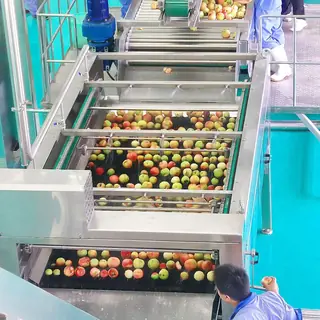
Fruit is unloaded into a water flume or hopper, cleaned in a roller brush washer for fruit and vegetables or bubble washer, inspected on a roller sorting table, and lifted by elevators to the processing floor. Washing and sorting decide microbial load and final colour; our fruit and vegetable washing machine guide covers the options.
Pulp and puree
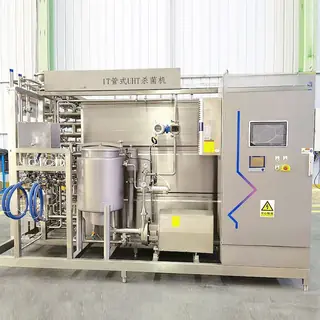
For stone fruit such as mango, a mango peeling, destoning and pulping machine separates pulp from stones and skins; a finisher with a finer screen removes fibre. Pulp is then deaerated, heat-treated in a tubular unit such as a tube-in-tube sterilizer for mango pulp, and filled aseptically. FAO Bulletin 119 describes mango puree heated to 90 °C for 1 minute in a plate heat exchanger and cooled to 35 °C. Apple puree follows the same idea after chopping and softening; see the apple puree and jam production line.
Jam
Jam needs a weighing and premixing station for fruit, sugar and pectin, a steam-jacketed kettle or vacuum pan to concentrate the mix, and a hot filler. FAO describes three basic fruit-to-sugar recipes (50:50, 45:55 and 40:60) boiled to about 68 °Brix. Vacuum cooking lowers boiling temperature, which helps colour and flavour on delicate fruit.
Juice
Juice lines use a pulper or juice extractor for soft fruit, belt or hydraulic presses for apples and pineapples, and dedicated extractors for citrus. The Tetra Pak Orange Book gives about 5 t/h of medium oranges, or roughly 2,500 L/h of juice, per extractor. Juice is then clarified or finished, pasteurized and filled. A citrus juice processing line adds oil recovery and pulp handling.
Dried fruit
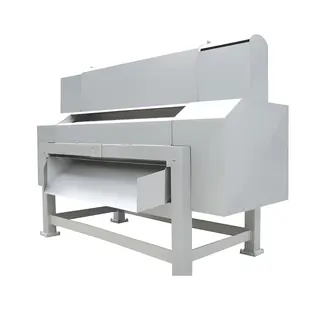
Dried fruit equipment covers peeling, a fruit chopper machine or slicer with adjustable thickness, pre-treatment tanks, trays or belts, and the fruit dryer machine itself. These modules cost far less than aseptic equipment, which is why dried fruit is a common first product for small plants.
What are the main steps in a mango pulp line?
A mango pulp line receives and ripens fruit, washes and sorts it, softens and destones it, pulps and finishes the flesh, deaerates and heat-treats the pulp, and fills it aseptically or into cans. The same sequence, with different front-end machines, applies to guava, papaya, peach and apple puree.
- Receiving and ripening: fruit is weighed and ripened evenly; unripe fruit lowers brix and colour.
- Washing and sorting: brush washing and spray rinsing remove soil and residues; damaged fruit is removed by hand.
- Softening and destoning: FAO describes steaming whole mangoes for 2–2.5 minutes to loosen skins before pulping and stone removal.
- Pulping and finishing: paddle pulpers push flesh through screens; FAO cites a 0.084 cm finishing screen to remove fibre.
- Deaeration and heat treatment: vacuum deaeration protects colour and vitamin C before pasteurization or sterilization.
- Filling and storage: aseptic bags in drums for bulk sale, or cans and jars for retail; frozen storage is the alternative.
A combined mango pulp, juice and jam processing line uses this sequence and then splits pulp to the juice blending and jam cooking sections.
When does a fruit or vegetable processing line need a blancher?
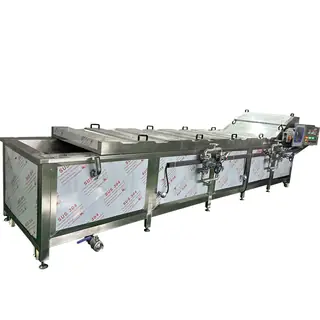
A blancher is needed when enzymes would otherwise cause browning, off-flavours or texture loss, mainly before freezing, drying or canning vegetables and some fruits. FAO recommends hot water at 85–95 °C rather than full boiling to limit nutrient losses, followed immediately by rapid cooling below 37 °C.
Blanching is a short heat treatment that inactivates enzymes. FAO notes that catalase and peroxidase are the most heat-resistant, so when they are destroyed the other significant enzymes are too. Blanch too little and the enzymes survive; blanch too much and the product overcooks. Times therefore have to be validated for each product and piece size.
| Vegetable | Water temperature | Time |
|---|---|---|
| Peas | 85–90 °C | 2–7 min |
| Green beans | 90–95 °C | 2–5 min |
| Carrots | 90 °C | 3–5 min |
| Peppers | 90 °C | 3 min |
| Cauliflower | Boiling | 2 min |
An industrial vegetable blancher can be a hot-water drum or belt unit, or a steam blancher with a mesh belt. FAO notes that vegetables bound for a vegetables dryer can go straight from steaming to drying without cooling.
Which drying machine for fruits suits a commercial plant?
For most small and mid-size plants, a hot-air cabinet (tray) dryer or continuous belt or tunnel dryer is the practical drying machine for fruits and vegetables. Vacuum and freeze dryers give better quality at much higher cost, solar dryers suit hot, dry climates, and spray or drum dryers are used for purees and juice powders.
Any food dryer machine works by lowering water activity until microbes cannot grow; FAO notes that most bacteria need a water activity of about 0.90–1.00, while some yeasts and moulds grow slowly down to about 0.65. FAO tunnel-drying tables show fruit dried with air at roughly 55–80 °C, with high-sugar fruit started at lower temperatures, and its mango bar example combines about 10 hours of solar drying at around 55 °C with 16 hours at 70 °C.
| Dryer type | Operation | Suits | Notes |
|---|---|---|---|
| Cabinet / tray dryer | Batch, hot air | Pieces, purees, small volumes | Low cost, flexible; labour for loading trays |
| Tunnel dryer | Continuous, hot air on trolleys | Pieces, mainly vegetables | Good for steady single-product runs |
| Belt / conveyor dryer | Continuous, hot air | Pieces, purees | Higher throughput, less labour |
| Solar or hybrid solar dryer | Batch | Mango, banana, apricot, dates | Needs hot, dry, rain-free conditions; backup heat for nights |
| Vacuum dryer | Batch or belt, sub-atmospheric | High-sugar fruit such as peaches, pears, apricots | Better colour and flavour; higher cost |
| Freeze dryer | Batch, sub-atmospheric | Premium pieces and powders | Highest quality and cost |
| Spray or drum dryer | Continuous | Juice concentrates, purees | Produces powders and flakes |
Yield is the other planning number. FAO's tunnel-drying data give finished yields of about 10–12% of fresh weight for apples and 10–15% for apricots and pears, so one tonne of fresh apples gives only about 100–120 kg of dried rings. Osmotic pre-treatment in sugar syrup can, according to FAO, raise solar dryer throughput two to three times by removing part of the water before drying.
Not sure which dryer or pulp configuration fits your fruit and budget? Our engineers can size this for you from your fruit volumes and target products; send us your data and we will suggest a layout.
How do you keep a fruit processing plant running outside the season?
Combine fruits with different harvest windows on one flexible line, store semi-finished pulp or juice aseptically or frozen to finish later, and add products such as jam, nectar or tomato-based sauces that can be made from stored bases. A plant that runs only during one fruit's season carries its fixed costs for the rest of the year.
Seasonality is the main economic challenge in fruit and vegetable processing. The Tetra Pak Orange Book notes that not-from-concentrate juice may be stored for up to a year because production is seasonal while consumption is year-round, and that concentrate can be kept for several years. FAO Bulletin 119 describes semi-processed pulps and purees made specifically for later conversion into jams, syrups and fruit in syrup, preserved by freezing at about −20 to −30 °C or by chemical preservatives where permitted.
- Multi-fruit front end: choose washers, pulpers and finishers with interchangeable screens and adjustable rotor speeds so mango, guava, papaya and apple can share the line.
- Aseptic buffer: pulp filled into aseptic bags during the season becomes raw material for juice, nectar and jam later in the year.
- Concentration: a multi-effect falling film juice evaporator reduces storage volume and freight for juice and some purees.
- Vegetable products: tomato and pepper extend the calendar; see our tomato paste factory cost guide.
How do you calculate the capacity of a fruit processing plant?
Start with the fresh fruit you can secure per day, multiply by the product yield, and divide by effective operating hours. For example, 2 t/h of mango at roughly 50% pulp yield gives about 1 t/h of pulp, or about 16 t per 16-hour day. Size each module to the same hourly flow.
FAO's mango example converts 720 kg of mango into 360 kg of pulp, about 50%. Real yields depend on variety, ripeness and machine settings, so confirm them with trial runs on your own fruit.
| Fresh fruit intake | Product | Approximate yield | Output per 16-hour day |
|---|---|---|---|
| 2 t/h mango | Mango pulp | About 50% | About 16 t pulp |
| 5 t/h oranges | Pulpy orange juice | About 50% | About 40 t juice before finishing |
| 1 t/h apples | Dried apple rings (about 20% moisture) | About 10–12% | About 1.6–1.9 t dried rings |
- Fix the daily intake for your main fruit and the number of season days.
- Subtract cleaning and changeover time to get effective hours.
- Apply realistic yields for each product and grade.
- Match the bottleneck, usually the heat treatment, evaporator, dryer or filler, to the hourly flow.
- Size storage for raw fruit, aseptic pulp and finished goods.
Our line planner turns these inputs into a first equipment list, and the full range of modules is listed under fruit and vegetable processing equipment.
What utilities and buildings does a fruit processing plant need?
A fruit plant needs clean potable water for washing and cleaning, steam for blanching, cooking, pasteurization and evaporation, chilled or cooling water, compressed air, and a stable electrical supply at the local voltage and frequency, plus a hygienic building with separate raw and finished zones and a wastewater plan.
- Water: washers and CIP are the largest users; recirculating flumes with filtration reduce consumption.
- Steam: size the boiler for the peak simultaneous load of blancher, cooker, sterilizer and evaporator.
- Cooling: cooling towers or chillers for product cooling, evaporator condensers and aseptic fillers; tropical sites need extra margin for high wet-bulb temperatures.
- Electricity: motors and control panels must match 50 or 60 Hz and the local voltage; plan for voltage fluctuation and standby generation where the grid is unstable.
- Building: washable floors with drains, separated raw and packing areas, and covered fruit reception.
- Waste: peels, stones and pomace can go to feed or compost; wastewater needs screening and treatment.
What information do you need for a quotation?
To quote a fruit processing plant accurately, we need your fruits and season lengths, daily intake, target products and specifications, packaging, available utilities and voltage, and site details. With these data our engineers can prepare a mass balance, equipment list and layout.
- Fruits and vegetables to process, with harvest months and expected quality (ripeness, brix).
- Daily or hourly fresh fruit intake and operating hours.
- Products and grades: pulp, puree, juice, nectar, jam, dried fruit, and target brix or moisture.
- Packaging: aseptic bags in drums, cans, glass, PET, pouches, and pack sizes.
- Utilities: steam or fuel type, water quality, voltage, frequency (50/60 Hz) and available power.
- Site: building dimensions or plot size, climate, and any existing equipment to integrate.
When we engineer a fruit line, we size every module to one hourly flow and leave room to add products later. Request a quotation or browse our juice and beverage lines for related equipment.
Frequently asked questions
What equipment is needed for a fruit processing plant?
Every fruit processing plant needs receiving hoppers or flumes, washers, sorting tables and elevators. Pulp lines add destoners, pulpers, finishers, deaerators, sterilizers and aseptic fillers; jam lines add cooking kettles or vacuum pans and hot fillers; juice lines add extractors or presses and pasteurizers; dried fruit lines add slicers, pre-treatment tanks and dryers. Utilities such as a boiler, cooling and CIP complete the plant.
Which drying machine for fruits is best for a small business?
For most small businesses, an electric or steam-heated hot-air cabinet (tray) dryer is the most practical start because it is affordable and handles many fruits. As volumes grow, a continuous belt or tunnel dryer reduces labour. Solar or hybrid dryers suit hot, dry climates, while vacuum and freeze dryers give premium quality at much higher investment.
What does a vegetable blancher do?
A vegetable blancher heats vegetables briefly in hot water or steam to inactivate enzymes that cause browning, off-flavours and texture loss during freezing, drying or canning. FAO suggests 85–95 °C water instead of boiling to reduce nutrient losses, with times of about 2–7 minutes depending on the vegetable, followed by rapid cooling below 37 °C.
How much pulp do you get from mangoes?
As a planning figure, mango gives roughly 50% pulp by weight. FAO Bulletin 119 gives an example where 720 kg of mangoes produce 360 kg of pulp. Actual yield depends on variety, ripeness, stone and peel size and the pulper and finisher settings, so trial runs with your local fruit are recommended before final sizing.
How can a fruit processing plant operate all year?
Process several fruits with different harvest seasons on a flexible line, and store semi-finished pulp or juice in aseptic bags or frozen during the season. The stored base can then be converted into juice, nectar or jam later. Adding vegetable products such as tomato paste or sauces further extends the operating calendar.
What is the difference between fruit and vegetable processing lines?
Fruit and vegetable processing lines share washing, sorting, heat treatment and packaging equipment. Fruit lines focus on pulping, juicing, jam cooking and drying of high-sugar, acidic products. A vegetable processing plant more often includes blanching, cutting, freezing or drying of low-acid products, which need stricter heat treatment if they are canned.
Sources
- FAO – Fruit and vegetable processing (Agricultural Services Bulletin 119): Fruit drying and dehydration
- FAO – Fruit and vegetable processing (Bulletin 119): Mango and guava processing
- FAO – Fruit and vegetable processing (Bulletin 119): Vegetable-specific processing technologies (blanching)
- FAO – Fruit and vegetable processing (Bulletin 119): Drying/dehydration and concentration
- FAO – Fruit and vegetable processing (Bulletin 119): Semi-processed fruit products
- eCFR – 21 CFR 150.160 Fruit preserves and jams
- Tetra Pak Orange Book – Fruit processing
- IISD SDG Knowledge Hub – The State of Food and Agriculture 2019 explores food loss and waste