Juice & beverage lines · · 12 min read
Juice Production Line: Process Steps, Equipment and Capacity
Juice production line explained: NFC vs concentrate, extraction, enzymes, 5-log pasteurization, evaporation, filling and a yield table for capacity sizing.
By the process engineering team at Shanghai Mars Industrial Co., Ltd.

Key takeaways
- A fruit juice production line runs receiving, washing, sorting, extraction, enzyme treatment, clarification or finishing, deaeration, pasteurization and filling, with evaporation and aroma recovery added for concentrate.
- US juice HACCP (21 CFR 120.24) requires processes that achieve at least a 5-log reduction of the most resistant pathogen likely in the juice; typical juice pasteurization runs at 80–95 °C for about 15–30 seconds.
- FAO reports apple juice yields of about 730 L per tonne on a belt press and 690–770 L per tonne on a screw press; industrial citrus extraction gives pulpy juice of about 50% of fruit weight.
- NFC juice needs five to six times the storage volume of frozen orange concentrate, which is typically 65–66 °Brix and is reconstituted to at least 11.8 °Brix in the US.
- Size the line from fruit intake per hour times realistic yield, then match pasteurizer, evaporator and filler to the finished-juice flow with buffer tanks between them.
What is a juice production line and how does it work?
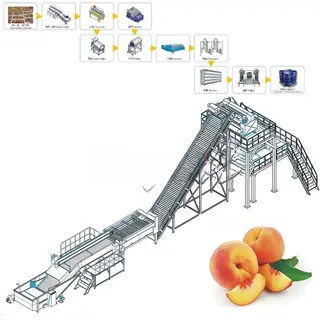
A juice production line receives, washes and sorts fruit, extracts juice by pressing, reaming or pulping, then clarifies or finishes it, deaerates it, pasteurizes it to a validated lethality and fills it hot, aseptically or cold. Plants making concentrate add an evaporator with aroma recovery before storage or bulk filling.
Every fruit juice production line follows the same logic: protect the fruit, extract as much juice as the product allows, stop enzymes and microbes quickly, and package without recontaminating. The equipment changes with the fruit, but the sequence rarely does. This guide walks through each step of fruit juice processing, the verified temperatures behind it, the yields you can expect by fruit and a practical method for sizing capacity.
Should you make NFC juice or juice from concentrate?
Make not-from-concentrate (NFC) juice when you sell fresh, premium juice close to the orchard or market; make concentrate when you must store a seasonal crop for a year or ship it long distances. According to the Tetra Pak Orange Book, NFC needs five to six times the storage and transport volume of frozen concentrate.
NFC juice is extracted, pasteurized and either packed directly or stored chilled or aseptically. Concentrate is evaporated to a high Brix, stored and later reconstituted with water by a juice packer. The Orange Book notes that water makes up 80–85% of a reconstituted juice, so the quality of the water treatment plant matters as much as the concentrate.
| Factor | NFC juice | Juice from concentrate |
|---|---|---|
| Typical Brix at storage | Single strength, about 10–12 °Brix for orange | Orange concentrate typically 65–66 °Brix; apple concentrate standardized to about 70 °Brix |
| Storage volume | Five to six times that of frozen concentrate | Lowest; concentrate can be held chilled or frozen in bulk |
| Key extra equipment | Large aseptic or chilled tanks | Multi-effect evaporator, aroma recovery, cold storage |
| Reconstitution | Not needed | Treated water plus concentrate; minimum orange juice Brix is 11.8 in the US and 11.2 in the EU |
| Typical buyer | Premium retail, chilled distribution | Juice packers, beverage bottlers, export markets |
As a worked example from the Orange Book, one litre of 11.2 °Brix orange juice needs roughly 180 g of 65 °Brix concentrate and about 865 g of water. Many mid-size plants combine both routes: NFC or nectar in season, concentrate or aseptic pulp for off-season production.
What are the steps in fruit juice processing?
The core steps are receiving, washing, sorting, crushing or extraction, enzyme treatment where needed, clarification or finishing, deaeration, pasteurization, optional evaporation with aroma recovery, and filling. Each step either protects yield, protects flavor and color, or protects food safety.
- Receiving and short storage: fruit is weighed and sampled. The Orange Book recommends keeping citrus in storage bins for less than 24 hours where possible.
- Washing: spray, brush or bubble washers remove soil and reduce surface microbes. The FAO juice manual warns that dumping fruit into water tanks is dangerous unless the dump water is adequately chlorinated.
- Sorting: damaged, rotten and unripe fruit is removed on roller or belt inspection tables. For apples this step directly controls patulin, a mold toxin that FAO lists with a limit of 50 parts per billion in juice.
- Crushing and extraction: apples and pears are milled and pressed, citrus is extracted in cup-type or reamer machines, and mango, guava or banana go through pulpers and finishers.
- Enzyme treatment: pectinase breaks down pectin to raise press yield and allow clarification.
- Clarification or finishing: centrifuges, fining agents and filters produce clear juice; finishers control pulp in cloudy juice.
- Blending and standardization: Brix, acid and pulp are adjusted in mixing tanks.
- Deaeration: dissolved oxygen is removed under vacuum to protect color, flavor and vitamins and to prevent foaming at the filler.
- Pasteurization: a plate or tubular heat exchanger heats, holds and cools the juice.
- Evaporation and aroma recovery (concentrate plants only), then filling by hot-fill, aseptic or chilled cold-fill.
Washing and sorting
Washing is the first food-safety step and the cheapest place to lose yield if it is done badly. Brush washers suit firm fruit such as apples and citrus; air-bubble washers suit softer fruit such as mango, berries and tomatoes. Our guide to industrial fruit and vegetable washing machines compares washer types and wash-water sanitizers in detail. After washing, a roller sorting machine turns each fruit so inspectors see the whole surface.
Crushing and extraction
Extraction is where most of the economics are decided. FAO reports that a continuous belt press yields about 730 litres of apple juice per tonne of apples, while a continuous screw press gives 690–770 L per tonne with more suspended solids. Citrus is never crushed whole, because peel oil and the white albedo make juice bitter; dedicated extractors separate juice from peel instead. Our industrial juice extractor and fruit press guide compares citrus extractors, belt presses, hydraulic presses, screw presses and pulper-finishers.
Enzymes, clarification and filtration
For clear apple juice, FAO describes two depectinization regimes: a hot method at 54 °C for one to two hours, or a cold method at 20 °C for six to eight hours. Completion is checked with an acidified-alcohol test; if no gel forms after five minutes, the pectin is broken down. Skipping this step is costly: according to FAO, filtering juice that has not been depectinized runs at roughly one third of the rate of enzyme-treated juice.
Clarification then uses some combination of centrifugation, fining with bentonite or gelatin and tannin, and filtration with diatomaceous earth precoat. Ultrafiltration membranes, which remove proteins and carbohydrate polymers, replace much of the fining and earth filtration in larger plants. Cloudy juices such as orange or mango skip clarification and instead pass through finishers, whose screen size sets the pulp level.
Deaeration
The Orange Book states that blended juice is usually saturated with about 8–10 ppm of dissolved oxygen. A vacuum deaerator, fed with juice preheated to 50–60 °C so that it partly flashes, can bring oxygen below 1 ppm. Volatile aroma lost in the vapor is condensed and returned to the juice. Deaeration also prevents foaming in containers during hot filling.
What pasteurization does juice need under FDA juice HACCP?
Under 21 CFR 120.24, US juice processors must use a process that achieves at least a 5-log (100,000-fold) reduction of the most resistant pathogen likely to occur in the juice. In practice this is a heat treatment: the Tetra Pak Orange Book gives 80–95 °C for about 15–30 seconds for juice.
The rule applies the 5-log reduction directly to the juice, with one exception: citrus processors may count surface treatment of whole fruit, but only after culling and cleaning, and the whole 5-log process must be completed within one facility. Processors whose single thermal step makes the juice shelf-stable, or who use a thermal concentration process that heats all ingredients, are exempt from the 5-log requirement but must document that process in their hazard analysis. Packaged juice that has not received a 5-log process must carry a warning statement under 21 CFR 101.17(g). Even if you export to other markets, the 5-log benchmark is a useful design target for any buyer audit.
| Product / purpose | Temperature | Time | Source |
|---|---|---|---|
| General juice pasteurization | 80–95 °C | About 15–30 s | Tetra Pak Orange Book |
| Citrus juice, pectinesterase inactivation (cloud stability) | At least 90 °C | A few seconds for juice below pH 4.0 | FAO juice manual |
| Apple juice, flash pasteurization | Above 88 °C | 25–30 s | FAO juice manual |
| Grape juice pasteurization | 85 °C | 3 min | FAO juice manual |
| Hot filling into containers | Heated to 90–98 °C, filled at 84–95 °C | Hold depends on container | Tetra Pak Orange Book |
| Pre-sterilizing the pasteurizer | 95–110 °C water | 20–30 min | Tetra Pak Orange Book |
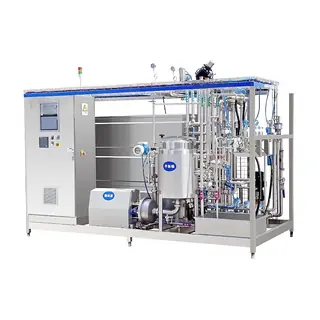
The heat exchanger type follows the product. The Orange Book recommends plate heat exchangers for clear juices and tubular units for juices containing cells or pulp. For pulpy juices and nectars we usually specify a tubular pasteurizer for fruit juice, with a holding tube sized for the required seconds at full flow and an automatic diversion valve. Pasteurization is only one control point in a juice HACCP plan; sorting, sanitation and filling hygiene carry equal weight.
How do evaporation and aroma recovery work in juice concentrate plants?
Juice is concentrated in multi-effect vacuum evaporators, where vapor from one effect heats the next. According to the Orange Book, orange evaporators use up to seven effects, evaporate about 6 kg of water per kg of steam and reach 65–66 °Brix. Volatile aroma is stripped early and condensed as essence for later add-back.
FAO describes almost all orange juice as concentrated in thermally accelerated short-time evaporators, taking juice from 10–12 °Brix to 62–65 °Brix. For apple juice, FAO outlines a staged process: 20–25 °Brix at about 90 °C in the first stage, 40–45 °Brix at about 100 °C, and a final stage of about 71 °Brix at 45 °C, standardized to 70 °Brix. Aroma is recovered from the first-effect vapor by fractional distillation.
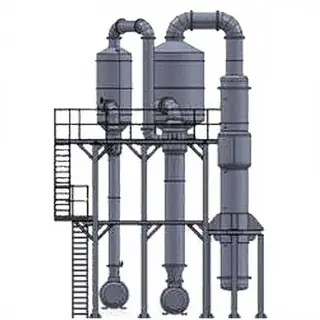
Choosing between falling-film, forced-circulation and mechanical vapor recompression designs depends on viscosity, pulp and energy cost, which our evaporator selection guide covers. For clear and cloudy fruit juices, a multi-effect falling film juice evaporator is the usual starting point.
Hot-fill, aseptic or cold fill: which filling route fits your juice?
Hot-fill suits shelf-stable juice in glass, heat-set PET or cans at moderate capacity; aseptic filling suits cartons, pouches and bulk bag-in-box with long ambient shelf life; chilled cold-fill suits premium NFC juice with a cold chain. The choice drives container cost, capital cost and the distribution model.
| Route | How it works | Typical containers | Points to plan |
|---|---|---|---|
| Hot-fill | Juice filled at 84–95 °C sterilizes the container; packs are capped, held and spray-cooled | Glass, heat-set PET, cans | Heat-resistant bottles, cooling tunnel, deaeration to stop foaming |
| Aseptic | Commercially sterile, cooled juice filled into presterilized containers in a sterile zone | Cartons, pouches, bag-in-box, aseptic bulk bags | Highest capital cost; aseptic buffer tank holding at least one hour of production |
| Chilled cold-fill | Pasteurized juice cooled and filled cold, stored and sold refrigerated | PET, HDPE, cartons | Cold chain; non-aseptic chilled juice with shelf life over 20 days needs commercial sterility (Orange Book) |
FAO notes that aseptic systems are the most demanding to run and, in its 2001 manual, cost more than US$1 million; treat that as an indicative, dated figure. For a small or mid-size plant, hot-fill into glass or heat-set PET is usually the most practical first step.
How do you size juice production line capacity?
Start from fruit intake per hour, multiply by the realistic juice yield for your fruit and extraction method, then size every downstream unit to that juice flow with 10–20% headroom. For example, the Orange Book cites a typical citrus extractor processing 5 t/h of medium fruit to give about 2,500 L/h of juice.
| Fruit and method | Published yield | Notes |
|---|---|---|
| Orange, industrial citrus extractor | Pulpy juice about 50% of fruit weight | Peel oil about 0.3% of intake; pulp later partly removed by finishers |
| Apple, continuous belt press | About 730 L per tonne | Gentle continuous pressing between porous belts |
| Apple, continuous screw press | 690–770 L per tonne | 2–6% suspended solids; 1.5–4% press aid |
| Grape, hot press (60–63 °C) | About 820 L per tonne | Pectolytic enzyme in the pulp |
| Grape, cold press | About 710 L per tonne | Used for light-colored grapes |
| Banana puree | About 75% | Juice about 22 °Brix after enzyme treatment |
| Mango pulp | Varies widely by variety | Peel is 7–24% and stone 20–60% of fruit weight, so confirm yield with a trial |
- Fix the fruit intake in tonnes per day and the season length; tropical plants often run several fruits in sequence.
- Convert to hourly intake using effective production hours after start-up and cleaning-in-place (CIP).
- Apply the yield. Using the FAO belt-press figure, 2 t/h of apples gives roughly 1,460 L/h of raw juice.
- Allow for losses in clarification and finishing, then size the pasteurizer and filler to the finished-juice flow plus headroom.
- Size the evaporator by water removed, not juice input, if you make concentrate.
- Add buffer tanks between extraction, pasteurization and filling so a filler stop does not halt extraction.
Capacity sizing is where most first-time projects go wrong, usually by buying an extractor that outruns the pasteurizer or filler. Our engineers can size a complete line from your fruit mix and daily tonnage; you can also start with our line planner or ask for a sizing review.
What beverage processing equipment and automation does a juice plant need?
A complete fruit juice processing plant needs fruit handling, washing and sorting, extraction, enzyme and blending tanks, clarification or finishing, a deaerator, a pasteurizer, optional evaporator, a CIP station and a filler. Automation ranges from manual valves to PLC control with recipe management and recorded pasteurization data.
Use this equipment checklist when comparing beverage processing equipment quotations:
- Fruit handling: receiving hopper, elevator, washer, sorting table.
- Extraction: crusher or mill plus press, citrus extractor, or pulper-finisher, matched to each fruit.
- Process tanks: enzyme, blending and buffer tanks in AISI 304 or 316L stainless steel.
- Separation: centrifuge, filter or ultrafiltration for clear juice; finisher for cloudy juice.
- Thermal: deaerator, plate or tubular pasteurizer with holding tube, diversion valve and temperature recording.
- Concentration: multi-effect evaporator with aroma recovery, if producing concentrate.
- Cleaning: CIP station with caustic, acid and hot-water circuits.
- Packaging: rinser, filler and capper, plus cooling tunnel for hot-fill.
- Utilities: steam, chilled water, compressed air, treated water and power at local voltage and 50 or 60 Hz.
Beverage production automation systems pay back fastest at three points: Brix and blend control, pasteurizer temperature and diversion logic, and CIP sequencing. For very small plants, semi-automatic control with a recorded pasteurizer is often enough to start. Ready-engineered options in our juice and beverage line range include a 500 kg/h apple, orange and mango juice processing line, a citrus juice processing line and a concentrated fruit juice production line.
In tropical climates, plan for higher cooling loads, fruit that ripens fast after harvest and shorter safe holding times; FAO recommends heating citrus juice within 30 minutes of extraction. When we engineer a juice line for these regions, we usually add chilled-water capacity and shorten fruit buffers rather than add storage.
What information do you need for a juice line quotation?
A useful quotation needs your fruits, daily intake and season, final products, packaging format, required automation and the utilities and power supply on site. With these data our engineers can propose a layout, a yield estimate and an equipment list that can be compared line by line.
- Fruits to be processed and the share of each, with expected Brix and ripeness.
- Fruit intake in tonnes per hour or per day, working hours and season length.
- Final products: NFC, nectar, clear or cloudy juice, pulp or concentrate, with target Brix.
- Packaging: glass, PET, carton, pouch, bag-in-box or aseptic drum, and container sizes.
- Utilities available: steam or boiler fuel, water quality, chilled water, compressed air.
- Electrical supply: voltage, phase and 50 or 60 Hz.
- Building size, ceiling height and whether the site is new or existing.
- Target market and any buyer standards, such as US juice HACCP.
Send these details through our quotation request form, and our engineers will reply with a proposed process flow and capacity estimate.
Frequently asked questions
What are the main steps of a juice production line?
A juice production line receives and washes fruit, sorts out damaged pieces, extracts juice by pressing, reaming or pulping, applies enzymes where needed, clarifies or finishes the juice, deaerates it, pasteurizes it and fills it hot, aseptically or cold. Concentrate plants add a multi-effect evaporator with aroma recovery before storage.
What temperature is fruit juice pasteurized at?
The Tetra Pak Orange Book gives 80–95 °C for about 15–30 seconds for juice. FAO cites above 88 °C for 25–30 seconds for apple juice and at least 90 °C for citrus to inactivate pectinesterase. In the US, the process must deliver a validated 5-log reduction of the pertinent pathogen under 21 CFR 120.24.
How much juice do you get from a tonne of fruit?
It depends on fruit and equipment. FAO reports about 730 litres per tonne of apples on a belt press and 690–770 litres on a screw press, about 820 litres per tonne of grapes with hot pressing, and about 710 litres with cold pressing. Industrial citrus extraction yields pulpy juice of roughly half the fruit weight.
What is the difference between NFC juice and juice from concentrate?
NFC (not-from-concentrate) juice is pasteurized and packed at single strength. Juice from concentrate is evaporated to a high Brix, typically 65–66 °Brix for orange, stored, and later reconstituted with treated water. NFC tastes closer to fresh juice but needs five to six times more storage and transport volume.
Is hot-fill or aseptic filling better for a small juice plant?
For most small and mid-size plants, hot-fill is the more practical start. Juice is filled at 84–95 °C into glass, heat-set PET or cans, which pasteurizes the container. Aseptic filling gives cartons and pouches long ambient shelf life but costs considerably more and requires sterile zones, sterile buffer tanks and skilled operators.
What fruit juice making equipment does a start-up need first?
A start-up needs a washer and sorting table, an extractor matched to its main fruit, process and buffer tanks, a pasteurizer with holding tube and diversion valve, a CIP station and a filler. Evaporators, ultrafiltration and aseptic fillers can be added later as volume and markets grow.
Sources
- eCFR – 21 CFR 120.24 Process controls (Juice HACCP 5-log reduction)
- Cornell LII – 21 CFR 101.17 Food labeling warning statements (juice)
- FAO – Principles and practices of small- and medium-scale fruit juice processing: General juice manufacture
- FAO – Fruit juice processing: Juice stabilization and preservation
- FAO – Fruit juice processing: Citrus juice processing
- FAO – Fruit juice processing: Tree fruit (apple) juice
- Tetra Pak Orange Book – Fruit processing
- Tetra Pak Orange Book – Processing at the juice packer
- FAO Feedipedia – Mango by-products