Fruit & vegetable processing · · 10 min read
Industrial Juice Extractor and Fruit Press: Types and Yields
Compare industrial juice extractors: citrus extractors, belt, hydraulic and screw fruit presses and pulper-finishers, with real yields and a selection table.
By the process engineering team at Shanghai Mars Industrial Co., Ltd.

Key takeaways
- Choose the juice extractor by fruit structure: citrus extractors for oranges and lemons, belt or hydraulic presses for apples, pears and grapes, screw presses for high volume, and pulper-finishers for mango, guava and tomato.
- A typical industrial citrus extractor processes about 5 t/h of medium oranges, roughly 2,500 L/h of juice, according to the Tetra Pak Orange Book; retail orange juice machines work at a tiny fraction of that.
- FAO reports apple juice yields of about 730 L per tonne for belt presses and 690–770 L per tonne for continuous screw presses, which carry 2–6% suspended solids.
- Peel oil must be controlled in citrus juice: Florida grade A juice allows at most 0.035% oil, and consumers accept about 0.015–0.030% in ready-to-drink juice.
- Hydraulic rack-and-cloth presses run 20–30 minute batch cycles and suit cider makers and cold-pressed juice brands that value clarity over throughput.
Which industrial juice extractor or fruit press do you need?
Choose a citrus juice extractor for oranges, lemons and grapefruit; a belt press or hydraulic press for apples, pears, grapes and pineapple; a screw press for high-throughput pressing of firm fruit; and a pulper-finisher for soft, pulpy fruit such as mango, guava and tomato. Fruit structure, not brand or price, decides the machine.
"Juice extractor" covers very different machines, from a countertop juicer to an industrial line handling several tonnes of fruit per hour. This guide is for buyers moving into commercial and industrial juice production: juice bars scaling up, fruit growers, beverage start-ups and food factories. It compares commercial orange juice machines with industrial citrus extractors, explains belt, hydraulic and screw presses and pulper-finishers, and gives published yields and a selection table by fruit and capacity.
How is a commercial orange juice machine different from an industrial citrus extractor?
A commercial orange juice machine for cafés or supermarkets cuts and squeezes whole oranges one at a time for fresh juice served the same day. An industrial citrus juice extractor processes several tonnes of fruit per hour, separates juice, pulp, peel and peel oil in one pass, and feeds a finisher and pasteurizer.
People searching for a "juicer orange machine" or "fresh squeezed orange juice machine" usually want an automatic unit that takes whole fruit, halves it and presses each half. These machines suit retail service. They are not designed to feed a pasteurizer continuously, to recover peel oil, or to run through a sanitation cycle between shifts like a processing plant.
The scale gap is large. FAO describes a simple bicycle- or engine-driven twin reamer that handles about 70 kg of citrus per hour and gives about 30 L of juice. At the other end, the Tetra Pak Orange Book cites a typical industrial extractor processing 5 t/h of medium fruit, or roughly 2,500 L/h of juice, with up to five heads per machine and up to 15 extractors per line.
| Factor | Commercial orange juice machine | Industrial citrus extractor |
|---|---|---|
| Typical user | Juice bar, hotel, supermarket | Juice factory, concentrate plant, NFC producer |
| Feed | Whole fruit, loaded by hand or from a small hopper | Washed, sorted and sized fruit from an elevator |
| Principle | Cut in half and squeeze or ream each half | Cup-type whole-fruit extraction or industrial half-cut reaming, several heads in parallel |
| By-products | Peel discarded | Pulp, peel oil emulsion and peel to feed or oil recovery |
| Downstream | Served fresh | Finisher, deoiling, pasteurizer, evaporator or filler |
| Food-safety rule (US) | Packaged juice without a 5-log process needs a warning label (21 CFR 101.17(g)) | Juice HACCP 5-log process (21 CFR 120.24) |
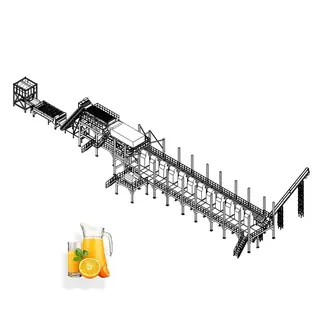
If you sell bottled fresh juice rather than glass-by-glass, you have crossed into processing. In the US, packaged juice that has not received a 5-log pathogen reduction must carry a warning statement, and juice processors must follow the juice HACCP rule. Our juice production line guide explains the full process around the extractor.
How do industrial citrus juice extractors work?
Industrial citrus extractors keep juice away from the peel. Cup-type machines squeeze the whole fruit while a strainer tube draws juice from its center; half-cut machines slice fruit and ream each half. Both aim to extract juice without forcing bitter albedo compounds and excess peel oil into it.
In a typical industrial citrus extraction section, fruit moves through these steps:
- Washing and grading: fruit is washed, inspected and damaged pieces are removed.
- Sizing: fruit is split by diameter so each extractor head receives a narrow size range.
- Extraction: juice and pulp leave through strainer tubes or reamers; peel exits separately.
- Peel oil recovery: peel oil is sprayed off with water as an emulsion and sent to centrifuges.
- Finishing: screw or paddle finishers remove seeds, membranes and excess pulp.
- Deoiling and heating: excess oil is removed and the juice is pasteurized without delay.
Cup-type whole-fruit extractors
FAO describes the cup-type principle: a plug is cut from the fruit, a strainer tube enters, and the cups compress the orange so juice and pulp pass through the strainer while the peel is pushed out separately. Because juice never runs over the outside of the peel, peel oil can be washed off with water and recovered as an emulsion. The Orange Book notes these machines are fed through sizing, with two or three size settings per extractor line, because each head size suits a narrow fruit diameter.
Half-cut and reamer extractors
Half-cut machines orient, slice and ream or press each half. They are simpler to change over between fruit sizes and suit lemons, limes and mid-size orange lines. An industrial half-cut orange juicer is often the first step up from retail machines for plants processing a few tonnes per day.
Peel oil, bitterness and finishing
Peel oil and the white albedo are the main quality risks in citrus extraction. FAO warns that the peel holds very bitter compounds and the highest pesticide residues, so over-extraction must be avoided. The Orange Book gives a maximum oil content of 0.035% for Florida grade A juice and 0.015–0.030% as the range consumers accept in ready-to-drink juice. Excess oil is removed by deoiling centrifuges or vacuum flashing.
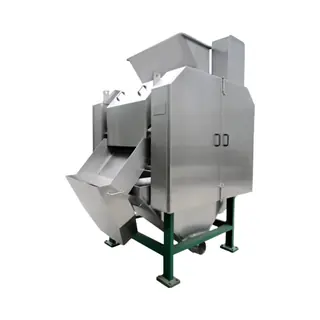
After extraction, pulpy juice contains about 20–25% floating and sinking pulp, according to the Orange Book, so it passes a finisher before pasteurization. For larger plants, our industrial orange juice extractor (3–10 t/h) and industrial citrus press juice machine cover this stage.
How do belt, hydraulic and screw fruit presses compare?
Belt presses squeeze milled fruit continuously between porous belts and suit medium-to-large apple and pineapple lines. Hydraulic rack-and-cloth or basket presses work in batches, give clear juice and suit small producers and cider makers. Screw presses offer high continuous throughput but put more solids into the juice.
| Machine | Operation | Published performance | Best for | Watch-outs |
|---|---|---|---|---|
| Belt press | Continuous | About 730 L juice per tonne of apples | Apple, pear, pineapple, mid-to-large lines | Belt washing and wear; usually needs a mill upstream |
| Hydraulic rack-and-cloth press | Batch | Press cycle of 20–30 minutes | Cider, small apple and grape runs, premium cold-pressed juice | Labor-intensive; cloths need careful cleaning |
| Bladder (pneumatic) press | Batch | Maximum about 600 kPa | Grapes and gentle pressing | Lower throughput per unit |
| Continuous screw press | Continuous | 690–770 L per tonne of apples at 500–600 kPa; 2–6% suspended solids | High-volume apple and grape pressing | Shear can release seed components; 1.5–4% press aid used |
| Citrus extractor | Continuous | Pulpy juice about 50% of fruit weight (Orange Book) | Orange, lemon, lime, grapefruit | Fruit sizing; peel oil control |
| Pulper-finisher | Continuous | Screen sizes from about 1 mm down to 0.2 mm | Mango, guava, banana, tomato, papaya | Fruit must be destoned or peeled first for some fruits |
Belt press
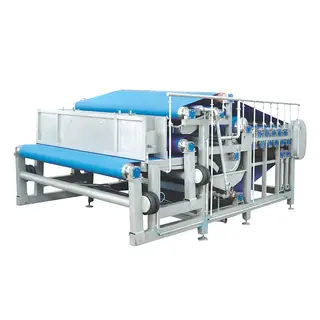
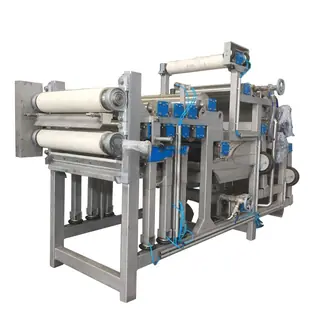
A belt press feeds a layer of milled fruit between two filter belts that run around rollers of decreasing diameter, so pressure rises gradually. FAO describes it as a gentler continuous system than the screw press. Enzyme treatment of the mash before pressing usually raises yield. Our fruit belt squeezer for apple and pineapple is built on this principle.
Hydraulic presses: rack-and-cloth and basket
The hydraulic fruit press is the classic cider press. Milled apples are wrapped in cloths, stacked between racks and squeezed by a hydraulic ram; FAO gives a cycle of 20–30 minutes and notes that the method is labor-intensive but effective. The same principle, using press bags, is used for cold-pressed juice sold under high-pressure processing. A stainless steel hydraulic juice press such as our hydraulic cold press juicer for fruit and vegetables suits juice brands, cideries and pilot plants that value clarity and flavor over throughput. A hydraulic wine press works the same way for grapes.
Screw press
A screw press drives mash along a tapering screw inside a perforated cage. FAO reports capacities of many tonnes per hour and yields of 690–770 L per tonne of apples, but warns that excessive shear can release components from seeds.
When do you need a pulper-finisher instead of a press?
Use a pulper-finisher for fruits whose juice is held in soft flesh rather than in firm cells: mango, guava, papaya, banana, passion fruit, tomato and berries. A rotating paddle or brush rotor forces the flesh through a perforated screen, separating pulp from skin and seeds; screen size sets the texture.
FAO notes that two pulpers in series, with screens from about 1 mm down to 0.2 mm, can clean up many juices. Reported screens include about 0.5–1 mm for pineapple and 0.3–0.5 mm mesh for guava. For mango, peel must be removed completely before pulping, so destoning and peeling come first. Our fruit pulping and juice extractor machine and mango peeling, destoning and pulping machine cover these stages.
Centrifugal juice extractors, which spin grated fruit against a basket screen, are common in retail but less so in industry. FAO mentions centrifugal extraction mainly for passion fruit, followed by a finisher to remove seeds.
Which extractor fits each fruit and capacity?
Match the extraction principle to the fruit first, then the machine size to hourly intake. Small producers can start with batch hydraulic presses or half-cut citrus juicers; once intake reaches several tonnes per hour, continuous belt presses, cup-type citrus extractors and pulper-finisher lines become standard.
| Fruit | Small scale (start-up, pilot) | Industrial scale | Key preparation |
|---|---|---|---|
| Orange, mandarin | Half-cut reamer juicer | Cup-type or multi-head half-cut extractors with finisher and deoiling | Wash, sort and size by diameter |
| Lemon, lime | Half-cut reamer juicer | Citrus extractors with peel oil recovery | Sizing; oil may be worth more than juice |
| Apple, pear | Mill plus hydraulic rack-and-cloth press | Mill plus belt press or screw press; enzyme treatment | Wash, sort out rotten fruit (patulin) |
| Grape | Mill plus basket or bladder press | Destemmer, crusher, enzyme and screw press | Hot or cold pressing depending on color |
| Pineapple | Peel and core, then small press | Peeling or crushing plus belt press or screw press | Remove crown and skin |
| Mango, guava, papaya | Small pulper with interchangeable screens | Destoner, pulper and finisher in series | Wash, peel or destone |
| Tomato | Small pulper-finisher | Hot or cold break plus pulper-refiner | Wash and sort |
Not sure which configuration fits your fruit mix? Our engineers can match extractor type and size to your intake; send your data through our engineering inquiry form.
What affects juice yield and quality at the extractor?
Yield depends on fruit variety and ripeness, how finely the fruit is milled, enzyme treatment, pressing pressure and time, and whether press aids are used. Quality depends on limiting oxidation, peel oil, seed damage and solids, and on heating the juice soon after extraction.
- Ripeness: immature grapefruit is high in naringin and limonin and makes very bitter juice, according to FAO.
- Milling: FAO notes that a hammer mill adjusts more easily to different pulp consistencies.
- Enzymes: macerating enzymes at about 55–60 °C raise yield from difficult fruit.
- Press aids: rice hulls or cellulose fiber at several percent of the mash help drainage.
- Time to heat: FAO advises heating citrus juice within 30 minutes of extraction.
- Pulp wash: in citrus plants, counter-current pulp washing can raise soluble solids yield by 4–7%, according to the Orange Book.
What should you check before buying an industrial juice extractor?
Check the fruit range and size tolerance, rated capacity on your fruit, measured yield, contact materials, cleaning method, spare parts and power supply. Ask for test results on your own fruit wherever possible, because yields from one variety rarely transfer exactly to another.
- Product-contact parts in AISI 304 or 316L stainless steel; food-grade belts, cloths and seals.
- Rated capacity in t/h of your fruit, not of water or a reference fruit.
- Juice yield and solids content measured on a trial batch.
- Cleaning: CIP connections or easy dismantling; belt and screen washing systems.
- Change parts for fruit sizes and screen sizes.
- Motor voltage and frequency for your site (for example 380–415 V at 50 Hz, or 60 Hz supplies), and protection class for wet areas.
- Integration with the upstream washer and sorter and with downstream tanks and pasteurizer.
- Local availability of wear parts such as belts, cloths, cups and screens.
When we engineer an extraction section, we size it together with the fruit washing and sorting equipment in front of it, because an extractor fed with dirty or unsorted fruit loses both yield and juice quality. You can browse all extraction, pulping and washing machines in our fruit and vegetable processing equipment range, or model the full line in our line planner.
What information do you need for a quotation?
To quote an industrial juice extractor or fruit press accurately, we need the fruits and varieties, hourly or daily intake, the juice style you want, the downstream equipment and your site's power supply. A short trial on your fruit, where possible, gives the most reliable yield figure.
- Fruits and varieties, typical fruit size range and ripeness at processing.
- Intake in tonnes per hour or per day, and season length.
- Product: cloudy or clear juice, NFC, pulp, cold-pressed or concentrate feed.
- Whether peel oil or by-products such as pomace will be recovered.
- Existing or planned washing, sorting, pasteurizing and filling equipment.
- Voltage, phase and 50 or 60 Hz; available water and compressed air.
- Available floor area and building height.
Send these details via our quotation request and our engineers will recommend an extractor configuration and expected throughput.
Frequently asked questions
What is the difference between a juice extractor and a fruit press?
A juice extractor is a general term for any machine that separates juice from fruit, including citrus extractors, centrifugal juicers and pulper-finishers. A fruit press specifically squeezes milled fruit under pressure, using a hydraulic ram, belts, a bladder or a screw. Presses suit apples, pears and grapes; citrus and pulpy fruit need dedicated extractors.
Can a commercial orange juice machine be used in a juice factory?
Not for continuous production. Commercial orange juice machines halve and squeeze fruit for fresh service in cafés and shops. A factory needs an industrial citrus juice extractor fed by washed, sorted and sized fruit, with finishing, deoiling and pasteurization downstream. The Tetra Pak Orange Book cites typical industrial extractors at about 5 t/h of fruit.
How much juice does a belt press get from apples?
FAO reports that a continuous belt press yields about 730 litres of juice per tonne of apples, compared with 690–770 litres per tonne for a continuous screw press. Actual yield depends on variety, ripeness, milling and enzyme treatment, so a trial on your own fruit gives the most reliable figure for planning.
Why does citrus juice from some machines taste bitter?
Bitterness usually comes from over-extraction. Pressing too hard pulls peel oil and compounds from the white albedo into the juice. FAO notes that the peel holds very bitter compounds and the highest pesticide residues. Industrial citrus extractors separate peel from juice and use deoiling to keep oil near 0.015–0.030%.
Is a hydraulic cider press suitable for commercial juice production?
Yes, for small to mid volumes. A hydraulic rack-and-cloth press gives clear juice with good flavor and is widely used for cider and cold-pressed juice. FAO gives a press cycle of 20–30 minutes and notes the method is labor-intensive. Above a few tonnes per hour, continuous belt or screw presses are usually more economical.
What machine extracts mango pulp?
Mango pulp is extracted with a destoner or peeler followed by a pulper and finisher, which force the flesh through perforated screens while rejecting skin and stones. FAO notes that mango peel must be removed completely before pulping. Screen size, typically below 1 mm in the finisher, sets the pulp's texture.
Sources
- FAO – Fruit juice processing: General juice manufacture (crushing, pressing, press types)
- FAO – Fruit juice processing: Citrus juice processing
- FAO – Fruit juice processing: Tree fruit (apple) juice
- FAO – Fruit juice processing: Tropical fruits
- FAO – Fruit juice processing: Grape juice
- Tetra Pak Orange Book – Fruit processing (citrus extraction, oil recovery)
- eCFR – 21 CFR 120.24 Process controls (Juice HACCP)
- Cornell LII – 21 CFR 101.17 Warning statement for juice