Fruit & vegetable processing · · 9 min read
Fruit and Vegetable Washing Machines: Bubble, Brush, Ozone
Compare industrial fruit and vegetable washing machines: bubble, brush, spray, ultrasonic and ozone washers, wash-water sanitizer limits and line placement.
By the process engineering team at Shanghai Mars Industrial Co., Ltd.

Key takeaways
- Air-bubble washers suit soft produce such as tomatoes, mango and berries, while roller brush washers suit firm produce such as apples, citrus and root crops; most lines finish with a clean-water spray rinse.
- Washing removes soil and part of the surface microbial load but cannot sterilize produce; its main food-safety role is stopping wash water from spreading contamination between pieces and lots.
- US rules limit chlorine dioxide in produce wash water to 3 ppm residual and peroxyacetic acid to 80 ppm, and permit ozone as an antimicrobial in aqueous or gaseous form.
- UC Davis guidance shows that chlorinated water at an ORP of 650–700 mV kills free-floating E. coli O157:H7 and Salmonella within 30 seconds.
- Place the washer directly after receiving and before sorting, so inspectors see clean produce, and keep wash water about 5 °C warmer than the produce interior to limit infiltration.
Which industrial fruit and vegetable washing machine do you need?
Use an air-bubble washer for soft or delicate produce such as tomatoes, berries, mango and leafy vegetables; a roller brush washer for firm produce such as apples, citrus, carrots and potatoes; and spray rinsing at the exit of either. Add a sanitizer, such as chlorine, peracetic acid or ozone, to keep recirculated water from spreading contamination.
An industrial fruit and vegetable washing machine is the first processing step in almost every juice, pulp, paste, fresh-cut or frozen-vegetable line. It removes soil, stones, leaves, insects and part of the surface microbial load before the produce reaches sorting, peeling or extraction. This guide compares bubble, brush, spray, flume, ultrasonic and ozone washers, explains which sanitizers US regulations allow in produce wash water, and shows where the washer sits in a processing line.
How do bubble, brush, spray and ozone washers differ?
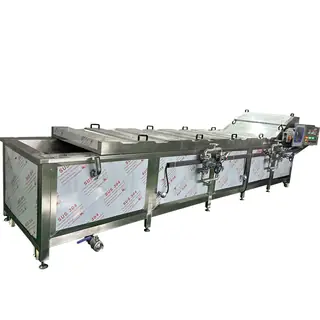
Bubble washers tumble produce in water agitated by air; brush washers scrub produce on rotating rollers under spray; spray and drum washers rinse with pressurized water; ozone and ultrasonic systems are add-ons that treat the wash water or the produce surface. Most lines combine a soak stage with a spray or brush rinse.
| Washer type | How it works | Removes well | Suits | Limitations |
|---|---|---|---|---|
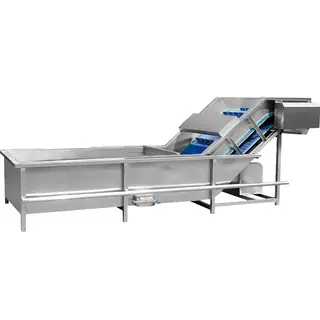
| Air-bubble (soak) washer | Blower injects air under a water tank; mesh conveyor lifts produce out under spray | Loose soil, sand, leaves, floating debris | Tomatoes, mango, berries, grapes, leafy and cut vegetables | Water quality degrades quickly without filtration and sanitizer |
| Roller brush washer | Rotating nylon brush rollers scrub produce under spray nozzles | Adhered soil and surface dirt, including around stems | Apples, citrus, potatoes, carrots, ginger, cassava | Can bruise soft fruit; brushes need regular cleaning |
| Spray or drum washer | Produce tumbles or conveys under high-pressure nozzles | Remaining soil and residual wash water | Final rinse after soaking; root crops | Higher fresh-water use if not recirculated |
| Flume and dump tank | Water carries produce from receiving to the line | Gross soil; cushions unloading | Tomatoes and high-volume fruit receiving | Shared water can spread contamination across lots |
| Ultrasonic washer | Ultrasound in the tank creates cavitation at the surface | Fine particles in crevices | Fresh-cut, berries, specialty produce | Limited microbial effect on its own; can damage tender leaves |
| Ozone-assisted washer | Ozone dissolved in wash or rinse water | Microbes in the water and on exposed surfaces | Most produce, as a rinse or water treatment | Consumed by organic load; off-gas must be controlled |
Air-bubble washers
The bubble washer is the most common vegetable washing machine in processing plants. Air bubbles turn the produce so all sides are exposed, while heavy soil and stones settle to the tank bottom. An inclined mesh belt then lifts produce out under a spray bar of clean water. Bubble washers are gentle, which is why tomato, mango and berry lines rely on them.
Roller brush washers
A brush washer combines mechanical scrubbing with spray. Rotating brush rollers carry the produce forward while it turns, so soil stuck in skin pores or near the stem is removed. Our roller brush washer for fruit and vegetables is used ahead of citrus extractors and apple mills; a heavier roller brush washer for vegetables, fruit and wheat suits root crops.
Ultrasonic washers
Ultrasonic vegetable cleaners are sold both as small household devices and as industrial tanks. Research supports using them as part of a system, not alone. In a 2022 study in Ultrasonics Sonochemistry, Sun and colleagues washed lettuce with 28 kHz ultrasound; ultrasound alone or chlorine alone each reduced E. coli O157:H7 and Salmonella by less than 1 log, while combining ultrasound and chlorine with an aqueous ozone rinse exceeded a 2-log reduction. The same authors warn that ultrasound can damage tender leaf surfaces.
Ozone washers
Ozone is a strong oxidant that breaks down to oxygen and leaves no residue. In the US, 21 CFR 173.368 permits ozone as an antimicrobial agent in gaseous or aqueous form in food treatment, storage and processing. In the lettuce study above, a 1.0 ppm aqueous ozone rinse caused no quality loss, while 2.0 ppm produced brown spots by day seven, and organic load in the water consumed ozone quickly. In practice, ozone works best on clean rinse water or as part of water treatment, not as a replacement for good soil removal.
What can washing remove, and what can it not?
Washing reliably removes soil, debris and part of the surface microbial load, but it cannot sterilize produce. Its most important food-safety role is preventing cross-contamination: a sanitizer keeps the wash water from carrying pathogens from one contaminated piece to the rest of the lot.
Two findings shape washer design. First, according to UC Davis extension specialist Trevor Suslow, microbes lodged in surface contours, openings and wounds are not affected by common wash treatments at legal rates. Second, recirculated water can spread a single contamination point to clean produce, which is why sanitizer is maintained in the water itself.
Temperature matters too. Virginia Cooperative Extension, citing Florida guidance, recommends keeping postharvest water about 5 °C (10 °F) warmer than the produce interior, because cold water on warm fruit can draw water and microbes in through the stem scar or wounds. Tomatoes, melons, mangos, oranges, apples and avocados are listed as susceptible. For thermal processing lines, the later pasteurization step provides the main microbial kill; washing protects that step by lowering the starting load.
Which sanitizers are allowed in produce wash water?
In the US, common options include chlorine controlled by ORP and pH, chlorine dioxide up to 3 ppm residual, peroxyacetic acid up to 80 ppm, and ozone. Under the FSMA Produce Safety Rule, water that contacts covered produce during or after harvest must have no detectable generic E. coli in 100 mL.
| Sanitizer | Published limit or target | Reference | Practical notes |
|---|---|---|---|
| Chlorine (hypochlorite) | ORP of 650–700 mV kills free-floating pathogens such as E. coli O157:H7 and Salmonella within 30 seconds | UC ANR Publication 8149 (Suslow) | Activity depends on pH: at pH 7.5 the active and less active forms are about 50:50; above 800 mV is generally unnecessary |
| Chlorine dioxide | Not more than 3 ppm residual | 21 CFR 173.300 | Must be followed by a potable water rinse or by blanching, cooking or canning |
| Peroxyacetic acid | Not more than 80 ppm in wash water | 21 CFR 173.315 | Formed from acetic acid and hydrogen peroxide; hydrogen peroxide limited to 59 ppm |
| Ozone | Permitted as an antimicrobial in gaseous or aqueous phase under good manufacturing practice | 21 CFR 173.368 | Decomposes to oxygen; requires ozone generator and off-gas destruction |
Suslow notes that in clean water 3–5 ppm free chlorine controls free-floating bacteria with very short contact time, and that pushing chlorine higher gives little extra ORP while risking by-products, product damage and flavor taint. Excess chlorination can also form trihalomethanes and raise wastewater costs. Outside the US, check your national food additive and processing-aid rules; many importers also audit against these US references.
How should you manage water recirculation in a washing machine?
Recirculate wash water through screens and filters, maintain sanitizer automatically, monitor ORP, pH and turbidity, and follow a written water-change schedule. The FSMA Produce Safety Rule requires managing recirculated water, visually monitoring for organic build-up, and keeping water temperature suitable for the commodity.
Under 21 CFR 112.48, farms covered by the Produce Safety Rule must establish water-change schedules for recirculated water, visually check dump tanks, flumes and wash tanks for soil and plant debris, and maintain water temperature to minimize infiltration. Processing plants follow their own preventive controls rules, but the same practices are good design targets. A practical routine looks like this:
- Remove solids continuously with a rotary or vibrating screen and a settling zone in the tank.
- Dose sanitizer automatically with an ORP or concentration controller, and adjust pH with an inorganic acid where chlorine is used.
- Measure and record ORP, pH, temperature and turbidity at set intervals; Suslow recommends a 30-second window for hand-held ORP readings.
- Change water on a schedule based on load and turbidity, not only when it looks dirty.
- Finish with a clean-water spray rinse so produce leaves the washer in potable water.
- Clean and sanitize the machine at the end of each shift, including brushes, belts and nozzles.
Recirculation can cut fresh-water use substantially, which matters in water-scarce regions of the Middle East, Africa and South Asia. When we engineer washing sections for these sites, we usually include a filtration loop and a separate fresh-water final spray.
Where does the washing machine go in a processing line?
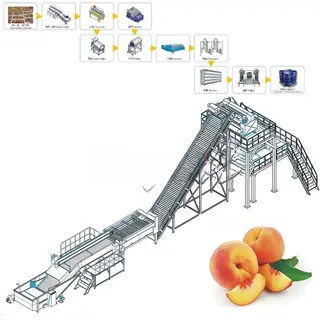
The washer sits directly after receiving and before sorting, so inspectors see clean produce and defects are not hidden by soil. In juice, pulp and paste lines the typical order is receiving, soaking, brushing or spraying, sorting, then crushing, peeling or extraction.
- Receiving: bins or trucks are unloaded into a hopper, flume or dump tank.
- Pre-wash or soak: an air-bubble washer loosens soil and floats off leaves.
- Brush and spray rinse: brushes scrub adhered dirt; clean water rinses residues.
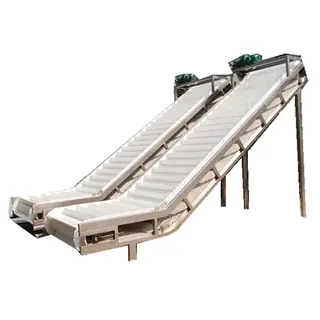
- Elevating: a clapboard elevator lifts produce to the inspection level, often with a final spray.
- Sorting and grading: a roller sorting machine rotates fruit so workers can remove rotten, green or damaged pieces; an avocado sorting and grading machine shows how produce can also be graded by size.
- Processing: extraction, peeling, cutting, crushing or blanching.
FAO's fruit juice manual describes the same logic: wash, then inspect and sort, with a final human inspection mandatory after mechanical peeling. Our juice production line guide and tomato paste processing line guide show how washing connects to the rest of the process.
How do you size an industrial vegetable washer?
Size the washer from peak intake in tonnes per hour, then check tank length for enough dwell time, belt or roller width for an even single layer, and water flow for the spray rinse. Fragile produce needs lower loading and gentler agitation, so the same machine processes fewer tonnes of berries than of apples.
Key sizing factors to give your supplier:
- Peak and average intake in t/h, and the daily operating window.
- Produce type, size range, fragility and how dirty it arrives (field soil, sand, leaves).
- Required dwell time in the soak tank and length of brush section.
- Fresh-water availability and whether wash water must be recirculated.
- Sanitizer chosen and the dosing and monitoring equipment required.
- Downstream line speed, so washer output matches the sorter and extractor.
Buying a washer separately from the rest of the line often leads to a mismatch with the elevator or sorting table. Our engineers can size the complete receiving, washing and sorting section for your crop and capacity; you can start with our line planner or request a layout proposal.
What should a produce washing machine specification include?
A complete specification states produce, capacity, washer type, tank and belt dimensions, contact materials, water system, sanitizer dosing, drainage and power supply. Missing items such as filtration or final rinse are the most common reason two quotations cannot be compared.
- Product-contact parts and tank in AISI 304 or 316L stainless steel; food-grade brushes and belts.
- Variable-speed drives for conveyor and brushes to suit different produce.
- Blower size and air distribution for bubble washers.
- Spray bar with adjustable nozzles and a separate fresh-water final rinse.
- Water filtration, settling zone and drain valves for sludge removal.
- Sanitizer dosing and ORP or pH monitoring, or connections for them.
- Ozone generator with off-gas destruction, if ozone is specified.
- Motor voltage, phase and 50 or 60 Hz frequency, with wash-down rated electrics.
You can browse washing, elevating and sorting machines in our fruit and vegetable processing equipment range.
What information do you need for a quotation?
For an accurate quotation on a fruit or vegetable washer, send the produce types, peak capacity, condition of incoming produce, the next process step, your water and sanitizer preferences, and the site's power supply. With these data our engineers can recommend the washer type and configuration.
- Produce types and size range, and how they arrive (bins, crates, bulk truck).
- Capacity in t/h at peak and average, and working hours.
- Level of soil, sand or debris, and any specific contaminants to remove.
- Next step in your line: sorting, peeling, extraction, cutting or packing.
- Water source and limits on fresh-water use or discharge.
- Preferred sanitizer: chlorine, peracetic acid, ozone or none.
- Voltage, phase and 50 or 60 Hz; available floor space.
Send these details through our quotation request form, and our engineers will respond with a recommended washer and layout.
Frequently asked questions
What is the best vegetable washing machine for a processing plant?
There is no single best type. Air-bubble washers suit soft or leafy produce because they are gentle; roller brush washers suit firm fruit and root crops that carry adhered soil. Most plants combine a soak stage with brushing or spray rinsing, plus sanitizer dosing and filtration to keep recirculated water clean.
Does ozone water really clean fruit and vegetables?
Ozone kills microbes in the water and on exposed surfaces and decomposes to oxygen without residue. US regulation 21 CFR 173.368 permits it as an antimicrobial. Its effect drops as organic load rises, and a 2022 lettuce study found 2.0 ppm caused browning while 1.0 ppm did not. It works best after soil has been removed.
Are ultrasonic vegetable cleaners effective?
Ultrasound helps dislodge fine particles, but on its own its microbial effect is limited. In a 2022 study on lettuce, ultrasound alone reduced E. coli O157:H7 and Salmonella by less than 1 log. Combined with chlorine and an ozone rinse, reductions exceeded 2 log. Industrial lines therefore use ultrasound as one stage, not the only one.
What chlorine level should be used in a fruit washer?
Rather than a fixed ppm, many processors control chlorine by ORP and pH. UC Davis guidance reports that an ORP of 650–700 mV kills free-floating pathogens within 30 seconds, and that 3–5 ppm free chlorine is adequate in clean water. Higher doses add little benefit and can cause by-products and taint.
Where should the washing machine be placed in a juice line?
The washer goes immediately after fruit receiving and before sorting and extraction. Clean fruit lets inspectors spot rotten or damaged pieces, and it protects the extractor and pasteurizer from soil and a high microbial load. A typical sequence is receiving, bubble soak, brush and spray rinse, elevator, sorting table, then extraction.
How do you reduce water use in an industrial produce washer?
Recirculate the soak water through screens and filters, maintain sanitizer automatically, and reserve fresh water for the final spray rinse. Follow a written water-change schedule based on load and turbidity. The FSMA Produce Safety Rule requires water-change schedules and visual monitoring for organic build-up in recirculated water.
Sources
- eCFR – 21 CFR 173.315 Chemicals used in washing or to assist in the peeling of fruits and vegetables
- eCFR – 21 CFR 173.300 Chlorine dioxide
- eCFR – 21 CFR 173.368 Ozone
- eCFR – 21 CFR 112.44 Microbial quality criteria for agricultural water (Produce Safety Rule)
- FindLaw – 21 CFR 112.48 Agricultural water used during harvest, packing and holding
- UC ANR Publication 8149 – ORP for Water Disinfection Monitoring, Control, and Documentation (Suslow)
- Virginia Cooperative Extension – Susceptibility of Produce to Infiltration
- Sun et al. (2022) – Aqueous ozone rinsing with ultrasound-assisted washing of fresh produce, Ultrasonics Sonochemistry
- FAO – Fruit juice processing: General juice manufacture (washing and sorting)