Tanks, silos & CIP · · 9 min read
Stainless Steel Mixing Tank with Agitator: Types and Sizes
Stainless steel mixing tank guide: 304 vs 316L, single/double/triple jackets, agitator types, 50–2,000 gallon sizes in litres, insulation and what to specify.
By the process engineering team at Shanghai Mars Industrial Co., Ltd.

Key takeaways
- AISI 304 stainless steel suits milk, juice and most neutral foods, while 316L adds 2–3% molybdenum and limits carbon to 0.03% for better resistance to chlorides, brines and acidic products.
- A triple-layer mixing tank combines an inner product shell, a heating or cooling jacket of dimples or welded channels, insulation and outer cladding for processes that must heat, cool or hold temperature.
- Propellers and turbines suit thin liquids, side-mounted propellers give gentle mixing in large tanks and silos, anchor or scraper agitators handle viscous products, and high-shear rotor-stator mixers dissolve powders and form emulsions.
- One US gallon equals 3.785 litres, so 50, 100 and 500 gallon stainless steel tanks hold about 189 L, 379 L and 1,893 L of total volume.
- EHEDG recommends product-contact surface roughness below Ra 0.8 µm, and 3-A criteria call for Ra 0.8 µm (32 µin) or smoother.
Which stainless steel mixing tank with agitator do you need?
Match the tank to the product: a single-wall 304 tank with a top-entry propeller for thin liquids at ambient temperature, a jacketed and insulated 316L tank for heating, cooling or salty and acidic recipes, an anchor or scraper agitator for viscous products, and a high-shear mixer for powders and emulsions. Size by working volume, not nominal volume.
A stainless steel mixing tank looks simple, yet small specification choices decide whether it blends evenly, heats without scorching and cleans reliably. This guide covers the decisions that matter to food, dairy and beverage buyers: 304 vs 316L stainless steel, single, double or triple jackets, agitator types including side-mounted, high-shear and anchor/scraper designs, standard sizes in gallons and litres, tank insulation, hygienic design and how to specify custom stainless steel tanks. We write from the perspective of a manufacturer that builds process tanks for dairies, juice plants, sauce makers and fermentation plants.
Should your mixing tank be 304 or 316L stainless steel?
AISI 304 (about 18% chromium, 8% nickel) is the standard choice for milk, juice, beer and most neutral products. Choose 316L, with 2–3% molybdenum and no more than 0.03% carbon, for brines, sauces, tomato products, acidic or chloride-rich recipes and aggressive cleaning, because molybdenum improves pitting resistance.
| Property | AISI 304 | AISI 316L |
|---|---|---|
| Chromium | About 18% minimum | 16–18% |
| Nickel | About 8% minimum | 10–14% |
| Molybdenum | None | 2–3% |
| Carbon (max) | 0.08% | 0.03% (low-carbon "L" grade, better after welding) |
| Pitting resistance | Good in fresh water and neutral foods | Better against chlorides and acids |
| Typical food uses | Milk, cream, juice, beer, syrups, water | Brines, soy sauce, ketchup, pickles, fermented and salty products |
| Relative cost | Lower | Higher |
Chloride resistance depends on both concentration and temperature. A Becht engineering review of cooling-water service gives one illustration: in water with 300 ppm chloride, 304 has a critical pitting temperature of about 40 °C, while 316 reaches about 70 °C at 500 ppm. Those are test conditions, not safe limits, but they show why hot salty products and chlorinated cleaning call for 316L. A common compromise is a 316L inner shell for product contact with a 304 jacket and cladding.
Do you need a single, double or triple-layer mixing tank?
A single-layer tank is a plain stainless vessel for ambient blending and storage. A double-layer tank adds either a heating/cooling jacket or an insulation layer. A triple-layer tank combines an inner product shell, a heating or cooling jacket, insulation and an outer cladding, and is the standard for processes that must heat, cool or hold temperature.
The Tetra Pak Dairy Processing Handbook describes mixing tanks with a jacket of welded channels or dimples through which heating or cooling medium circulates, and storage tanks insulated with mineral wool between stainless inner and outer shells. In practice the choice comes down to the duty:
- Single layer: water treatment, ambient syrup and ingredient blending, short-term buffering of chilled product in a cool room.
- Double layer, jacketed: heating or cooling where heat loss to the room is acceptable, for example small batch pasteurizing or melting.
- Double layer, insulated: holding temperature without active heating or cooling, such as storage of pre-chilled milk or hot-fill product.
- Triple layer (jacket plus insulation): yogurt fermentation, ice cream mix aging, sauce cooking and any process where energy cost or operator safety requires a cool outer surface.
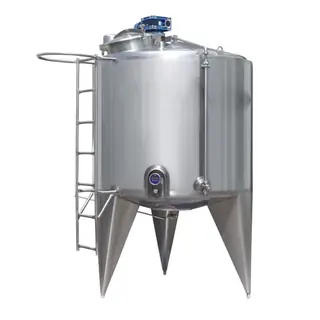
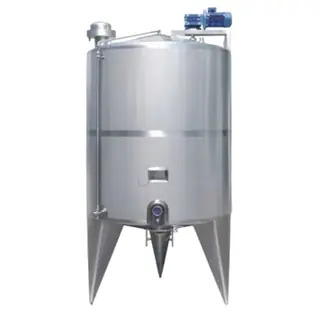
Jacket design matters as much as the number of layers. Dimple and channel jackets handle the pressure of steam or glycol, while low-pressure hot or chilled water can use simpler designs. Tell your supplier the heating or cooling medium, its pressure and temperature, and the required heat-up or cool-down time; that is what sets the jacket area. Examples include our double-layer storage tank with side agitator and ice cream aging tank.
Which agitator type suits your product?
Use propellers or pitched-blade turbines for thin liquids, side-mounted propellers for gentle mixing in large storage tanks and silos, anchor or scraper agitators for viscous products that must be heated or cooled through the wall, and high-shear rotor-stator mixers for dissolving powders, making emulsions and breaking lumps.
| Agitator | Mounting and speed | Suited viscosity | Typical uses |
|---|---|---|---|
| Propeller (marine type) | Top or side entry; high speed | Low | Juice, milk, syrups, water-based blends |
| Pitched-blade or flat-blade turbine | Top entry; medium speed | Low to moderate | General blending, solids suspension, fermentation |
| Side-mounted propeller | Through the tank wall near the bottom; intermittent | Low | Milk silos, large storage tanks, gentle mixing without a tall shaft |
| Anchor with scrapers | Top entry; low speed, close to the wall | Moderate to high | Sauces, jams, yogurt base, ice cream mix, cheese milk |
| High-shear rotor-stator | Bottom or top entry, or inline; very high speed | Low to moderate | Powder dissolving, emulsions, stabilizer hydration, recombined milk |
| Combination (anchor plus high-shear) | Two drives | Wide range | Mayonnaise, dressings, creams, viscous emulsions |
The Tetra Pak handbook notes that silo tanks usually have a side-mounted propeller agitator, that process tanks for viscous products may use a scraper agitator, and that mixing tank agitators are chosen for each application. A Michigan Technological University course note on agitation summarizes the general rule: propellers are high-speed, low-viscosity impellers, while turbines cover moderate viscosities, and the best mixer is the one that reaches the required blend time with the least power.
High-shear mixers work differently. A rotor spinning inside a slotted stator draws product in and forces it through narrow gaps, producing intense local shear. A review chapter by Rodgers and Trinh (University of Manchester, 2016) lists emulsification, encapsulation, thickeners and powders as the main food applications. Use high shear where you need to wet powders such as milk powder, sugar or gums without lumps, not for gentle storage, where it would only add heat and damage fat globules. For dry powder blending before liquids are added, a ribbon blender is the right tool; see our ribbon blender and powder mixer guide.
If your recipe combines powders, oils and heating in one vessel, our engineers can recommend an agitator combination for your product from a short recipe description.
What sizes do stainless steel mixing tanks come in, in gallons and litres?
Common sizes run from 50 and 100 gallon stainless steel tanks for pilot work to 500, 1,000 and 2,000 gallon production tanks. One US gallon is 3.785 litres, so a 100 gallon tank holds about 379 L and a 500 gallon tank about 1,893 L. Always confirm whether a size is total or working volume.
| US gallons | Litres | Imperial gallons (approx.) | Inner diameter if height equals diameter | Typical use |
|---|---|---|---|---|
| 50 | 189 | 42 | about 0.62 m | Lab and pilot batches, flavor premixes |
| 100 | 379 | 83 | about 0.78 m | Pilot plants, small sauce or syrup batches |
| 200 | 757 | 167 | about 0.99 m | Small dairies, juice start-ups |
| 300 | 1,136 | 250 | about 1.13 m | Batch pasteurizing, yogurt base |
| 500 | 1,893 | 416 | about 1.34 m | Production batching, CIP solution tanks |
| 1,000 | 3,785 | 833 | about 1.69 m | Mid-size production, fermentation |
| 2,000 | 7,571 | 1,665 | about 2.13 m | Large batching and buffer tanks |
The diameter column is a geometric illustration for the cylindrical part only. Real tanks use different height-to-diameter ratios depending on ceiling height, agitator type and heat transfer area, and dished or conical heads add volume. Buyers outside the US should also note that "gallon" in older British and some Commonwealth specifications means the imperial gallon, about 4.546 L, which changes the volume by about 20%.
Two volume terms cause most misunderstandings. Total (or gross) volume is the full internal capacity; working volume is how much product you can actually mix, leaving headspace for vortex, foam and expansion while still covering the agitator. Specify working volume, minimum batch size and maximum batch size, so the agitator is positioned to mix both.
When does a mixing tank need insulation?
Insulate any tank that holds product above or below room temperature for more than a short time, sits outdoors, or has a hot surface that operators can touch. Insulation cuts energy use, stabilizes product temperature, prevents condensation on cold tanks and protects staff from hot jackets.
The Tetra Pak handbook specifies at least 70 mm of mineral wool for outdoor silos, with stainless inner and outer shells on insulated storage tanks. For indoor process tanks, the insulation thickness is a calculation, not a catalog number: it depends on product temperature, room temperature, humidity, holding time and the acceptable temperature change. Cold tanks in humid tropical plants need a vapor-tight outer cladding so condensation does not soak the insulation. Hot tanks need enough thickness that the outer cladding is safe to touch. Fully welded stainless cladding is easier to clean than tank wrap insulation or painted carbon steel, and is preferred in wet food plants.
Carbon steel tanks have their place for utility water or fuel storage, but product-contact tanks in food processing should be stainless steel throughout the wetted area.
What hygienic design features should a food mixing tank have?
A food-grade mixing tank should have smooth product-contact surfaces of about Ra 0.8 µm or better, fully drainable sloped or dished bottoms, crevice-free welds, sanitary fittings, a CIP spray device sized to the tank, a sealed agitator shaft and no internal ledges where product can collect.
- Surface finish: a peer-reviewed review in Food Science and Technology notes that EHEDG recommends roughness below Ra 0.8 µm and that 3-A criteria call for Ra 0.8 µm (32 µin) or smoother.
- Drainability: the Tetra Pak handbook cites bottoms sloped about 6% toward the outlet, or dished bottoms with a center outlet.
- Cleaning: a static spray ball for light soil, a rotary jet head for viscous or sticky products; agitators and baffles can create spray shadows. Our CIP system guide gives flow guidelines for tank cleaning devices.
- Agitator seals: hygienic mechanical seals and shaft designs without exposed threads in the product zone.
- Fittings: sanitary clamp or union connections, hygienic sample valves, and manholes with food-grade gaskets.
- Venting: vents sized so the tank cannot be damaged by vacuum when it is emptied or cooled quickly after hot CIP.
How do you specify a custom stainless steel tank?
Define the process first, then the vessel. List the product, batch sizes, temperatures, heating and cooling times, viscosity and ingredients added, then select material, jacket, insulation, agitator and cleaning method. A custom stainless steel tank built from this data mixes and cleans correctly; one built from a volume alone rarely does.
- Describe the product and recipe: liquids, powders, oils, particle size, final viscosity, pH and salt content.
- Set batch volumes: minimum, normal and maximum working volume.
- Define the thermal duty: start and end temperatures, heat-up or cool-down time, holding time, heating and cooling media.
- Choose the material: 304 or 316L for product contact, and the internal finish.
- Select the agitator: type, speed or variable-frequency drive, and whether high shear is needed for powders.
- Specify instruments: temperature sensor, level or load cells, sight glass, pressure and vacuum protection.
- Plan cleaning and installation: CIP connection, spray device, legs or load cells, ceiling height, access for maintenance.
Fermentation duty adds its own requirements for sterility, cooling and culture addition, covered in our fermentation tank guide and products such as the milk and yogurt fermentation tank. Related equipment includes the stainless steel storage tank for beer, honey and milk, the jacketed cheese vat and the industrial bone broth cooking kettle. Browse all tanks, silos and CIP equipment, and if you are sizing several tanks for a full line, our line planner helps match tank volumes to hourly capacity.
What information do you need for a mixing tank quotation?
Send the product and recipe, working volume, required temperatures and heating or cooling times, viscosity, ingredients and how they are added, preferred material, agitator requirements, cleaning method, installation space, and your power supply. With these details our engineers can quote a tank that fits the process instead of a generic vessel.
- Product, recipe and viscosity (or a sample description)
- Working volume: minimum, normal, maximum, in litres or gallons
- Heating or cooling: media, temperatures, required times
- Material: 304 or 316L, internal finish
- Agitator: type, speed control, high-shear requirement
- Insulation and indoor or outdoor installation
- Cleaning: CIP connection or manual
- Instruments and automation level
- Electrical supply: voltage, phase, 50 or 60 Hz
- Site limits: ceiling height, door width, floor loading
Send these details through our quotation request form, and we will reply with a recommended configuration and drawings for review.
Frequently asked questions
What is a stainless steel mixing tank with agitator used for?
A mixing tank with agitator blends liquids, dissolves powders, suspends solids, and heats or cools product evenly in food, dairy and beverage plants. Typical uses include syrup and juice blending, yogurt and ice cream mix preparation, sauce cooking, brine making and CIP solution preparation. The agitator type and jacket design are chosen to suit the product's viscosity and temperature program.
Is 304 or 316 stainless steel better for a food mixing tank?
For milk, juice, beer and most neutral products, 304 stainless steel is adequate and costs less. Choose 316L, which contains 2–3% molybdenum and no more than 0.03% carbon, for salty, acidic or chloride-rich products such as brines, ketchup and soy sauce, and where hot chlorinated cleaning is used, because it resists pitting better.
How many litres is a 500 gallon stainless steel tank?
A 500 US gallon stainless steel tank holds about 1,893 litres, because one US gallon equals 3.785 litres. If the specification uses imperial gallons, common in older British documents, 500 gallons is about 2,273 litres. Always confirm whether the stated size is total internal volume or usable working volume after headspace.
What is the difference between a double and a triple jacket tank?
A double-layer tank has the product shell plus either a heating or cooling jacket or an insulation layer. A triple-layer tank has the product shell, a jacket for steam, hot water or glycol, insulation and an outer stainless cladding. Triple-layer tanks are used when a process must heat or cool and also hold temperature efficiently and safely.
When do I need a high-shear mixer in a tank?
Use a high-shear rotor-stator mixer when you must dissolve powders such as milk powder, sugar, gums or stabilizers without lumps, create stable emulsions, or reduce droplet and particle size. For gentle blending or storage, a propeller or slow agitator is better, because high shear adds heat and can damage fat globules and delicate ingredients.
Does a stainless steel tank need insulation?
A stainless steel tank needs insulation when it holds product above or below room temperature for long periods, stands outdoors, or has a hot jacket that operators could touch. Insulation saves energy and stabilizes temperature. The Tetra Pak Dairy Processing Handbook specifies at least 70 mm of mineral wool for outdoor milk silos.
Sources
- Tetra Pak Dairy Processing Handbook – Tanks
- Lenntech – Stainless steel 316L composition and properties
- Lenntech – Stainless steel 304 composition and properties
- Becht via Digital Refining – Susceptibility of 304/304L and 316/316L stainless steels to chlorides in cooling water
- Milledge – The cleanability of stainless steel used as a food contact surface (Food Science and Technology)
- Rodgers and Trinh (2016) – High shear mixing applications in the food industry, University of Manchester
- Michigan Technological University – Agitation and mixing lecture notes