Tanks, silos & CIP · · 10 min read
Fermentation Tank Guide: Yogurt, Beer, Wine and Bioreactors
Fermentation tank guide comparing yogurt tanks, beer unitanks and brite tanks, wine tanks and stirred-tank bioreactors, with verified temperatures and sizing.
By the process engineering team at Shanghai Mars Industrial Co., Ltd.

Key takeaways
- Stirred yogurt ferments in insulated tanks at 42–43 °C for about 4–5 hours and is cooled to 15–22 °C once the pH reaches 4.2–4.5, according to the Tetra Pak Dairy Processing Handbook.
- Ale yeasts typically ferment at about 15–25 °C and lager yeasts at about 6–14 °C, so beer fermenters need zoned cooling jackets and lager plants need extra cold-conditioning tanks.
- Red wine is fermented at about 22–28 °C with control to stay below roughly 30 °C, while white wines are fermented cooler to retain aroma.
- Microbial bioreactors for baker's yeast and precision fermentation are sealed, aerated stirred tanks; yeast is grown fed-batch with slow molasses feeding to avoid ethanol formation.
- Size fermentation tanks from the full cycle time, including filling, fermentation, cooling or conditioning, emptying and CIP, plus one spare tank for cleaning.
Which fermentation tank or bioreactor do you need?
Match the fermentation tank to the organism and the product: insulated, agitated tanks for stirred yogurt; jacketed cylindroconical fermenters, unitanks and brite tanks for beer; open or closed jacketed tanks for wine; and sealed, aerated stirred-tank bioreactors for yeast and precision fermentation. Temperature control, hygiene level and oxygen supply decide the design.
All four families are stainless-steel vessels with cooling jackets, but they solve different problems. A yogurt tank must hold 42–43 °C without disturbing the gel. A beer fermenter must remove the heat of an active fermentation and let yeast settle into a cone. A wine tank must manage a floating cap of grape skins. A microbial bioreactor must keep out every foreign organism while pushing large volumes of sterile air through the broth. This guide compares the tank types, gives verified process temperatures, and shows how to size and specify each one.
What types of fermentation tanks and bioreactors are there?
Industrial fermentation vessels fall into four groups: dairy incubation and fermentation tanks, brewery tanks (fermenters, unitanks, brite and lager tanks), winery tanks, and sealed stirred-tank or bubble-column bioreactors. They differ mainly in operating temperature, whether air is excluded or supplied, and how strictly the vessel must be sterile.
| Tank type | Typical products | Process temperature | Oxygen | Key design features |
|---|---|---|---|---|
| Yogurt fermentation tank | Stirred and drinking yogurt, cultured milk | 42–43 °C for 4–5 h (Tetra Pak handbook) | Not supplied | Insulated shell, gentle agitator, pH sampling, sterile air vent |
| Cylindroconical beer fermenter / unitank | Ale, lager, cider | Ales about 15–25 °C, lagers about 6–14 °C | Brief aeration of wort only | Cone bottom, zoned cooling jackets, pressure rating for unitanks |
| Brite and lager tanks | Conditioning, clarification, carbonation | Near 0 °C | Excluded | Insulated, pressure-rated, carbonation stone option |
| Wine fermentation and storage tanks | Red and white wine | Reds about 22–28 °C; whites cooler | Limited | Jackets, cap-management ports, variable-capacity lids for storage |
| Stirred-tank bioreactor | Baker's yeast, enzymes, precision-fermentation ingredients | Strain-specific, tightly controlled | Sterile air sparged continuously | Impeller, sparger, baffles, pH/DO/foam control, steam-sterilizable |
How do yogurt fermentation and incubation tanks work?
For stirred yogurt, heat-treated milk is cooled to 40–45 °C, inoculated as it fills an insulated fermentation tank, and held at 42–43 °C for about 4–5 hours. At pH 4.2–4.5 the coagulum is pumped through a plate cooler to 15–22 °C. Set yogurt is incubated in the cup instead.
According to the Tetra Pak Dairy Processing Handbook, yogurt milk is first heated to 90–95 °C for about 5 minutes and homogenized at 200–250 bar. The fermentation tank then has three jobs: keep the temperature steady, distribute the culture evenly without breaking the gel, and let operators track acidity.
- Insulation, not heavy cooling: the handbook describes insulated tanks that hold incubation temperature; cooling happens afterwards in a plate heat exchanger sized to empty a tank in roughly 30 minutes.
- Gentle agitation: the agitator runs briefly after filling to mix the culture, then stops. Excess mechanical treatment gives a thin yogurt and whey separation.
- Sterile air: tanks breathe through sterile air filters; the handbook cites filters that retain particles above 0.3 µm.
- Short buffer storage: cooled yogurt should not wait long in buffer tanks before filling, or viscosity drops.
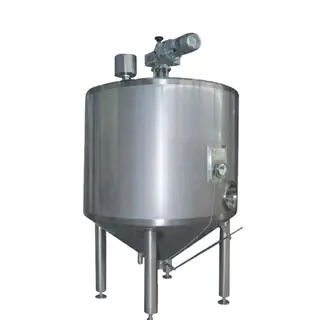
Set yogurt follows a different route: the inoculated milk is filled into cups and incubated in a chamber for about 3–3.5 hours, then cooled to about 5 °C. For set yogurt the "fermentation tank" is mainly a yogurt seed tank for preparing bulk starter and an intermediate tank feeding the cup filler. For stirred yogurt, a dedicated milk and yogurt fermentation tank with a conical or dished bottom and low-shear agitator is the standard choice.
Which brewery tanks does a beer plant need?
A commercial brewery needs fermenters (usually cylindroconical), conditioning capacity in the form of unitanks, lager tanks or brite tanks, and storage before packaging. Ales ferment at roughly 15–25 °C and lagers at roughly 6–14 °C, so jacket cooling capacity is the main design figure.
Those ranges come from a 2010 study by VTT researchers published in FEMS Yeast Research, which notes that lager strains ferment faster than ale strains at low temperature. The tank family follows the process:
- Fermenter: cooled wort is pitched with yeast in a cylindroconical vessel. The cone collects settled yeast for harvesting and repitching.
- Temperature control: fermentation releases heat, so the cylinder carries several cooling jacket zones. A Master Brewers Association of the Americas paper describing 500-barrel vessels with a 70-degree cone reports that the author later found the cone jacket unnecessary on those tanks, because the body jackets carried the load.
- Cold conditioning (lagering): the beer is chilled close to 0 °C so yeast drops out and flavor matures. The same paper describes chilling lager to 32 °F (0 °C) after an 8-day fermentation.
- Brite tank: clarified beer is held, carbonated if needed and fed to the filler. Brite tanks are pressure-rated and well insulated.
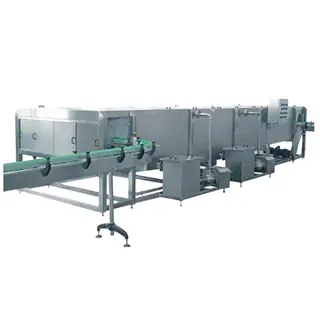
- Packaging: bottles or cans may then pass through a beer tunnel pasteurizer; see our tunnel pasteurizer guide for pasteurization units.
Unitank vs separate fermenter and brite tank
A unitank is a pressure-rated cylindroconical fermenter in which fermentation and conditioning happen in the same vessel. It saves a transfer and floor space, which suits craft breweries with many recipes. Separate fermenters and brite tanks raise annual output, because the fermenter is freed for the next brew while the previous batch conditions elsewhere. Most craft brewery tank farms combine both.
How are winery fermentation and storage tanks different?
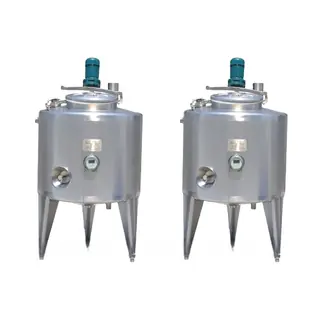
Winery tanks must remove fermentation heat and, for reds, manage a cap of skins. Britannica gives about 22–28 °C for red-wine color extraction, with control needed to stay below roughly 30 °C, while white wines are fermented cooler, often around 20 °C or as low as 10–15 °C.
The UC Davis wine fermentation diagnostic guide warns that an uncontrolled red fermentation can exceed 42 °C, a level that inhibits yeast, and that the cap can run about 10 °C warmer than the liquid below. That is why red fermenters need cooling jackets plus a way to pump over or punch down the cap, and why a temperature probe in the juice alone can mislead the winemaker. Whites lose volatile aroma compounds faster as temperature rises, so their tanks need more cooling per liter.
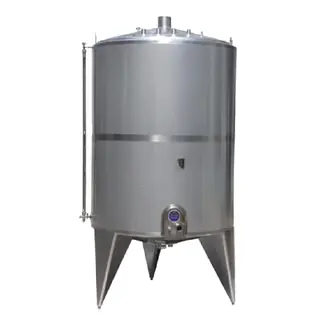
After fermentation, wine moves to storage tanks, where the aim shifts to limiting air contact and holding a stable temperature. A closed beer and wine storage tank with a jacket can serve for cold stabilization and blending.
How does a microbial bioreactor work?
A stirred-tank bioreactor is a sealed, steam-sterilizable vessel in which an impeller, a sparger and baffles disperse sterile air through the broth while probes control temperature, pH, dissolved oxygen and foam. Feed, acid, base and antifoam are added aseptically so only the production strain grows.
The Good Food Institute describes classical stirred-tank bioreactors as the standard design for submerged fermentation, in which cells are suspended in a liquid nutrient medium. It also notes that industrial fermentation tanks can reach hundreds of thousands of liters and that stainless-steel stirred tanks are capital-intensive. The main components are:
- Agitator: one or more impellers on a sealed shaft. University bioprocess course notes give a Rushton turbine diameter of about one-third of the tank diameter.
- Sparger and air filtration: a ring or pipe below the lowest impeller, fed with oil-free compressed air through sterile filters.
- Jacket or internal coils: coils transfer heat more efficiently but take up working volume and are harder to clean.
- Instrumentation: steam-sterilizable pH and dissolved-oxygen probes, temperature sensors, foam probes linked to antifoam dosing, and a bioreactor controller (PLC with recipe and data logging).
- Working volume: course notes typically allow 70–80% of total volume, with more headspace for strongly foaming broths.
Types of bioreactors
Besides stirred tanks, industry uses bubble-column and airlift reactors, which mix with gas alone and need no impeller. GFI notes that airlift designs use substantially less energy and suit thick filamentous-fungus cultures. Bench-top bioreactors of a few liters are used for strain and recipe development before scale-up.
What do yeast and precision fermentation require?
Baker's yeast is grown aerobically in fed-batch mode: molasses is fed slowly so sugar stays low, because Saccharomyces cerevisiae produces ethanol instead of biomass when sugar is in excess, even with air. Precision fermentation uses microbes as cell factories for specific ingredients and needs the same sterile, aerated design.
A 2013 study in the Brazilian Journal of Microbiology describes industrial yeast propagation moving from flasks through seed reactors to production vessels of up to about 150,000 liters, with the molasses medium adjusted to pH 4.5. The same authors attributed the lower biomass yield of their small reactor to poor oxygen transfer and to sugar overfeeding, which shows why aeration and feed control are the core design parameters of a yeast plant. GFI defines precision fermentation as using microbial hosts to make targeted ingredients such as enzymes, flavors, vitamins, pigments and fats.
When we engineer a yeast fermentation tank reactor or an industrial fermentor and bioreactor, we size the air compressor, sterile filters, cooling water and feed pumps together with the vessel, because oxygen transfer and heat removal, not tank volume, usually limit output.
What design features matter most in a stainless steel fermentation tank?
The features that matter most are cooling capacity matched to peak heat release, hygienic CIP-cleanable internals, the correct pressure and vacuum rating, the right bottom shape for draining or yeast removal, and instrumentation for temperature, pH or pressure. Material is normally AISI 304, with 316L for aggressive products and cleaning chemicals.
| Feature | Yogurt | Beer | Wine | Microbial bioreactor |
|---|---|---|---|---|
| Bottom | Conical or dished, full drainage | Cone for yeast harvest | Flat sloped or cone; racking valve | Dished, bottom valve |
| Temperature control | Insulation; external plate cooler | Zoned glycol or chilled-water jackets | Jackets sized for red-wine heat peaks | Jacket and/or coils, heating and cooling |
| Agitation | Low-speed, low-shear | None (CO2 mixes) | Pump-over or punch-down | High-power impellers plus baffles |
| Pressure rating | Atmospheric with sterile vent | Pressure-rated for unitanks and brite tanks | Usually atmospheric | Pressure vessel, steam-sterilizable |
| Cleaning | CIP spray balls | CIP spray balls | CIP or manual door access | CIP plus sterilize-in-place |
Whatever the product, internal welds should be ground smooth, dead legs avoided, and spray devices placed so that every product-contact surface is wetted during cleaning. Our CIP system guide explains detergent concentrations, temperatures and flow velocities, and our stainless mixing tank guide covers agitator selection for non-fermenting process tanks.
How do you size fermentation tanks for your plant?
Size fermentation capacity from batch volume multiplied by the full cycle time, which includes filling, fermentation, cooling or conditioning, emptying and cleaning, then add tanks so one is always free for CIP. Long conditioning, as in lager, multiplies the number of tanks far more than fermentation itself.
- Fix the daily or weekly output for each product and the batch size the downstream filler can absorb.
- List every step of the tank cycle: for stirred yogurt, filling plus 4–5 hours of fermentation, about 30 minutes of cooling-out and a CIP cycle; for beer, primary fermentation plus days or weeks of conditioning.
- Calculate turns per tank per day or week from the cycle time, then the number of tanks needed.
- Add headspace: foaming yogurt milk, actively fermenting beer and aerated broths all need free volume above the working level.
- Check utilities: chilled-water or glycol capacity at peak simultaneous load, compressed and sterile air for bioreactors, and steam for heating and sterilization.
As an illustration only, a plant producing 10,000 liters of stirred yogurt per day in two batches needs two 5,000-liter working-volume tanks if each cycle fits within one shift, plus a third tank if cleaning and a long fermentation overlap. Our line planner runs the same calculation for your own volumes, and if you prefer, our engineers can size the tank farm and cooling system for you through a quotation request.
Climate, power and site conditions
In hot climates, outdoor tanks and insulated jackets carry more heat load, so refrigeration must be sized for the highest ambient temperature, not the annual average. Motors, chillers and controls must match the local supply, whether 50 Hz or 60 Hz, and the site voltage. Browse all our tanks, silos and CIP equipment to compare standard capacities.
What information do you need for a fermentation tank quotation?
Send the product and organism, batch volume, number of batches per day or week, fermentation and conditioning temperatures, required pressure rating, cleaning or sterilization method, available cooling medium, and local power supply. With these data, suppliers can quote comparable tank sizes, jacket areas and control scopes.
- Product and process: yogurt type, beer style (ale or lager), wine color, or yeast strain and fermentation mode (batch or fed-batch).
- Capacity: working volume per batch, batches per day or week, and planned growth.
- Temperatures and times: fermentation, conditioning or cold-crash temperature and duration.
- Hygiene level: hygienic CIP only, or full sterilize-in-place with sterile air and aseptic sampling.
- Utilities: chilled water, glycol or ammonia; steam pressure; compressed air quality.
- Site: indoor or outdoor installation, ceiling height, ambient temperature range, voltage and frequency (50/60 Hz).
- Automation: manual valves, PLC with touch screen, or integration into a plant SCADA.
Send this list to our team through the request-a-quote form and our engineers will propose a tank configuration with jacket, agitator and control details.
Frequently asked questions
What is a fermentation tank?
A fermentation tank is a stainless-steel vessel in which microorganisms convert a raw material into a product under controlled temperature and hygiene. Examples include insulated yogurt tanks, cylindroconical beer fermenters, jacketed wine tanks and sealed microbial bioreactors. Designs differ in cooling capacity, pressure rating, agitation and how strictly they exclude unwanted organisms.
What is the difference between a fermenter and a bioreactor?
In food processing, fermenter usually means a tank for beer, wine or dairy fermentation, where air is excluded and the culture is robust. A bioreactor is normally a sealed, steam-sterilizable stirred tank with sterile aeration and pH, dissolved-oxygen and foam control, used to grow yeast or produce enzymes and precision-fermentation ingredients.
What temperature should a yogurt fermentation tank hold?
For stirred yogurt, the Tetra Pak Dairy Processing Handbook gives 42–43 °C for about 4–5 hours. Fermentation is stopped at pH 4.2–4.5 by pumping the yogurt through a plate cooler to 15–22 °C. Set yogurt is instead incubated in its cups and cooled in a chamber.
What is a unitank in brewing?
A unitank is a pressure-rated cylindroconical vessel in which beer is both fermented and conditioned, so it does not need a transfer to a separate tank. It saves space and handling. Breweries chasing higher output often add separate brite tanks so fermenters can be refilled sooner.
What are lager tanks used for?
Lager tanks hold beer at low temperature, close to 0 °C, after primary fermentation so yeast settles out and flavor matures. Because conditioning can last much longer than fermentation, a lager brewery usually needs more conditioning tank volume than fermenter volume.
How does a bioreactor work for yeast production?
Sterile air is sparged into a sealed tank while an impeller disperses the bubbles and a jacket removes heat. Molasses or another sugar is fed slowly in fed-batch mode, because Saccharomyces cerevisiae makes ethanol instead of biomass when sugar is in excess. Probes control temperature, pH, dissolved oxygen and foam.
Sources
- Tetra Pak Dairy Processing Handbook – Fermented milk products
- Vidgren et al. (2010), The temperature dependence of maltose transport in ale and lager strains of brewer's yeast, FEMS Yeast Research (VTT)
- Master Brewers Association of the Americas – Technical Quarterly 1972 abstract on cylindroconical fermenters
- Britannica – Wine: Fermentation
- UC Davis Viticulture & Enology – Wine fermentation diagnostic: fermentation too fast
- Vieira et al. (2013), Yeast biomass production: a new approach in glucose-limited feeding strategy, Brazilian Journal of Microbiology
- The Good Food Institute – The science of fermentation
- SRM University – The design of fermenter (bioprocess course notes)