Juice & beverage lines · · 10 min read
Tunnel Pasteurization Guide: PU, Zones and Sizing for Beer
Tunnel pasteurization explained: how to calculate pasteurization units, PU targets for beer and drinks, zone layout, regeneration and tunnel sizing.
By the process engineering team at Shanghai Mars Industrial Co., Ltd.

Key takeaways
- One pasteurization unit (PU) equals one minute at 60 °C, and PU = t × 1.393^(T − 60), based on a z-value of 6.94 °C.
- Most beers receive about 5–25 PU, while non-alcoholic beers below 0.5% ABV need more than 40 PU for a comparable safety margin.
- A tunnel pasteurizer heats sealed containers through preheat, heating, holding and cooling spray zones, pairing preheat and cooling zones to recover heat.
- Flash pasteurization at about 70–75 °C uses far less energy and space than a tunnel but requires sterile or highly hygienic filling.
- Size a tunnel from filler output multiplied by residence time, then multiply the containers inside by the area each occupies to find the belt area.
What is tunnel pasteurization?
Tunnel pasteurization heats beverages after they are filled and sealed. Bottles or cans travel on a conveyor through a long chamber where water sprays warm them in stages, hold them at pasteurizing temperature, then cool them. The heat dose is measured in pasteurization units (PU), where one PU equals one minute at 60 °C.
Because the product is treated inside its final container, tunnel pasteurization protects against contamination during filling as well as in the liquid itself. That is why it remains the standard for much bottled and canned beer, and for many cider, juice and ready-to-drink (RTD) products. This guide explains how PU are calculated, typical PU targets, how the zones and regeneration work, when flash pasteurization is the better choice, and how to size a beer tunnel pasteurizer for your line.
For the time–temperature rules for milk, juice and egg, see our pasteurization temperature and time chart.
What is a pasteurization unit and how is PU calculated?
One pasteurization unit (PU) is the lethal effect of holding a product at 60 °C for one minute. According to the Master Brewers Association of the Americas, PU = t × 1.393^(T − 60), with t in minutes and T in °C, based on a z-value of 6.94 °C. Each 1 °C rise multiplies the PU rate by about 1.39.
The z-value is the temperature change that alters microbial death rate tenfold. With z = 6.94 °C, heating roughly 7 °C hotter delivers ten times the PU per minute. The 60 °C base comes from brewing history: the Oxford Companion to Beer, published via Craft Beer & Brewing, notes that early practice showed a few minutes at 60 °C kept beer stable for months, and the industry adopted that temperature as the reference.
In a tunnel, the product temperature is never constant. It rises through the preheat zones, plateaus in the pasteurizing zone and falls during cooling. The total PU is the sum of every short interval's PU, calculated at the slowest-heating point of the container (the cold spot), not from the spray water temperature.
| Product temperature | PU per minute | Minutes at this temperature for 15 PU |
|---|---|---|
| 60 °C | 1.0 | 15.0 |
| 62 °C | 1.9 | 7.7 |
| 64 °C | 3.8 | 4.0 |
| 66 °C | 7.3 | 2.1 |
| 68 °C | 14.2 | 1.1 |
| 70 °C | 27.5 | 0.55 (33 s) |
| 72 °C | 53.4 | 0.28 (17 s) |
The table shows why temperature control matters so much: two degrees too hot nearly doubles the heat dose and can damage flavour, while two degrees too cool halves it.
How many PU do beer, juice and RTD drinks need?
Most beers receive about 5–25 PU, with around 15 PU a common industry figure. Low- and no-alcohol beers need much more, from about 20 PU to over 40 PU. Juices and RTD drinks have no single PU standard; their process must be validated against the target pathogens and local regulations.
| Product | PU guidance | Source |
|---|---|---|
| Typical lager and ale | About 5–25 PU; around 15 PU common | Oxford Companion to Beer (Craft Beer & Brewing) |
| Regular-strength beer | About 10 PU for a 6-log reduction of the most heat-resistant spoiler | Brewers Association presentation (2025) |
| Extra-light beer (about 1.8% ABV) | More than 18–20 PU | Brewers Association presentation (2025) |
| Non-alcoholic beer (under 0.5% ABV) | More than 40 PU | Brewers Association presentation (2025) |
| Low/no-alcohol beer, European guide | 60–120 PU (practicality questioned by the presenter) | Cited in Brewers Association presentation |
| Fruit juice in the US | Validated 5-log reduction of the pertinent pathogen, not a fixed PU | 21 CFR 120.24 |
Alcohol, hop compounds, low pH and carbon dioxide all make beer hostile to microorganisms, which is why regular beer needs only a modest heat dose. Remove the alcohol and the safety margin shrinks; the Brewers Association presentation advises keeping non-alcoholic beer pH well below 4.6, preferably around 4.0. For juice, the US juice HACCP rule (21 CFR 120.24) requires at least a 5-log reduction of the most resistant pathogen likely to occur, so a juice or juice-based RTD needs a validated process rather than a beer PU figure. Sweetened, low-alcohol products such as some RTDs should have their settings confirmed by microbiological validation before production.
How is a tunnel pasteurizer laid out?
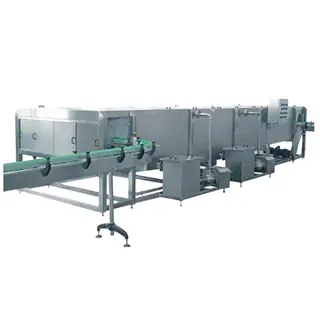
A tunnel pasteurizer is divided into spray zones: several preheating zones, a superheat or heating zone, a pasteurizing (holding) zone, and several cooling zones. Each zone has its own water tank, pump and spray headers, and water temperatures step up and down gradually so containers are not shocked.
A classic design described in US patent 4,441,406 uses ten zones. In that example, containers pass through the following sequence:
- Preheat zones (four): sprays warm the containers step by step using water recovered from the cooling zones.
- Heating (superheat) zone: hotter water quickly brings the product up to pasteurizing temperature, around 60 °C (140 °F) or above for beer.
- Holding (pasteurizing) zone: sprays hold the product at temperature until the target PU accumulate.
- Precool zones (four): sprays remove heat step by step, warming that water for reuse in the preheat zones.
- Final cooling and discharge: containers leave cool enough for labelling and packing.
The same patent warns of thermal shock in glass when spray water is roughly 44 °C (80 °F) hotter or 22 °C (40 °F) cooler than the container surface, which is why zones step gradually. Internal pressure from heated, carbonated product is another limit: the Brewers Association lists container failure with high temperatures and low headspace among common tunnel problems, and MBAA notes that heating agitates dissolved CO2, making seal integrity critical.
Residence time depends on container size and the PU target. In a published Brazilian study of 600 mL glass beer bottles, the normal maximum cycle time was about 47 minutes (2,830 seconds).
How does regeneration save energy in a tunnel pasteurizer?
Regeneration pairs each preheat zone with a cooling zone. Water that cools hot containers absorbs heat, then is pumped to spray incoming cold containers. This recovers much of the energy that would otherwise be lost, and reduces both steam and cooling demand.
In the ten-zone example from US patent 4,441,406, the four preheat zones are paired with the four precool zones, the first preheat zone with the last cooling zone and so on, forming four regenerative pairs. The patent notes that economic justification "becomes difficult at five or more regenerative pairs", because each added pair brings pumps, tanks and controls for a smaller saving. US patent 5,750,174 describes the same principle of returning cooling-zone water to the preheating zones, and highlights a weakness of older designs: when the filler stops and the infeed gap passes through, cold make-up water was added and heat was wasted. A tunnel pasteurization study presented through the American Society of Brewing Chemists (ASBC) likewise notes that reusing water between zones reduces the system's energy load.
Line stoppages also matter for quality. US patent 4,441,406 calculates that a ten-minute stop with beer held at about 63 °C (145 °F) adds over 25 PU, enough to cause the "burnt" or cooked flavour that the Brewers Association lists as a common tunnel problem. Stoppage management is therefore central to tunnel control: in the ENCIT 2010 bottle study, a model-based control kept about 95% of PU measurements within the target range, compared with 83% without it.
Should you choose tunnel or flash pasteurization?
Choose tunnel pasteurization when you fill bottles or cans without a sterile filling room and want the container protected too. Choose flash pasteurization when you fill kegs or have a sterile, low-oxygen filler, because it uses far less energy and space. Many breweries use flash for kegs and tunnels for small packs.
| Criterion | Tunnel pasteurization | Flash pasteurization |
|---|---|---|
| What is heated | Filled, sealed bottles or cans | Liquid in a plate heat exchanger before filling |
| Typical heat profile | Around 60 °C or above, held for minutes | About 70–75 °C for seconds, then cooled to about 5 °C |
| Protection against filler contamination | Yes, container and contents are treated together | No; needs sterile or very hygienic filling |
| Energy use | Higher; Brewers Association cites flash energy costs 8–10 times lower | Lower; plate units reach up to about 95% energy efficiency |
| Footprint | Large | Small |
| Main risks | Over-pasteurization on stops, container failure, glass breakage, spray fouling | Re-contamination at filling, over-pasteurization if flow is unstable |
| Best suited to | Bottles and cans, especially at small and mid capacities | Kegs, bulk, and sterile bottle or can lines |
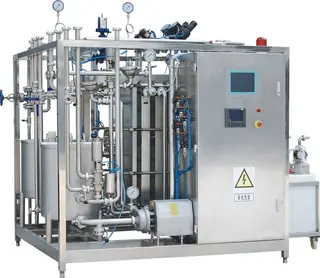
The Brewers Association recommends keeping dissolved oxygen below 0.3 mg/L and using controlled flow or a surge tank with flash pasteurization. MBAA adds that flash pasteurizers work best at a constant rate, since stoppages extend time at temperature. Our continuous milk, juice and beer pasteurizer (500–10,000 L/h) is a plate-type flash unit, and our plate vs tubular heat exchanger guide explains how to choose the heat exchanger. If you are unsure which route suits your packaging, our engineers can compare both options for your line.
How do you size a tunnel pasteurizer?
Size a tunnel pasteurizer from the filler's maximum output and the total residence time needed to reach your PU target. The number of containers inside the tunnel equals output per minute multiplied by residence time; multiply that by the area each container occupies to get the required belt area.
A worked example, using illustrative figures:
- Filler output: 10,000 bottles per hour, or about 167 per minute.
- Residence time: 47 minutes, similar to the bottle study above.
- Containers in the tunnel: 167 × 47 ≈ 7,830 bottles.
- Area per bottle: if each occupies a 76 × 76 mm square (0.0058 m²), required belt area ≈ 7,830 × 0.0058 ≈ 45 m².
Round up for growth and for the largest container you will run, and check that the tunnel can maintain PU when the filler runs slower. Craft breweries, cider makers and juice start-ups with lower filler speeds need correspondingly smaller belt areas; our beer tunnel pasteurizer is configured to the filler output and container you specify. For complete beverage plants, see the PLC fruit juice line with PET bottle filling, the UHT fruit juice and carbonated beverage line and the apple cider processing plant (2–20 t/h), or browse all juice and beverage lines. Our line planner helps convert daily volume into filler and pasteurizer capacity.
What should you check before buying a tunnel pasteurizer?
Check the PU range and control method, number of zones and regenerative pairs, container types and sizes, belt width and length, heating source, water treatment and filtration, stoppage management, and PU recording. These determine product safety, flavour consistency, energy cost and how easily the tunnel adapts to new products.
- Target PU for each product, and the control range of the pasteurizing zone.
- Number of zones and regenerative pairs, and expected steam and water use.
- Container list: glass bottles, aluminium cans, PET (if any), sizes and fill heights.
- Maximum temperature step between zones to avoid thermal shock and container failure.
- Automatic temperature reduction and PU tracking during filler stoppages.
- Spray water filtration and treatment against scale, corrosion and spray-nozzle fouling.
- Stainless-steel construction (AISI 304 or 316L in wet areas) and access for cleaning.
- Heating source (steam, hot water or electric) and cooling-water supply in hot climates.
- Electrical supply: voltage, frequency (50/60 Hz) and control-panel language.
- Validation: a probe-equipped test container run through the tunnel to log the cold-spot temperature and calculate actual PU.
When we engineer a tunnel pasteurizer, we start from the container with the slowest heating and the product with the highest PU target, then set zone temperatures so every other product is treated within its window.
What information do you need for a quotation?
Send the products and their PU or time–temperature targets, container types and sizes, filler output, available floor space, heating and cooling utilities, and local voltage and frequency. With this, our engineers can size the tunnel, zones and regeneration and propose a layout.
- Products: beer style and ABV, cider, juice, RTD, tea or other beverages.
- Target PU or required time and temperature for each product.
- Containers: glass, cans or PET, with dimensions and volumes.
- Filler speed now and planned in five years.
- Available length, width and height in the packaging hall.
- Steam or hot-water supply, cooling water temperature and water quality.
- Power supply: voltage, frequency (50/60 Hz) and phase.
- Upstream and downstream equipment to connect (filler, labeller, packer).
Send your data through our quotation request form, by email to [email protected] or via WhatsApp +86 176 2154 1688.
Frequently asked questions
What is tunnel pasteurization?
Tunnel pasteurization is a method of heat-treating beverages after they are filled and sealed. Bottles or cans move on a conveyor through spray zones that preheat them, hold them at pasteurizing temperature and cool them again. Because product and container are treated together, it protects against contamination introduced during filling.
How do you calculate pasteurization units for beer?
Use PU = t × 1.393^(T − 60), where t is time in minutes and T is product temperature in °C. One minute at 60 °C equals one PU. In a tunnel, the temperature changes constantly, so total PU is calculated by adding the PU of each short interval measured at the container's slowest-heating point.
How many PU does beer need?
Most beers receive between about 5 and 25 PU, with roughly 15 PU a common industry figure. Brewers Association guidance suggests about 10 PU gives a 6-log reduction of the most heat-resistant spoiler in regular beer, while non-alcoholic beer needs more than 40 PU. Each brewery should validate its own target.
What is the difference between tunnel and flash pasteurization?
Tunnel pasteurization heats filled, sealed containers for several minutes at around 60 °C or above. Flash pasteurization heats the liquid in a plate heat exchanger to about 70–75 °C for seconds before filling. Flash uses much less energy and space but needs sterile filling; tunnels protect against filling contamination but cost more to run.
Can a tunnel pasteurizer be used for juice and soft drinks?
Yes. Tunnel pasteurizers treat juices, ciders, teas and RTD drinks in glass bottles and cans. However, the beer PU figures do not transfer directly; juice in the US must meet a validated 5-log pathogen reduction, and sugary, low-alcohol drinks need validation for yeast and mould spoilage before settings are fixed.
What should I look for in a tunnel pasteurizer for sale?
Look for accurate PU control with automatic temperature reduction during stoppages, enough regenerative zone pairs for your energy costs, gradual temperature steps to avoid container breakage, good spray-water filtration, stainless construction, and a belt sized for your filler speed and residence time. Confirm it matches your local voltage and 50 or 60 Hz supply.
Sources
- MBAA Food Safety Bite No. 5 – Pasteurization (2024)
- Brewers Association – Foundations of Pasteurization for Regular and Non-Alcohol Beers (2025)
- Craft Beer & Brewing – Pasteurization (Oxford Companion to Beer entry)
- US Patent 4,441,406 – Pasteurization apparatus (zones, regeneration, PU)
- US Patent 5,750,174 – Process and apparatus for pasteurizing liquid contained in containers
- Fontana & Schneider (2010) Formulation of a model for controlling the pasteurization process in bottled beer, ENCIT 2010
- ASBC – Tunnel pasteurization study (PU trials and zone water reuse)
- eCFR – 21 CFR 120.24 Process controls (juice HACCP 5-log reduction)