Pasteurizers & sterilizers · · 12 min read
Plate Heat Exchanger vs Tubular: Which Pasteurizer Fits?
Plate heat exchanger or tubular? Compare plate, shell-and-tube, tube-in-tube and scraped-surface designs by particle size, viscosity and fouling.
By the process engineering team at Shanghai Mars Industrial Co., Ltd.

Key takeaways
- A gasketed plate heat exchanger suits thin, particle-free liquids such as milk, whey and clear juice, and its regeneration section can recover up to 94–95% of heat.
- Tubular heat exchangers have no contact points in the product channel, so they pass pulp and particles: about 25 mm in coiled monotubes and up to 50 mm in straight monotubes.
- Tube-in-tube (concentric) designs suit highly viscous, non-Newtonian products such as tomato paste and fruit concentrates, while scraped-surface units handle jams, fillings and fats.
- Brazed plate heat exchangers cannot be opened for inspection, so they belong on utility circuits such as chillers, not on product-contact duty.
- Dairy fouling starts once milk is heated above about 65 °C; soft protein-rich Type A deposits form at 70–90 °C and hard mineral-rich Type B deposits at 110–140 °C.
Plate or tubular heat exchanger: which should you choose?
Choose a gasketed plate heat exchanger for thin, clean liquids such as milk, whey, clear juice and beer, where it gives the highest heat recovery in the smallest footprint. Choose a tubular design for pulp, fibres, particles, high viscosity, high pressure or long UHT runs, and a scraped-surface unit for very thick or sticky products.
Every continuous pasteurizer or sterilizer is built around a heat exchanger, and the heat exchanger type decides what the line can run, how long it runs between cleanings and how much energy it recovers. This guide compares the plate heat exchanger with shell-and-tube, tube-in-tube and scraped-surface designs across dairy, juice, tomato and other food products, explains how fouling limits run time, and gives a step-by-step selection method. If you are choosing specifically between plate, tubular, batch and UHT systems for liquid milk, our milk pasteurizer buying guide covers that decision in detail.
How does a plate heat exchanger work?
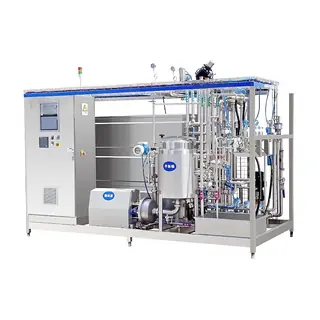
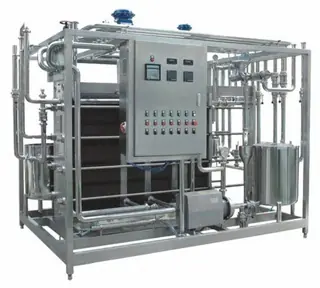
A plate heat exchanger clamps a pack of thin, corrugated stainless steel plates in a frame. Gaskets seal each plate so product and heating or cooling medium flow in alternate channels, and heat passes through the plate wall. Corner ports route each fluid, and separate plate packs in one frame handle regeneration, heating and cooling.
According to the Tetra Pak Dairy Processing Handbook, the corrugations create support points that hold the plates a fixed distance apart, forming thin channels in which the liquid flows turbulently. Each product channel has a service-medium channel on both sides, which is why a plate-and-frame heat exchanger (also called a plate type, plate-to-plate or flat plate heat exchanger) transfers heat so efficiently. The handbook's worked example uses an overall heat transfer coefficient of about 5,000 W/m²·K for thin stainless plates that are not heavily fouled.
In a plate pasteurizer the frame typically holds several sections:
- Regeneration: cold raw product is warmed by hot pasteurized product. The handbook states that modern units can recover up to 94–95% of the heat this way.
- Heating: hot water or steam-heated water brings the product to pasteurization temperature. The handbook recommends keeping the medium only about 2–3 °C above the product temperature to limit fouling.
- Holding: an external holding tube gives the required residence time before the product returns to the plates.
- Cooling: cold water, ice water or glycol chills the product for filling or storage.
To reduce pressure drop, the product can be split into several parallel passes, written as a grouping such as "4 x 2 / 2 x 4". Because the channels are narrow, pressure drop is relatively high, and many dairy plants fit a booster pump so the pasteurized side runs at higher pressure than the raw side. That way a pinhole in a plate leaks clean product into raw product, never the reverse.
What types of heat exchangers are used in food processing?
Five families cover almost all food duties: gasketed plate-and-frame, brazed plate (utility duty only), shell-and-tube or multitube, monotube and tube-in-tube (concentric) tubular designs, and scraped-surface heat exchangers. They differ in channel geometry, which sets particle tolerance, pressure rating, cleanability and the thermal efficiency you can expect.
| Type | Construction | Typical food duties | Main limitation |
|---|---|---|---|
| Gasketed plate-and-frame | Corrugated plates, elastomer gaskets, bolted frame; can be opened | Milk, cream, whey, clear juice, beer, water, CIP heating | Contact points and narrow gaps restrict particles and fibres |
| Brazed plate | Plates permanently brazed together, no gaskets | Refrigerant chillers, hot-water and glycol utility circuits | Cannot be opened for product-side inspection |
| Shell-and-tube / multitube | Bundle of straight smooth or corrugated tubes inside a shell | Juice, milk drinks, indirect UHT, product-to-product regeneration | Larger footprint than plates for the same duty |
| Monotube | Single wide inner tube inside an outer tube | Products with large particles or fruit pieces | Lower heat transfer area per metre |
| Tube-in-tube (concentric) | Nested tubes with media on both sides of an annular product channel | Fruit pulp, purees, concentrates, tomato paste, viscous sauces | Higher pumping energy |
| Scraped-surface | Jacketed cylinder with rotating scraper blades | Jams, fillings, dressings, chocolate, peanut butter, margarine fats | Highest capital and maintenance cost per m² |
Shell-and-tube heat exchangers
In food plants the shell-and-tube heat exchanger usually takes the multitube form: a bundle of tubes welded into tube plates inside an outer shell, with product inside the tubes and service water in the shell. The handbook describes floating designs with double O-ring seals that absorb thermal expansion and let the bundle be withdrawn for inspection. Corrugated tubes increase turbulence, and the absence of contact points in the product channel lets small particles pass. Tubular designs suit very high pressures and temperatures, which is why most indirect UHT plants use them. Of the many shell-and-tube heat exchanger types, only hygienic, drainable designs with sanitary connections belong on food duty.
Tube-in-tube heat exchangers
A tube-in-tube heat exchanger nests tubes of different diameters so that heating or cooling medium surrounds an annular product channel on both sides. The handbook notes that the channel depth can be varied to suit particles and that this concentric design suits highly viscous, strongly non-Newtonian products. That is why tube-in-tube sterilizers are standard for mango pulp, fruit concentrates and tomato paste.
Scraped-surface heat exchangers
A scraped-surface heat exchanger pumps product through a jacketed cylinder while rotating blades continuously scrape the heat transfer wall. The handbook lists jams, sweets, dressings, chocolate, peanut butter and fats for margarine and shortening as typical products. Scraping keeps the surface free of deposits, which is the only practical way to heat or cool products that would burn on or stall in a static channel. Rotor diameter is selectable: a smaller rotor passes larger particles, while a larger rotor shortens residence time and improves heat transfer.
Can a brazed plate heat exchanger be used for food products?
Not for product contact in a hygienic food line. A brazed plate heat exchanger is a sealed pack whose plates are joined with brazing filler, typically copper, so it cannot be opened to inspect plates, check for cracks or replace parts. It is excellent for refrigeration and utility water circuits, but product-side surfaces should be inspectable stainless steel.
Brazed units are compact and common in chillers and boilers.The problem in food processing is verification. Hygienic plate heat exchangers have their own design standard (3-A 11-10 for plate-type heat exchangers), and good hygienic practice depends on being able to open the pack, inspect plates and leak-test the regeneration section. A brazed pack offers no such access, and a copper filler is a poor match for acidic juices and for the caustic and acid chemicals used in CIP.
When we engineer a pasteurizer, brazed plates may appear on the utility side, for example to chill the ice-water circuit, while every product-contact surface stays in a gasketed plate pack or a tubular unit built from AISI 304 or 316L stainless steel.
What particle size and viscosity can each heat exchanger handle?
Standard plate heat exchangers are for liquids without significant particles or fibres; wide-gap plates accept limited fibre. Tubular designs pass particles up to a size set by the tube diameter: about 25 mm in coiled monotubes and up to 50 mm in straight monotubes. Highly viscous or sticky products need tube-in-tube or scraped-surface units.
| Design | Particles and fibres | Viscosity range | Typical examples |
|---|---|---|---|
| Standard gasketed plate | Essentially particle-free liquids | Low, water-like to moderately thick | Milk, cream, whey, clarified juice, beer |
| Wide-gap / free-flow plate | Limited fibres and small pulp cells | Low to moderate | Juice with pulp cells, some sugar syrups |
| Multitube (shell-and-tube) | Small particles, size limited by tube diameter | Low to medium | Flavored milk, juice with pulp, plant-based drinks |
| Coiled monotube | Up to about 25 mm | Medium to high | Soups, sauces with pieces |
| Straight monotube | Up to about 50 mm | Medium to high | Fruit preparations with whole pieces |
| Tube-in-tube (concentric) | Fibres and pulp; gap set to product | High, strongly non-Newtonian | Tomato paste, mango pulp, purees, concentrates |
| Scraped-surface | Large particles with small rotor | Very high, sticky or crystallizing | Jam, fillings, chocolate, margarine fats |
The handbook explains why plates are limited: the contact points that hold the plates apart sit inside the product channel, where fibres catch and bridge across. Tubular designs have no contact points but need higher flow velocities for good heat transfer, which raises pumping energy. Viscosity matters as much as particle size: as it rises, flow turns laminar, heat transfer drops and pressure drop across narrow plate channels climbs quickly.
What is fouling in a heat exchanger, and how does it limit run time?
Fouling is the build-up of deposits such as denatured protein, minerals, sugar or pulp on heat transfer surfaces. It adds thermal resistance (the fouling factor), raises pressure drop and forces more aggressive heating, so the line must stop for cleaning. In dairy, some fouling always occurs once milk is heated above about 65 °C.
The Tetra Pak handbook names the main drivers: the temperature difference between product and heating medium, raw material quality, air content and pressure conditions. Excess air greatly increases fouling, and once a deposit forms, the operator raises the medium temperature to hold the setpoint, which bakes on more deposit. A bulletin from India's National Dairy Development Board (NDDB) distinguishes two classes of milk fouling:
- Type A deposits form at about 70–90 °C. They are soft and creamy white and contain roughly 60% protein and 30–40% minerals.
- Type B deposits form at about 110–140 °C, as in UHT heaters. They are hard and glassy, with roughly 20% protein and 80% minerals.
The NDDB lists the costs: extra heat transfer area to compensate, higher pump power, lost production during cleaning, harder cleaning, a possible source of bacterial contamination and more load on effluent treatment. Fouling in heat exchanger tubes and plate channels is the main reason a pasteurizer sized correctly for flow misses its daily output.
Fouling is reduced by a hot-water heating circuit with a small temperature difference, deaeration before heating, stable flow rates and tubular channels for products that foul quickly. Plan production around regular cleaning; our CIP system guide explains how heat-exchanger cleaning cycles are built.
When do you need a tubular pasteurizer for pulp, paste or juice?
Specify a tubular pasteurizer when the product contains pulp, fibres or pieces, when viscosity is high, when the process temperature or pressure exceeds what gaskets tolerate comfortably, or when you need long runs between cleanings. Tomato paste, mango pulp, fruit concentrates, NFC juice with cells and many sauces fall into this group.
Fruit and vegetable products behave very differently from milk. Tomato paste and fruit concentrates are thick and non-Newtonian; their apparent viscosity changes with shear rate, and they carry insoluble solids that would block plate gaps within minutes. For these products we typically use a tube-in-tube sterilizer for mango pulp and fruit concentrate or a dedicated tomato paste and ketchup tubular pasteurizer, often followed by aseptic filling. The tomato paste processing line guide explains where the sterilizer sits in the full line.
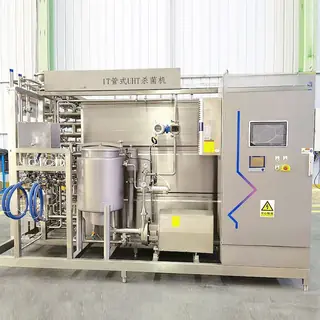
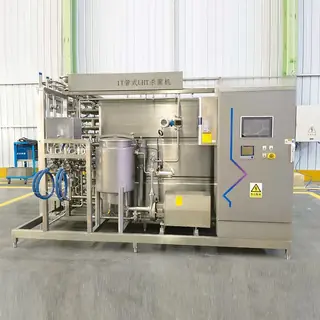
Juices and milk drinks with fine pulp sit in the middle. A tubular pasteurizer for fruit juice and milk handles both clear and pulpy drinks on one skid, which suits plants that switch between dairy and juice. For plain milk, whey or clear juice, a plate type HTST milk pasteurizer or a small plate pasteurizer for milk and juice remains the more economical choice because of its higher regeneration and smaller footprint.
Not sure which side of the line your product falls on? Our engineers can review a sample specification (solids, pulp content, viscosity, target temperature) and size the right heat exchanger for your product.
How do you select a heat exchanger for a pasteurizer, step by step?
Start from the product, not the machine: define solids, particle size, viscosity and fouling behavior, then the time–temperature program, hourly flow and run length. Those inputs eliminate unsuitable designs, and only then do regeneration percentage, footprint, utilities and budget decide between the remaining options.
- Characterize the product. Record Brix or total solids, fat, particle size and viscosity, and note whether it foams or bakes on.
- Fix the thermal program. Inlet, pasteurization or sterilization temperature, hold time and outlet temperature. Our pasteurization temperature and time guide lists the standard combinations.
- Eliminate designs by product limits. Particles or fibres rule out standard plates; very high viscosity points to tube-in-tube or scraped-surface designs.
- Set flow and run time. Divide daily volume by real production hours after cleaning, then decide how long the unit must run between CIP cycles. Products that foul quickly favor tubular channels.
- Decide on heat recovery. Product-to-product regeneration cuts steam and refrigeration demand. Plates reach the highest regeneration; tubular units recover slightly less but run longer.
- Check utilities and site. Steam or hot-water capacity, chilled-water temperature, power supply (50 or 60 Hz and local voltage), and cooling-water temperature in hot climates, which sets how much ice-water cooling you need.
- Confirm hygiene and controls. Holding tube, flow diversion valve, temperature recording, booster pump where required, and a CIP-ready layout.
For capacity planning across a whole line, from reception to filling, use our line planner. You can also browse the complete range of pasteurizers and sterilizers.
How do plate and tubular heat exchangers compare on maintenance and cost?
Plate units are usually cheaper to buy for clean liquids and easy to expand by adding plates, but gaskets need periodic replacement and plates must be inspected for cracks. Tubular units cost more per unit of heat transfer area and need more pumping power, yet have fewer gaskets, tolerate higher pressure and often run longer between cleanings.
We do not quote generic prices because cost depends on capacity, materials and automation. The main cost drivers are:
- Heat transfer area: higher regeneration means more plates or tubes, and doubling flow roughly doubles the area, as the handbook's sizing example shows.
- Materials: AISI 316L costs more than 304 but resists chlorides and acidic products better.
- Pressure class and controls: UHT duty needs heavier construction; PLC recording and CIP integration add cost.
- Operating cost: gaskets for plates, pumping energy for tubes, and cleaning downtime for both.
Both designs are governed by hygienic standards in the US: 3-A 11-10 for plate-type heat exchangers and 3-A 12-08 for tubular heat exchangers. Asking a supplier which design rules a heat exchanger follows is a simple way to compare quotations.
What information do you need for a heat exchanger quotation?
Send the product description and analysis, hourly capacity, inlet and outlet temperatures, pasteurization or sterilization temperature and hold time, required run time, available heating and cooling utilities, power supply and the downstream filling method. With these data, engineers can choose the heat exchanger type and size it correctly the first time.
- Product and recipe: milk, juice, pulp, paste or sauce; Brix or total solids; fat; particle size; viscosity if known
- Capacity in L/h or t/h, and daily operating hours
- Thermal program: inlet temperature, process temperature, hold time, outlet temperature
- Required regeneration or energy targets
- Utilities: steam pressure or hot-water source, cooling-water and chilled-water temperatures
- Electrical supply: voltage, phase and 50 or 60 Hz
- Downstream equipment: homogenizer, aseptic or hot filler, packaging type
- Site conditions: ambient temperature, humidity, available floor space
- CIP: existing central CIP station or integrated skid
Send this list to our team through the quotation request form, and our engineers will recommend a plate, tubular or combined configuration with a clear explanation of the trade-offs.
Frequently asked questions
How does a plate heat exchanger work?
A plate heat exchanger clamps corrugated stainless steel plates in a frame. Gaskets direct the product and the heating or cooling medium into alternate thin channels, so heat passes through each plate wall. In a pasteurizer, separate plate sections handle regeneration, heating and cooling, with an external holding tube providing the required hold time at pasteurization temperature.
What is the difference between a plate and a tubular heat exchanger?
A plate heat exchanger uses narrow channels between corrugated plates, giving high heat transfer and up to 94–95% regeneration in a compact frame. A tubular heat exchanger moves product through tubes without contact points, so it tolerates particles, pulp, higher viscosity and higher pressure, and often runs longer between cleanings, at the cost of more space and pumping energy.
Is a shell-and-tube heat exchanger suitable for food processing?
Yes, when it is built to hygienic standards. Food-grade shell-and-tube units, usually called multitube heat exchangers, have polished stainless steel tubes, sanitary connections and drainable layouts, and are covered in the US by 3-A Sanitary Standard 12-08 for tubular heat exchangers. They are widely used for juice, milk drinks and indirect UHT treatment.
What is fouling in a heat exchanger?
Fouling is the build-up of deposits such as denatured protein, minerals, sugar or pulp on heat transfer surfaces. The deposit adds thermal resistance, known as the fouling factor, and raises pressure drop, so the unit loses capacity and must be cleaned. In dairy plants, fouling always occurs once milk is heated above about 65 °C.
When should I use a scraped-surface heat exchanger?
Use a scraped-surface heat exchanger for very viscous, sticky, crystallizing or particle-laden products that would burn onto or block plate and tubular channels. Typical examples include jams, fruit fillings, dressings, chocolate, peanut butter and fats for margarine. Rotating blades keep the heat transfer wall clean, giving uniform heating and cooling.
Can a tubular pasteurizer handle milk as well as juice?
Yes. A tubular pasteurizer handles milk, flavored milk, juice with pulp and plant-based drinks, which makes it useful for plants that switch between dairy and fruit products. For plain milk only, a plate pasteurizer is usually more economical because it recovers more heat in a smaller footprint, but tubular units tolerate fouling and particles better.
Sources
- Tetra Pak Dairy Processing Handbook – Heat exchangers
- NDDB Technews No. 54 – Fouling of heat exchangers by dairy liquids
- 3-A Sanitary Standards – Plate Type Heat Exchangers (3-A 11-10)
- 3-A Sanitary Standards – Tubular Heat Exchangers (3-A 12-08)
- Tetra Pak Dairy Processing Handbook – Collection and reception of milk
- Wikipedia – Plate heat exchanger (construction overview)