Tanks, silos & CIP · · 10 min read
Milk Cooling Tanks and Silos: Storage Temperature and Sizing
Milk cooling tank guide: required storage temperatures under the PMO and EU 853/2004, DX vs ice-bank cooling, sizing by milkings and choosing milk silos.
By the process engineering team at Shanghai Mars Industrial Co., Ltd.

Key takeaways
- The US Pasteurized Milk Ordinance requires raw milk to reach 10 °C (50 °F) within four hours of the first milking and 7 °C (45 °F) within two more hours, with blend temperature not above 10 °C.
- EU Regulation 853/2004 requires raw milk to be cooled immediately to 8 °C or below with daily collection, or 6 °C or below when it is not collected daily.
- Best practice is 4 °C or below within about two hours of milking, as recommended by the Tetra Pak Dairy Processing Handbook.
- FAO reports that direct-expansion tanks can be up to 50% more energy-efficient than ice-bank tanks, while ice banks cool milk up to 50% faster and need a smaller compressor.
- Size a farm bulk milk tank as litres per milking times milkings between collections plus headroom; EN 13732 covers coolers for two, four or six milkings.
What temperature should raw milk be stored at?
Store raw milk at 4 °C (39 °F) or colder and reach that temperature within about two hours of milking. Legal limits are looser: the US Pasteurized Milk Ordinance requires 7 °C (45 °F) within two hours after a 10 °C first stage, and EU Regulation 853/2004 sets 8 °C for daily collection or 6 °C otherwise.
Milk leaves the cow at body temperature, roughly 35–37 °C, which is ideal for bacterial growth. A milk cooling tank, also called a bulk milk tank or farm cooler, exists to remove that heat quickly and hold the milk cold until collection; a milk silo does the same job at the dairy, at a much larger scale. This guide explains the regulatory milk temperature limits, compares direct-expansion and ice-bank cooling, shows how to size a tank by number of milkings, and covers insulation, agitation and the choice between farm tanks and outdoor silos. It is written for farms, collection centres and dairy plants planning stainless steel milk tanks from a few hundred litres up to 100 tonnes.
How fast must milk be cooled under US and EU rules?
Under the US Grade A Pasteurized Milk Ordinance (Item 18r), raw milk must be cooled to 10 °C (50 °F) or less within four hours of the start of the first milking and to 7 °C (45 °F) within two more hours. EU Regulation 853/2004 requires immediate cooling to 8 °C, or 6 °C without daily collection.
| Source | On the farm | Transport / arrival | At the dairy |
|---|---|---|---|
| US Grade A PMO, Item 18r (as adopted in state rules) | 10 °C (50 °F) within 4 h of first milking; 7 °C (45 °F) within a further 2 h; blend after later milkings not above 10 °C | Not covered in this item | Not covered in this item |
| EU Regulation (EC) No 853/2004, Annex III, Section IX | Immediately to 8 °C or below with daily collection; 6 °C or below otherwise | Not above 10 °C on arrival | Quickly cooled to 6 °C or below and held until processing, unless processed promptly |
| Tetra Pak Dairy Processing Handbook (recommendation) | 4 °C or below within 2 h of milking | Keep at 4 °C | Cool to below 4 °C before silo storage |
| FAO milk cooling centre guidelines, 2016 (recommendation) | 10 °C within 2 h and 4 °C within 3–4 h of milking | Reach the cooling centre within 3–4 h | Not specified |
The US rule measures time from the moment milk first enters an empty, clean tank, so a tank that cools the first milking slowly can fail even if the thermometer reads well the next morning. The blend-temperature rule matters for tank design: when warm milk from the second milking hits already-cold milk, the mixture must stay at or below 10 °C, so the refrigeration and agitation must be sized for the warm load. The handbook explains why speed matters: if the cold chain breaks, bacteria multiply and produce enzymes that lower quality, and chilling later stops growth but cannot undo the damage.
For consumers asking about milk temperature in the refrigerator, the same logic applies: pasteurized milk keeps best at about 4 °C. For processors, the target after pasteurization is also about 4 °C, as covered in our milk pasteurizer buying guide.
Should you choose a direct-expansion or an ice-bank milk cooling tank?
Choose direct expansion where the power supply is reliable and sized for a larger compressor: it is simpler and, according to FAO, can be up to 50% more energy-efficient. Choose an ice bank where grid capacity is limited or night power is cheaper: a small compressor builds ice over many hours, and stored ice cools milk up to 50% faster.
In a direct-expansion (DX) bulk milk tank, refrigerant evaporates in channels welded to the bottom of the inner tank, so heat flows straight from the milk through the stainless steel wall into the refrigerant. The Tetra Pak handbook names DX as the most common farm cooling method. An ice-bank tank instead cools milk through a jacket of ice water; a compressor builds ice around evaporator coils between milkings, and at milking time the ice water absorbs the heat load.
| Criterion | Direct expansion (DX) | Ice bank |
|---|---|---|
| Cooling speed | Good; at least 1.5 times faster than copper-coil tanks of similar size (FAO) | Up to 50% faster than DX at milking time (FAO) |
| Compressor | Larger, runs about 4–8 h per day | Smaller, runs about 10–16 h per day to build ice up to 8 cm thick |
| Energy efficiency | Up to 50% more efficient than ice bank (FAO) | Lower; older units about 45 L of milk per kWh, newer about 50 L/kWh (AHDB) |
| Peak electrical demand | Higher, during milking | Lower, spread over the day |
| Stored cooling | None | Ice can cool 60–70% of a tank's milk per milking (FAO) |
| Best fit | Farms with stable three-phase power | Weak grids, cheap night tariffs, solar-assisted systems |
The UK Agriculture and Horticulture Development Board (AHDB) reports that a DX system with an ice builder reached about 75 L of milk per kWh, the best of the options it compared, and that pre-cooling milk with water first makes plain DX the cheapest option. FAO adds that pre-cooling with mains or well water can cut refrigeration costs by up to 64% when the water is much colder than the milk. Our milk cooling plant and chiller unit combines a plate pre-cooler with chilled water for collection centres that receive warm milk from many farmers.
Do you need a farm cooling tank or a milk storage silo?
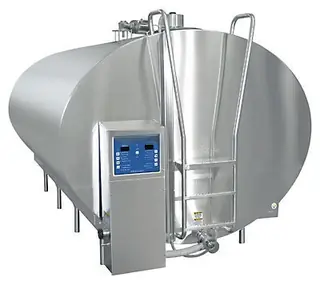
Use a refrigerated farm cooling tank, typically 500–8,000 L, where milk arrives warm straight from milking and must be cooled in the tank itself. Use an insulated milk silo, typically 10–100 tonnes, at a dairy plant or large collection centre where milk is already chilled through a plate cooler and only needs to be held cold and gently agitated.
The handbook lists farm cooling tanks from 300 to 40,000 L, always with an agitator and cooling equipment, and notes that larger farms often fit a plate cooler ahead of the tank so warm milk does not mix with chilled milk. Reception silos at dairies are far larger, from tens of thousands of litres up to several hundred thousand, and are usually installed outdoors with their valves and instruments in an alcove facing the process building.
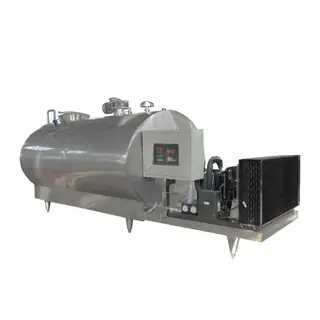
- Horizontal farm tanks such as our small farm milk cooling tank (500–8,000 L) have a low profile for milking parlors with limited headroom and easy manual inspection.
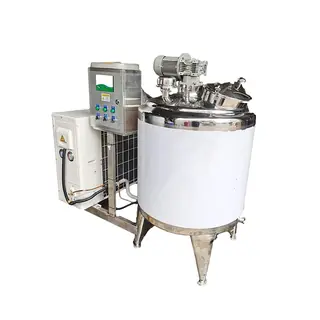
- Vertical cooling tanks such as the vertical milk cooling tank save floor space in collection centres.
- Cooling silos such as the milk cooling silo (10,000–80,000 L) add a cooling jacket for plants that need to hold or trim temperature.
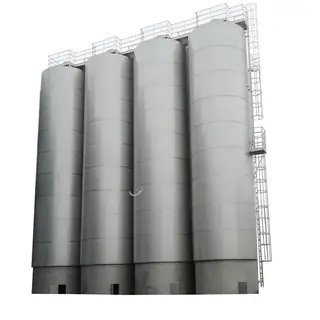
- Outdoor storage silos such as the large outdoor milk silo (20–100 t) or the insulated double-wall outdoor milk silo free indoor space in larger dairies.
How do you size a bulk milk tank or milk silo?
Size a farm tank as litres per milking multiplied by the number of milkings stored between collections, plus headroom for herd growth and peak season. European standard EN 13732 classifies farm bulk milk coolers for two, four or six milkings, that is 24, 48 or 72 hours of storage.
- Measure peak production per milking, not the annual average. Seasonal peaks can be far higher than winter output.
- Set the collection interval. Daily collection means two milkings in the tank; every-other-day collection means four.
- Multiply and add headroom. Example: 900 L per milking at peak, collected every two days: 900 × 4 = 3,600 L. Adding about 25% for growth gives 4,500 L, so a 5,000 L tank is the sensible standard size.
- Check the cooling class. The tank must cool each new milking fast enough to meet the blend and time limits in your market, with the incoming milk temperature and ambient temperature you actually have.
- Size silos from intake and shifts. The handbook says silo number and size depend on daily intake, working days, shifts and the number of products. Plan at least one silo to be empty for cleaning while others fill.
- Size buffer tanks from line flow. The handbook sizes intermediate tanks at up to 1.5 hours of operation, for example about 30,000 L for a 20,000 L/h line.
For a farm-scale example, a 5,000 L tank matches our 5,000 L farm milk cooling tank. For plant-level capacity planning from reception silos to filling, use our line planner, or ask our engineers to size your milk tanks and silos from your intake data.
How important are insulation and agitation in milk tanks?
Very important. FAO guidance says a well-insulated milk tank should keep milk cool for at least 12 hours with no more than a 1 °C rise at 30 °C ambient. Agitation keeps fat from creaming and temperature uniform, but it must be gentle and intermittent, because harsh mixing damages fat globules and invites rancidity.
Insulation keeps refrigeration running time down and protects milk during power cuts. The Tetra Pak handbook specifies at least 70 mm of mineral wool for outdoor silos, with stainless inner and outer shells on insulated tanks. For outdoor stainless steel silos in hot or very cold climates, ask for the insulation material, thickness and a calculated heat gain rather than a generic description.
Agitators in silos are usually side-mounted propeller types. The handbook explains that agitation must be gentle because aggressive mixing can draw in air and damage fat globules, exposing fat to lipase. Silo agitators therefore run in intervals of a few minutes on and a few minutes off, very tall silos may need two agitators at different heights, and the agitator stops at low level to avoid drawing in air. In farm tanks, the agitator also carries heat from the milk to the cooled bottom; a tank without effective agitation leaves warm layers above cold milk.
How do you cool milk where power is unreliable or the climate is hot?
In hot climates and on weak grids, combine water pre-cooling, an ice-bank or chilled-water buffer and well-insulated tanks. FAO notes that most milk refrigeration needs a continuous single- or three-phase supply, that diesel generators are a common backup but make ice banks expensive to run, and that solar PV currently cools only small volumes.
FAO's 2016 guidelines for milk cooling centres describe small to medium centres handling about 500–5,000 litres per day, sited on all-weather roads with reliable, preferably three-phase power, potable water and good drainage. They report that small solar PV systems can cool up to about 200 L of milk, and that solar works best off-grid when paired with thermal storage such as an ice bank rather than batteries. Where milk cannot be cooled within hours, FAO notes that the lactoperoxidase system can delay souring for about 7–8 hours at 30 °C, where national rules permit it.
When we engineer milk cooling for tropical sites, we size condensers for the real ambient temperature, specify the compressor and electrical components for local voltage and 50 or 60 Hz, and add a water pre-cooler wherever well or mains water is significantly colder than the incoming milk.
What should a milk cooling tank specification include?
A complete specification states usable volume, number of milkings, required cooling time and final temperature, cooling method, refrigerant, insulation material and thickness, agitator type and speed, stainless steel grade, cleaning method, instruments and electrical supply. Without these, quotations for stainless steel milk tanks cannot be compared fairly.
- Usable volume and number of milkings (2, 4 or 6)
- Cooling performance: from what inlet temperature to 4 °C, in how many hours, at what ambient temperature
- Cooling method: DX, ice bank, chilled water jacket or plate pre-cooler
- Product-contact material: AISI 304 or 316L stainless steel, internal finish
- Insulation: polyurethane or mineral wool, thickness, outer cladding
- Agitator: type, motor power, interval control
- Instruments: thermometer or digital controller, level or volume measurement, temperature recording
- Cleaning: manual, automatic wash unit or connection to a central CIP; see our CIP system guide
- Outlet valve size and tanker connection
- For silos: indoor or outdoor, alcove layout, manhole, vent, spray device, high and low level switches
Our full range of farm tanks, silos and cleaning equipment is in the tanks, silos and CIP category. Planning a complete plant around the silos? Read our dairy plant planning guide.
What information do you need for a milk tank or silo quotation?
Send daily and peak milk volume, milkings per day, collection interval, incoming milk temperature, target storage temperature, preferred cooling method, indoor or outdoor installation, ambient temperature range, power supply (voltage, phase, 50 or 60 Hz) and how the tank will be cleaned.
- Milk type: cow, buffalo, goat or camel milk
- Volume per milking and peak daily volume
- Collection interval or silo turnover
- Incoming milk temperature and target temperature
- Cooling method preference and available water for pre-cooling
- Installation: farm, collection centre or dairy plant; indoor or outdoor
- Climate: maximum ambient temperature, humidity
- Electrical supply: voltage, phase, 50 or 60 Hz, and generator backup
- Cleaning: manual, automatic wash or CIP connection
Send these details through our quotation request form, and our engineers will recommend a tank or silo size and cooling system that meets your local temperature rules.
Frequently asked questions
What temperature should milk be stored at in a milk tank?
Raw milk should be held at 4 °C (39 °F) or colder. Legal limits are 7 °C (45 °F) under the US Pasteurized Milk Ordinance and 8 °C (daily collection) or 6 °C (non-daily collection) under EU Regulation 853/2004 on the farm, with 6 °C or below at the dairy. Colder storage slows bacterial growth and protects quality.
How quickly must milk be cooled after milking?
Under the US Pasteurized Milk Ordinance, milk must reach 10 °C within four hours of the start of the first milking and 7 °C within two further hours. The EU requires immediate cooling to 8 °C or 6 °C. The Tetra Pak Dairy Processing Handbook recommends reaching 4 °C within about two hours of milking.
Is an ice-bank or direct-expansion milk cooling tank better?
Direct expansion is simpler and, according to FAO, can be up to 50% more energy-efficient, but it needs a larger compressor and stable power during milking. An ice-bank tank uses a smaller compressor that builds ice over many hours, cools milk faster at milking time and suits weak grids or cheap night electricity.
What size bulk milk tank do I need?
Multiply peak litres per milking by the number of milkings stored between collections, then add headroom for herd growth. For example, 900 L per milking with collection every two days means 3,600 L; with about 25% headroom a 5,000 L tank fits. EN 13732 classifies farm tanks for two, four or six milkings.
What is the difference between a milk tank and a milk silo?
A farm milk tank, typically 500–8,000 L, has its own refrigeration and cools warm milk directly after milking. A milk silo, typically 10–100 tonnes, stores milk that has already been chilled through a plate cooler at the dairy. Silos are insulated, often installed outdoors, and use gentle, intermittent side-mounted agitators.
How much insulation does a milk silo need?
The Tetra Pak Dairy Processing Handbook specifies at least 70 mm of mineral wool for outdoor silos, between stainless steel inner and outer shells. FAO guidance for cooling centres says a well-insulated tank should keep milk cold for at least 12 hours with no more than a 1 °C rise at 30 °C ambient.
Sources
- Regulation (EC) No 853/2004, Annex III, Section IX – Raw milk and dairy products
- FDA – NCIMS Model Documents (Grade A Pasteurized Milk Ordinance)
- Georgia Rules 40-2-16-.23 – Raw milk cooling (PMO-based cooling limits)
- FAO (2016) – Technical and investment guidelines for milk cooling centres
- Tetra Pak Dairy Processing Handbook – Collection and reception of milk
- Tetra Pak Dairy Processing Handbook – Tanks
- AHDB – How do the milk cooling options compare in terms of energy efficiency?
- EVS-EN 13732:2022 – Bulk milk coolers on farms: requirements for construction, performance, suitability for use, safety and hygiene