Tanks, silos & CIP · · 10 min read
CIP System Guide: Clean-in-Place Steps, Skids and Chemicals
CIP system guide: dairy clean-in-place steps with temperatures and caustic/acid strengths, skid components, spray ball sizing, CIP vs COP and verification.
By the process engineering team at Shanghai Mars Industrial Co., Ltd.

Key takeaways
- A typical dairy CIP cycle for heated equipment runs a warm pre-rinse, 0.5–2% caustic at about 75 °C for 30 minutes, a rinse, 0.5–1.5% nitric acid at about 70 °C for 20 minutes, and a final rinse.
- TACT (time, action, chemistry, temperature) governs cleaning; in pipes the action factor means a flow velocity of at least 1.5 m/s, and 1.5–3.0 m/s is the usual range.
- Recovery CIP reuses caustic and acid to save chemicals and water, while single-use CIP drains fresh solution after each cycle and suits heavily fouled heaters and UHT plants.
- Static spray balls need about 2.5 US gpm per foot of tank circumference, single-axis rotary heads about 1.9 and multi-axis rotary jet heads about 1.25, per a 3-A newsletter guideline.
- CIP cleans equipment in position; COP (clean-out-of-place) cleans removable parts such as gaskets, plug valves and hoses in a wash tank or cabinet washer.
What is a CIP system and what does it do?
A CIP (clean-in-place) system cleans tanks, pipes, heat exchangers and fillers without dismantling them by circulating or spraying water, caustic and acid solutions in a programmed sequence. A typical dairy CIP cycle runs pre-rinse, hot caustic, intermediate rinse, acid, final rinse and then disinfection, with time, temperature, flow and concentration recorded.
Clean in place became standard in dairies because manual cleaning limited plant size and could not be documented. An Oklahoma State University extension fact sheet records that the first automated CIP system was installed in a family dairy in 1953 and that CIP was common in dairy plants by the mid-1960s. Today the CIP system is as important to food safety as the pasteurizer: it decides how long the line can run, how much water and chemical the plant consumes, and whether every product-contact surface is verifiably clean. This guide explains the CIP process steps, the chemistry, skid design, spray devices, verification and the design rules we apply when we engineer CIP for dairy, juice and beverage plants.
What are the steps of a typical dairy CIP cycle?
The Tetra Pak Dairy Processing Handbook gives two standard programs. Hot surfaces such as pasteurizers get a warm rinse, 0.5–2% caustic at about 75 °C for 30 minutes, a rinse, 0.5–1.5% acid at about 70 °C for 20 minutes, and cooling. Cold surfaces such as tanks and pipes get a shorter caustic step and hot-water disinfection.
| Step | Hot surfaces (pasteurizers, UHT, heaters) | Cold surfaces (tanks, pipes, unheated equipment) |
|---|---|---|
| 1. Pre-rinse | Warm water, about 10 min | Warm water, about 3 min |
| 2. Caustic (alkaline) wash | 0.5–2% NaOH, about 75 °C, about 30 min | 0.5–1.5% NaOH, about 75 °C, about 10 min |
| 3. Intermediate rinse | Warm water, about 5 min | Warm water, about 3 min |
| 4. Acid wash | 0.5–1.5% nitric acid, about 70 °C, about 20 min | Not always required |
| 5. Final rinse | Cold water | Hot-water disinfection, 90–95 °C, about 5 min |
| 6. Cooling | Gradual cooling with cold water, about 8 min | Tap water, about 10 min (usually skipped for tanks) |
The handbook adds that pasteurizers are usually disinfected each morning before production by circulating 90–95 °C hot water for 10–15 minutes once the return temperature has reached at least 85 °C. In practice, the CIP cleaning procedure for a heat exchanger follows this order:
- Displace product with water and recover it where possible.
- Pre-rinse at no more than about 55 °C; the handbook warns that hotter water coagulates protein onto the surface.
- Circulate hot caustic to dissolve fat and protein. Conductivity at the return tells the controller when full-strength solution has arrived.
- Rinse out the caustic.
- Circulate acid to remove mineral scale (milkstone), which builds up fastest on heated surfaces.
- Final rinse with softened water; the handbook suggests 2–4 °dH hardness, acidified to below pH 5 to inhibit overnight bacterial growth.
- Disinfect with hot water or a chemical sanitizer before the next production run.
Plants that run several products per day may add an extra caustic step between products or a short acid-only clean, but the structure stays the same. Our guide to plate vs tubular heat exchangers explains why fouling in heated sections sets the cleaning frequency.
What is TACT, and how do time, action, chemistry and temperature work together?
TACT stands for time, action, chemistry and temperature, the four factors of cleaning often drawn as Sinner's circle after chemist Herbert Sinner. Reducing one factor must be compensated by increasing another. In CIP, "action" is the flow velocity or spray impact, typically at least 1.5 m/s in pipes.
- Time: the handbook notes that heavily encrusted heat exchangers need 20–60 minutes of combined caustic and acid circulation, while a light film in a milk tank may clear in about 10 minutes of caustic.
- Action: pipe velocities of 1.5–3.0 m/s create the turbulence that scours surfaces, so CIP supply pumps are usually larger than product pumps. Oklahoma State University gives the same minimum, about 5 ft/s.
- Chemistry: sodium hydroxide at 0.5–2.0% for organic soil and nitric acid at 0.5–1.5% for mineral deposits. The handbook warns that higher concentrations do not necessarily clean better and can cause foaming.
- Temperature: caustic cleaning should be at least 70 °C and match the temperature the product reached; acid works best at 60–75 °C.
TACT explains most CIP failures. A pump that cannot reach 1.5 m/s in the largest line, a heater that cannot hold 75 °C at the far end of a long circuit, or a dosing pump that drifts out of range will all leave soil behind even when the program timer looks correct.
Should you choose single-use or recovery CIP?
A recovery (reuse) CIP system stores caustic and acid in tanks, tops them up to strength and reuses them until they are too dirty, which saves chemicals, water and heat. A single-use system makes fresh solution for each cycle and drains it afterward, which costs more to run but avoids cross-contamination and suits heavily soiled equipment.
| Criterion | Single-use CIP | Recovery (reuse) CIP |
|---|---|---|
| Solution handling | Fresh solution each cycle, then drain | Returned to storage tanks and reused |
| Chemical and water use | Higher | Lower |
| Best for | UHT plants, heavily fouled heaters, small circuits | Tanks, silos, pipelines with light soil |
| Tanks on the skid | Usually water tank plus small make-up tank | Water, recovered water, caustic and acid tanks |
| Risk of soil carry-over | Minimal | Managed by conductivity, filtration and periodic dumping |
The handbook also distinguishes centralized from decentralized layouts. A central CIP station serves the whole plant, but in large plants long pipe runs dilute detergent with residual water and increase chemical use. Decentralized satellite units sit close to the equipment they clean and circulate small volumes at high flow, cutting water, steam and effluent. Many mid-size dairies combine both: a central recovery station for tanks and pipes, and a small single-use unit for the pasteurizer or UHT plant. When we plan a new site, the CIP layout is decided together with the process layout, as described in our dairy plant planning guide.
What goes into a CIP skid?
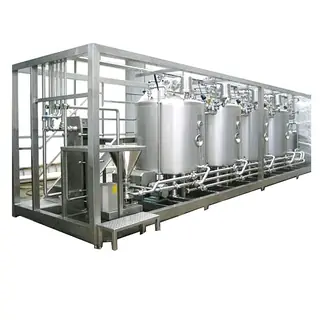
A CIP skid typically includes water, caustic and acid tanks (plus a recovered-water tank for reuse systems), a CIP supply pump, a heat exchanger or steam heater, chemical dosing pumps, conductivity, temperature and flow sensors, automatic valves, a return pump and a PLC that runs and records each cleaning program.
- CIP tanks: insulated stainless tanks for caustic and acid, with level probes and manholes; 316L is preferred where acid and chlorides are present.
- CIP supply pump: a centrifugal pump sized for the highest flow circuit, usually the largest pipe at 1.5 m/s or the largest tank's spray device.
- Heating: a plate or tubular heat exchanger, or direct steam injection, sized to bring the circuit to 75–85 °C quickly.
- Dosing: metering pumps for concentrated caustic and acid, controlled by conductivity.
- Return pump: a self-priming or liquid-ring pump that empties tanks reliably, since gravity return from a spray-cleaned vessel is rarely enough.
- Instrumentation: conductivity at the return line (to switch between recovery and drain), temperature at supply and return, flow meter, and pressure where spray devices are used.
- Controls: a PLC with stored programs per circuit, interlocks that prevent product and CIP mixing, and data logging for audits.
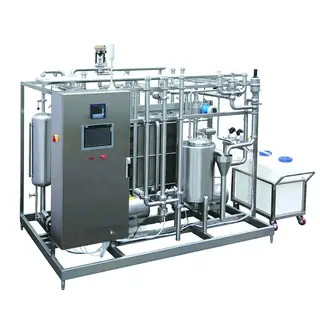
For small plants, the CIP skid is often integrated into the process line itself. Our yogurt production line with full-auto CIP and soy milk processing line with automatic CIP system are examples, and a milk pasteurizer with balance tank can be cleaned through its own circuit. If you are unsure how many circuits your plant needs, our engineers can design a CIP skid around your process layout.
Which spray balls and tank cleaning devices should you use?
Use static spray balls for light, easily removed soil such as fluid milk, whey and beverages; single-axis rotary spray heads where more impact is needed; and multi-axis rotary jet heads for tough soil, large tanks and low water use. Size the flow from the tank circumference and always confirm coverage with a riboflavin test.
A 2022 article in the 3-A Sanitary Standards newsletter gives minimum flow guidelines for vertical tanks, while noting that the device manufacturer's recommendation always takes priority:
| Device | Flow per foot of circumference | Approx. flow per metre of circumference | Example: 3 m diameter tank | Best for |
|---|---|---|---|---|
| Static spray ball | 2.5 US gpm/ft | about 31 L/min per m | about 290 L/min (17.5 m³/h) | Milk, whey, beverages |
| Single-axis rotary spray | 1.9 US gpm/ft | about 24 L/min per m | about 220 L/min (13 m³/h) | Moderate soil |
| Multi-axis rotary jet head | 1.25 US gpm/ft | about 15.5 L/min per m | about 146 L/min (9 m³/h) | Tough soil, tall tanks, yogurt, sauces |
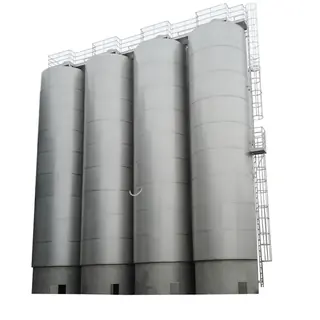
The Oklahoma State fact sheet adds that a typical static spray ball is designed for 20–30 gpm at a 20–30 psi pressure drop and cleans effectively over a diameter of about 8 ft (about 2.4 m), so larger tanks need bigger or multiple devices. The Dairy Processing Handbook describes rotary jet heads whose nozzles rotate in two planes for stronger scouring. Agitators, baffles, dip tubes and manholes create spray shadows, so tanks with internal fittings often need two devices. For milk silos and process tanks such as our large outdoor milk silo and double-layer storage tank with side agitator, the spray device is specified together with the tank geometry. More on silo design is in our milk cooling tank and silo guide.
What is the difference between CIP and COP?
CIP cleans equipment in its process position by circulating or spraying solutions through it. COP (clean-out-of-place) cleans parts that are removed or dismantled, such as gaskets, plug valves, hoses, fittings and access-port components, in a recirculating wash tank or cabinet washer. Most plants need both, because not every component can be cleaned in place.
Writing in Dairy Foods in 2022, sanitation specialist Gabriel Miller noted that CIP allows higher temperatures and chemical concentrations than COP or manual cleaning, and that parts should not nest in a COP tank. He also reported that cabinet-style washers can use roughly one-tenth or less of the water, energy and chemicals of a conventional COP tank. For buyers, the practical rule is simple: design as much as possible for CIP, and budget a COP station for what remains.
How do you verify that CIP cleaning worked?
Verify every cycle by recording time, temperature, flow and conductivity, then confirm cleanliness with visual inspection, ATP swabs and periodic microbiological tests. Validate spray coverage on new or modified tanks with a riboflavin (fluorescent dye) test under UV light, and repeat it whenever devices or internals change.
- Process records: the handbook recommends logging flow rate, temperature, time and conductivity on every run.
- Visual check: wipe with a clean white cloth at accessible points.
- ATP luminescence: results within minutes, indicating organic residues.
- Microbiological swabs and rinse-water samples: slower but definitive.
- Riboflavin test: the 3-A newsletter cautions that it proves coverage, not removal of the actual product soil.
Oklahoma State University adds that each plant must set its own cleanliness acceptance criteria and that analytical methods should detect residues at or below 25% of the target limit.
What design rules make a clean-in-place system work?
Good CIP system design means drainable, self-emptying equipment, no dead legs longer than hygienic rules allow, enough pump capacity for 1.5 m/s in every line, spray devices sized to each tank, separate circuits so product and cleaning solution cannot mix, and a controller that records every cycle.
Use this checklist when you review a CIP design or a supplier's proposal:
- Dead legs: EHEDG guidance limits branch depth to about one pipe diameter and 3-A to about two, measured from the pipe wall, according to a FORCE Technology review.
- Pipelines sloped to drain; tank bottoms sloped toward the outlet (the handbook cites about 6%).
- CIP supply pump sized for the largest pipe at 1.5 m/s or the largest spray device, whichever is higher.
- Return pump able to empty tanks fully so no solution pools around the outlet.
- Mix-proof or double-seat valves, or swing bends, between circuits being cleaned and circuits in production.
- Heat exchangers cleaned at full flow and at least the product's maximum temperature.
- Conductivity and temperature at the CIP return, not only at the supply.
- Water quality: softened water for final rinses in hard-water regions.
- Effluent: neutralization or a buffer tank for spent caustic and acid where local rules require it.
- Tropical sites: allow for higher incoming water temperature and humidity around chemical storage.
Browse our tanks, silos and CIP equipment, or plan line capacity, including cleaning windows, with the line planner.
What information do you need for a CIP system quotation?
Send a list of the equipment to be cleaned, with tank sizes and pipe diameters, the products and their soil type, the number of circuits and how many must run at once, preferred single-use or recovery operation, available steam and water, power supply, and any automation or recording requirements.
- Equipment list: tanks (volume, diameter, internals), pasteurizers, fillers, pipelines (diameter and length)
- Products processed: milk, yogurt, cheese, juice, plant-based drinks, sauces
- Number of CIP circuits and simultaneous circuits
- Single-use, recovery or hybrid CIP
- Heating: steam pressure or hot-water source
- Electrical supply: voltage, phase, 50 or 60 Hz
- Water hardness and effluent restrictions
- Automation level: manual, semi-automatic or PLC with data logging
- Site and climate: indoor or outdoor installation, ambient temperature
Send these details through our quotation request form, and our engineers will propose a CIP skid and circuit layout matched to your plant.
Frequently asked questions
What are the steps of a CIP cleaning process?
A standard CIP process runs a water pre-rinse, a hot caustic wash to remove fat and protein, an intermediate rinse, an acid wash to remove mineral scale, a final rinse and then disinfection with hot water at 90–95 °C or a chemical sanitizer. Cold equipment such as tanks may skip the acid step on some days.
What chemicals are used in a CIP system?
Dairy CIP systems mainly use sodium hydroxide (caustic soda) at about 0.5–2% for fat and protein, and nitric acid at about 0.5–1.5% for mineral deposits. Disinfection follows with hot water at 90–95 °C or chemical agents such as chlorine compounds, iodophors or hydrogen peroxide. Higher concentrations do not necessarily clean better and can cause foaming.
What temperature should CIP caustic be?
The Tetra Pak Dairy Processing Handbook recommends that caustic cleaning be at least 70 °C and at least as hot as the product reached in the equipment, with about 75 °C typical for both pasteurizers and tanks. Acid cleaning works best at 60–75 °C, while the pre-rinse should stay at or below about 55 °C to avoid baking protein on.
What is a CIP skid?
A CIP skid is a pre-assembled cleaning unit on a frame. It typically carries water, caustic and acid tanks, a supply pump, a heater, dosing pumps, conductivity and temperature sensors, automatic valves and a PLC. The skid prepares, heats and pumps cleaning solutions to each circuit, then recovers or drains them and records the results.
What is the difference between CIP and COP?
CIP (clean-in-place) cleans equipment such as tanks, pipelines and heat exchangers without dismantling them, by circulating or spraying solutions. COP (clean-out-of-place) cleans parts that are removed, such as gaskets, plug valves, hoses and fittings, in a recirculating wash tank or cabinet washer. Most food plants use both methods.
How fast should CIP solution flow in pipes?
CIP solution should flow at a minimum of about 1.5 m/s (5 ft/s) in pipelines to create turbulent flow that scours product-contact surfaces. The Tetra Pak Dairy Processing Handbook gives 1.5–3.0 m/s as the usual range, which is why CIP supply pumps are often larger than the product pumps on the same line.
Sources
- Tetra Pak Dairy Processing Handbook – Cleaning of dairy equipment
- Oklahoma State University Extension – What is Clean in Place (CIP)? (FAPC-251)
- 3-A SSI Sanitary Design Connections – Selecting a spray device for CIP cleaning hygienic equipment
- Dairy Foods – Dairy equipment cleaning: CIP vs COP
- FORCE Technology – Dead legs in piping systems: how can they be designed hygienically?
- Tetra Pak Dairy Processing Handbook – Tanks
- Sinner's circle: the four factors of cleaning (temperature, time, chemistry, mechanical action)