Pasteurizers & sterilizers · · 11 min read
Pasteurization Temperature and Time Chart: Milk, Juice, Eggs
Pasteurization temperature and time chart for milk, juice, liquid egg and beer, with HTST, vat, flash and UP rules and how to pasteurize milk at any scale.
By the process engineering team at Shanghai Mars Industrial Co., Ltd.

Key takeaways
- Under the US Pasteurized Milk Ordinance, milk must be heated to at least 63 °C (145 °F) for 30 minutes in a vat or 72 °C (161 °F) for 15 seconds in an HTST system.
- Dairy products with 10% or more fat, added sweeteners or concentrated solids need a pasteurization temperature 3 °C (5 °F) higher than plain milk.
- US juice processors must achieve a 5-log reduction of the most resistant pathogen; for apple juice at pH 4.0 or below, FDA-recommended treatment starts at 71.1 °C (160 °F) for 6 seconds.
- USDA FSIS accepts liquid whole egg pasteurized at 60 °C (140 °F) for 3.5 minutes as a safe harbor, but plants must still validate the process in their HACCP plan.
- Beer pasteurization is measured in pasteurization units, where 1 PU equals one minute at 60 °C; most beers receive about 5–25 PU.
What temperature and time are used for pasteurization?
Milk is pasteurized at 72 °C (161 °F) for 15 seconds in continuous HTST systems or 63 °C (145 °F) for 30 minutes in a vat. Juice must achieve a validated 5-log pathogen reduction, liquid whole egg is held at 60 °C (140 °F) for 3.5 minutes, and beer is dosed in pasteurization units.
The temperature of pasteurisation is always a pair: a temperature and a minimum holding time. Raise the temperature and the required time drops sharply. This chart collects the verified minimums for milk, juice, liquid egg and beer, explains the types of pasteurization (vat, HTST, flash, HHST and ultra-pasteurization) and shows how to pasteurize milk at small and industrial scale. All figures below come from US regulations, USDA guidance, university extension services and brewing associations; local rules in your country may differ, so confirm them with your food authority.
What is the pasteurization process?
Pasteurization is a mild heat treatment that destroys disease-causing microorganisms and reduces spoilage organisms without sterilizing the food. For milk, every particle must be heated in properly designed equipment to a set temperature and held there continuously for the required time.
The process is named after Louis Pasteur, whose work in the 1860s showed that gentle heating could extend the keeping quality of beverages such as beer. The definition of pasteurization of milk in the US Grade "A" Pasteurized Milk Ordinance (PMO) stresses "every particle": a pasteurizer must prove that no portion of the product bypassed the required temperature or left the holding section too early. That is why commercial systems use holding tubes, recording thermometers and automatic flow diversion rather than simply heating a tank.
Pasteurized foods are not shelf-stable. They still need refrigeration (milk, egg, most juices) or rely on other hurdles such as alcohol, hops and low pH (beer). Products that must keep at room temperature need sterilization or UHT treatment with aseptic packaging, which we explain in our guide to UHT vs pasteurized milk.
What is the pasteurization temperature of milk?
The legal minimum pasteurization temperature of milk under the US PMO is 63 °C (145 °F) for 30 minutes (vat) or 72 °C (161 °F) for 15 seconds (HTST). Higher-heat, shorter-time options run up to 100 °C for 0.01 seconds, and ultra-pasteurization requires 138 °C (280 °F) for 2 seconds.
| Method | Temperature | Minimum holding time |
|---|---|---|
| Vat (batch, LTLT) | 63 °C (145 °F) | 30 minutes |
| HTST | 72 °C (161 °F) | 15 seconds |
| HHST | 89 °C (191 °F) | 1.0 second |
| HHST | 90 °C (194 °F) | 0.5 second |
| HHST | 94 °C (201 °F) | 0.1 second |
| HHST | 96 °C (204 °F) | 0.05 second |
| HHST | 100 °C (212 °F) | 0.01 second |
| Ultra-pasteurization (UP) | 138 °C (280 °F) | 2.0 seconds |
| Eggnog, vat | 69 °C (155 °F) | 30 minutes |
| Eggnog, HTST | 80 °C (175 °F) / 83 °C (180 °F) | 25 seconds / 15 seconds |
IDFA notes that the temperature rises by 3 °C (5 °F) when a dairy product has 10% or more fat, contains added sweeteners or is concentrated. Cream, chocolate milk and ice cream mix therefore need higher settings than plain milk. Aseptic (UHT) processing has no fixed time and temperature in the PMO; a qualified process authority validates it for each product and system.
Does goat milk need a different pasteurization temperature?
No. The PMO defines goat milk as the normal secretion of healthy goats and states that the word "milk" includes goat milk, so the same time–temperature table applies. The PMO's definitions also cover milk from sheep, water buffalo and other hooved mammals, including the camel family. Our pasteurized milk line for buffalo, goat and camel milk is built around these standard HTST settings.
What are the types of pasteurization?
The main types of pasteurization are vat (low-temperature, long-time), HTST (high-temperature, short-time), flash pasteurization, HHST (higher-heat, shorter-time) and ultra-pasteurization. Tunnel pasteurization treats filled containers. All aim for the same safety result; they differ in speed, equipment, energy use and flavour impact.
Vat pasteurization (LTLT)
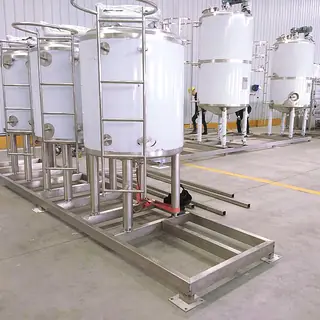
Vat pasteurized means the product was heated in a batch tank, typically 63 °C for 30 minutes, then cooled. Vat pasteurized vs pasteurized is a question of method rather than safety: both meet the legal standard. Vats are common for small creameries, farm cheese and yogurt, where the same tank can also be used for culturing.
HTST pasteurization
High temperature short time pasteurization (HTST pasteurisation) heats product continuously in a plate or tubular heat exchanger, holds it for 15 seconds at 72 °C in a holding tube, and cools it immediately. Regeneration recovers heat from outgoing product. HTST treatment is the standard for fresh market milk; see our milk pasteurizer buying guide for equipment choices.
Flash pasteurization
Flash pasteurization is a general term for heating a liquid in continuous flow for a few seconds before filling. What flash pasteurized means on a juice or beer label is essentially HTST: for beer, the Beer & Brewing dictionary describes heating to about 70–72 °C in a heat exchanger for as little as 30 seconds, then cooling before filling into clean containers. Flash pasteurization for beverages requires hygienic or sterile filling afterwards, because the container is not heated.
HHST and ultra-pasteurization
HHST uses 89–100 °C for one second or less, and ultra-pasteurization uses at least 138 °C for 2 seconds. Both extend refrigerated shelf life. UHT goes further by adding aseptic packaging so the product is shelf-stable.
Tunnel pasteurization
Filled and sealed bottles or cans pass under hot-water sprays, so product and container are pasteurized together. This is the standard for many beers and canned beverages; our tunnel pasteurizer guide covers zones and sizing.
What temperature is used to pasteurize juice?
There is no single juice temperature. Under the US juice HACCP rule (21 CFR 120.24), processors must achieve at least a 5-log (100,000-fold) reduction of the most resistant pathogen likely to occur. For apple juice at pH 4.0 or below, FDA-recommended treatments start at 71.1 °C (160 °F) for 6 seconds.
The rule defines the target as the "pertinent microorganism", the most resistant organism of public health significance likely to occur in that juice. The reduction must hold for the product's shelf life under normal and moderate-abuse storage. Citrus processors may apply part of the treatment to fruit surfaces, but all other juices must be treated directly. Processors subject to 21 CFR 113 or 114 are exempt from the 5-log requirement, as are those using a single thermal step that makes the juice shelf-stable; the latter must include that thermal process in their written hazard analysis.
| Temperature | Minimum time |
|---|---|
| 71.1 °C (160 °F) | 6 seconds |
| 73.9 °C (165 °F) | 2.8 seconds |
| 76.7 °C (170 °F) | 1.3 seconds |
| 79.4 °C (175 °F) | 0.6 seconds |
| 82.2 °C (180 °F) | 0.3 seconds |
These figures apply to apple juice and cider at low pH; higher-pH juices, vegetable juices and juices with pulp may need longer or hotter treatments, and the process must be validated for each product. A continuous unit such as our milk and fruit juice pasteurizer, 500–2,000 L/h covers typical small-to-mid juice lines, and the same unit can be switched to milk.
What temperature pasteurizes liquid egg?
USDA FSIS guidance accepts the former regulatory table as a "safe harbor": liquid whole egg at 60 °C (140 °F) for 3.5 minutes, plain yolk at 61.1 °C (142 °F) for 3.5 minutes, and salted or sugared products at higher temperatures. Since the 2020 rule, plants must also validate the process in their HACCP plan.
| Liquid egg product | Temperature | Minimum holding time |
|---|---|---|
| Whole egg | 60.0 °C (140 °F) | 3.5 minutes |
| Whole egg blends (under 2% non-egg ingredients) | 61.1 °C (142 °F) / 60.0 °C (140 °F) | 3.5 / 6.2 minutes |
| Plain yolk | 61.1 °C (142 °F) / 60.0 °C (140 °F) | 3.5 / 6.2 minutes |
| Sugar whole egg (2–12% sugar) | 61.1 °C (142 °F) / 60.0 °C (140 °F) | 3.5 / 6.2 minutes |
| Salt whole egg (2% or more salt) | 63.3 °C (146 °F) / 62.2 °C (144 °F) | 3.5 / 6.2 minutes |
| Salt yolk or sugar yolk | 63.3 °C (146 °F) / 62.2 °C (144 °F) | 3.5 / 6.2 minutes |
| Albumen (no chemicals) | 56.7 °C (134 °F) / 55.6 °C (132 °F) | 3.5 / 6.2 minutes |
Egg proteins coagulate easily, so the margin between pasteurized and cooked is narrow. FSIS points out that the albumen setting does not by itself deliver a 5-log Salmonella reduction and is accepted only under conditions, and that salted yolk needs a much longer hold to control Listeria. Precise temperature control, gentle plate heating and accurate holding tubes are essential; our mixed liquid egg pasteurization line is designed around these low-temperature, longer-hold settings.
How is beer pasteurized?
Beer pasteurization is measured in pasteurization units (PU): one PU equals one minute at 60 °C. Most beers receive about 5–25 PU, with around 15 PU a common target. Beer is either flash pasteurized at about 70–72 °C before filling or tunnel pasteurized in the container.
The Master Brewers Association of the Americas (MBAA) gives the formula PU = t × 1.393^(T − 60), where t is minutes and T is temperature in °C, based on a z-value of 6.94 °C. For example, 15 minutes at 62 °C delivers about 29 PU, while one minute at 70 °C delivers about 27 PU. Low- and non-alcohol beers need more PU because alcohol no longer helps suppress spoilage organisms. For equipment, a continuous milk, juice and beer pasteurizer handles flash pasteurization, while a beer tunnel pasteurizer treats filled bottles and cans.
How do you pasteurize milk at small and industrial scale?
At small scale, heat milk in a double boiler to 63 °C (145 °F) and hold 30 minutes, or to 72 °C (161 °F) for 15 seconds, stirring constantly, then cool quickly in iced water. Industrially, an HTST system heats, holds, checks and cools milk continuously with automatic diversion of under-heated product.
Can you pasteurize your own milk? Yes. Oregon State University Extension describes how to pasteurize fresh milk at home: use a double boiler and a thermometer placed in the milk, hold at 145 °F for 30 minutes (restarting the timer if it drops below), or at 161 °F for 15 seconds, then cool the pan in ice water while stirring and refrigerate. The same source notes that small electric batch pasteurizers handle roughly 2–12 gallons. Below 145 °F, harmful bacteria are not reliably destroyed.
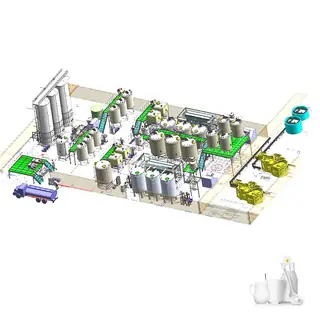
Industrial pasteurization follows the same physics but with controls that prove every particle was treated. A typical HTST sequence is:
- Balance tank: keeps a constant level and receives any diverted milk.
- Regeneration (heating side): cold raw milk is warmed by hot pasteurized milk.
- Separation, standardization and homogenization: usually at intermediate temperature.
- Heating section: hot water raises milk to the set temperature, for example 72–75 °C.
- Holding tube: sized so every particle stays at least 15 seconds at the maximum flow rate. At 2,000 L/h, 15 seconds corresponds to about 8.3 litres of tube volume.
- Flow diversion valve: returns milk to the balance tank if the temperature at the end of the holding tube is too low.
- Regeneration (cooling side) and chilling: pasteurized milk gives up heat to raw milk, then ice water cools it to about 4 °C.
- Filling and cold storage.
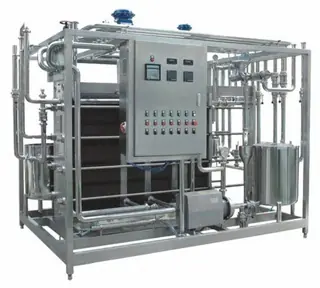
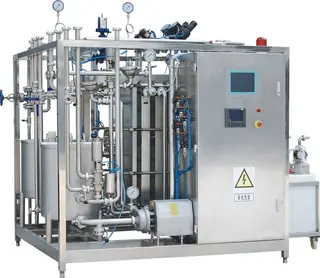
Small dairies starting with a few hundred litres per hour often choose a small plate pasteurizer for milk and juice, while fresh-milk plants usually move to a plate type HTST milk pasteurizer. Browse all pasteurizers and sterilizers to compare capacities, or use our line planner to convert daily volume into hourly flow. If you would like a second opinion, our engineers can size a pasteurizer for your product and recommend the right holding time and temperature.
How do you verify that a pasteurizer meets the required time and temperature?
Verify the holding time at maximum flow, calibrate the indicating and recording thermometers, test the flow diversion valve, confirm pressure protection across regeneration, and keep continuous records. These checks prove every particle reached the legal temperature for the legal time, which inspectors and buyers will ask to see.
- Holding tube length and diameter calculated for the maximum pump flow, not the nominal flow.
- Indicating thermometer calibrated against a traceable reference.
- Recording thermometer or data logger at the end of the holding tube, with charts or electronic records kept.
- Flow diversion valve tested at the cut-in and cut-out temperatures.
- Pasteurized product kept at higher pressure than raw product in the regeneration section.
- Higher set points for products with 10% or more fat, added sugar or concentrated solids.
- Rapid cooling to about 4 °C for milk, with a cold chain afterwards.
- Cleaning in place after each production run, with records.
When we engineer a pasteurization skid, we set the holding tube and controls for the product with the strictest time–temperature requirement in your range, so the same unit can handle milk, cream and juice without re-piping.
What information do you need for a quotation?
Send your products, daily volume and production hours, target pasteurization temperature and time, inlet and outlet temperatures, packaging, utilities, local voltage and frequency, and space available. Our engineers then size the heat exchanger, holding tube, controls and cooling section for you.
- Products to be pasteurized: milk, cream, juice, liquid egg, beer or plant-based drinks.
- Daily volume, production hours and required hourly capacity.
- Required temperature and holding time, or the regulation you must meet.
- Product inlet temperature and required outlet (filling) temperature.
- Particles, pulp or viscosity details.
- Heating source (steam boiler, electric, hot water) and cooling water or chiller availability.
- Power supply: voltage, frequency (50/60 Hz) and phase; ambient temperature for tropical sites.
- Packaging and filler type downstream.
Send the details through our quotation request form, email [email protected] or WhatsApp +86 176 2154 1688.
Frequently asked questions
What is the pasteurization temperature of milk?
The pasteurization temperature of milk is at least 72 °C (161 °F) for 15 seconds in continuous HTST systems, or 63 °C (145 °F) for 30 minutes in a vat, according to the US Pasteurized Milk Ordinance. Products with 10% or more fat, added sugar or concentrated solids need 3 °C (5 °F) more. Ultra-pasteurization uses at least 138 °C for 2 seconds.
How do you pasteurize milk at home or on a small farm?
To pasteurize milk at small scale, heat it in a double boiler with a thermometer in the milk to 63 °C (145 °F) and hold for 30 minutes, or to 72 °C (161 °F) for 15 seconds, stirring constantly. Then cool it quickly in iced water and refrigerate. Commercial sales require approved equipment with recording and diversion controls.
What does vat pasteurized mean?
Vat pasteurized means the milk was heated in a batch tank, usually to 63 °C (145 °F), and held for 30 minutes before cooling. It is also called low-temperature, long-time pasteurization. It is as safe as HTST pasteurization; the difference is method, throughput and sometimes flavour, which some small creameries and cheesemakers prefer.
What does flash pasteurized mean?
Flash pasteurized means a liquid such as juice or beer was heated in continuous flow through a heat exchanger for a few seconds, then cooled immediately and filled. It is essentially high-temperature, short-time (HTST) treatment. Because the container is not heated, flash pasteurized products need hygienic or sterile filling to avoid recontamination.
What temperature is required to pasteurize juice?
US rules do not fix one temperature for juice; they require a validated 5-log reduction of the most resistant pathogen likely to be present. For apple juice and cider at pH 4.0 or below, FDA-recommended options include 71.1 °C (160 °F) for 6 seconds or 76.7 °C (170 °F) for 1.3 seconds. Higher-pH juices may need more.
How many pasteurization units does beer need?
One pasteurization unit (PU) equals one minute at 60 °C. Most beers receive about 5–25 PU, with roughly 15 PU a common industry figure. Beers with low or no alcohol need considerably more, because alcohol no longer helps suppress spoilage organisms. Each brewery should validate its own target against its spoilage risks.
Sources
- IDFA – Pasteurization: definitions and time/temperature table
- Grade "A" Pasteurized Milk Ordinance, Section 1 Definitions (Purdue Extension copy)
- eCFR – 21 CFR 120.24 Process controls (juice HACCP 5-log reduction)
- Clemson Cooperative Extension HGIC 3872 – Raw juice preparation and storage (FDA apple juice pasteurization table)
- USDA FSIS – Food Safety Guideline for Egg Products (2021)
- 9 CFR 590.570 Pasteurization of liquid eggs (2021 edition, GovInfo)
- Oregon State University Extension – Home pasteurization of raw milk
- MBAA Food Safety Bite No. 5 – Pasteurization (2024)
- Craft Beer & Brewing – Pasteurization (Oxford Companion to Beer entry)