Dairy processing lines · · 11 min read
Ultra Pasteurized Milk vs UHT vs Pasteurized: Key Differences
Ultra pasteurized milk vs UHT vs pasteurized milk: verified temperatures, shelf life, taste, direct vs indirect UHT and what a UHT production line includes.
By the process engineering team at Shanghai Mars Industrial Co., Ltd.

Key takeaways
- Pasteurized milk is heated to at least 72 °C for 15 seconds (or 63 °C for 30 minutes) and needs refrigeration, typically lasting 7–10 days at 5–7 °C.
- In the US, ultra-pasteurized milk is heated to at least 138 °C (280 °F) for 2 seconds and keeps for weeks, but it must still be refrigerated.
- UHT milk is heated to about 135–150 °C for 1–10 seconds and filled aseptically into sterile packs, giving months of shelf life at room temperature until opened.
- Indirect UHT heats milk through a steel wall to about 138 °C; direct UHT injects or infuses steam to 140–150 °C and flash-cools under vacuum for a cleaner taste.
- A UHT milk production line needs a sterilizer with holding tube, homogenizer, aseptic buffer tank and aseptic filler, all pre-sterilized at 125 °C or more for 30 minutes.
What is the difference between pasteurized, ultra-pasteurized and UHT milk?
Pasteurized milk is heated to at least 72 °C for 15 seconds and lasts days in the fridge. Ultra-pasteurized milk is heated to at least 138 °C for 2 seconds and lasts weeks refrigerated. UHT milk is heated to roughly 135–150 °C, then filled aseptically into sterile packs, so it keeps for months without refrigeration.
Pasteurized, ultra pasteurized milk and UHT milk all start from the same raw milk. What separates them is the heat load, how the milk is packed and whether a cold chain is needed afterwards. Those differences decide the equipment you buy, the markets you can reach and how much the line costs. This guide explains what ultra pasteurized milk is, how it differs from UHT treated milk, how direct and indirect UHT systems work, and what a UHT milk production line actually contains.
For the full time–temperature rules of every pasteurization method, see our pasteurization temperature and time chart. For choosing between plate, tubular and batch pasteurizers, see the milk pasteurizer buying guide.
What does ultra-pasteurized milk mean?
In the United States, ultra-pasteurized (UP) means milk thermally processed at or above 138 °C (280 °F) for at least 2 seconds, before or after packaging, to give an extended shelf life under refrigeration. UP milk is not necessarily sterile or aseptically packed, so it must still be kept cold.
The definition comes from the US Code of Federal Regulations (21 CFR 131.3) and is repeated in the Grade "A" Pasteurized Milk Ordinance (PMO). The key phrase is "under refrigerated conditions": ultra-pasteurization destroys far more spoilage organisms than standard pasteurization, but the milk is usually filled on clean, hygienic fillers rather than fully aseptic ones, so it is not shelf-stable.
According to US dairy industry consumer guidance, UP milk typically keeps for about 30–90 days refrigerated, compared with roughly 10–21 days for conventionally pasteurized milk. The Tetra Pak Dairy Processing Handbook gives a more conservative 7–10 days at 5–7 °C for ordinary pasteurized milk made from good raw milk. Actual shelf life depends on raw milk quality, filling hygiene and how cold the product stays in distribution.
What does "aseptically pasteurized" or "aseptically processed" mean?
When milk is ultra-high-temperature treated and then filled into pre-sterilized packages in a sterile zone, US regulations call it "aseptically processed and packaged". The PMO states that such products are regulated under 21 CFR Parts 108, 110 and 113, the same rules that cover low-acid canned foods. Some cartons use consumer wording such as "aseptically pasteurized" for the same idea: heat treatment plus sterile packing. State dairy rules based on the PMO, such as Virginia's, require aseptically processed and packaged milk to carry the term "UHT" and the instruction "keep refrigerated after opening".
The International Dairy Foods Association (IDFA) notes that there is no single fixed time and temperature for aseptic processing. Instead, a qualified process authority sets and validates the process for each product and equipment combination.
What is UHT milk and what does UHT stand for?
UHT stands for ultra-high temperature (also expanded as ultra-heat treatment). UHT milk is low-acid milk heated in continuous flow, typically to 135–150 °C for about 1–10 seconds, to reach commercial sterility, then packed aseptically so it can be stored at room temperature until opened.
The Tetra Pak Dairy Processing Handbook describes practical European settings of 137–142 °C for 4–6 seconds and notes that EU rules require at least 135 °C with a suitable holding time. "Commercial sterility" does not mean the absence of every microorganism; it means the product is free of organisms able to grow under normal, non-refrigerated storage. As a general guide, the handbook cites a sterilizing effect (F0) of 5–6 minutes, and notes that some countries require a minimum F0 of 3, equal to about a 12-log reduction of Clostridium botulinum spores.
Shelf life for unopened UHT milk is measured in months. US dairy industry guidance quotes six months or more; the handbook explains that the practical limit is not microbial but physical and enzymatic, such as cream layering, age gelation and flavour change. It gives the example of tuning homogenization differently for three months of local distribution versus nine months for export. Once opened, UHT milk should be refrigerated and used within about 7–10 days.
How do pasteurized, ultra-pasteurized and UHT milk compare?
The main trade-off is heat versus logistics. Pasteurized milk has the mildest heat treatment but needs a strict cold chain and fast sale. Ultra-pasteurized milk stretches refrigerated life to weeks. UHT milk adds aseptic packaging and removes the cold chain entirely, at a higher equipment cost.
| Factor | Pasteurized (HTST) | Ultra-pasteurized (UP) | UHT + aseptic |
|---|---|---|---|
| Minimum heat treatment | 72 °C (161 °F) for 15 s, or 63 °C (145 °F) for 30 min in a vat | 138 °C (280 °F) for at least 2 s | Typically 135–150 °C for about 1–10 s; validated per product |
| Microbial result | Pathogens destroyed; spoilage organisms reduced | Most spoilage organisms destroyed | Commercially sterile |
| Filling | Clean, hygienic filler | Clean or ultra-clean filler | Aseptic filler into pre-sterilized packs |
| Storage | Refrigerated | Refrigerated | Ambient until opened |
| Typical shelf life | About 7–10 days at 5–7 °C (handbook); up to about 21 days (industry guidance) | About 30–90 days refrigerated | Several months, commonly 3–9 months or more |
| US regulatory basis | PMO, 21 CFR 131.3 | PMO, 21 CFR 131.3 | PMO plus 21 CFR 108, 110 and 113 |
| Relative equipment cost | Lowest | Medium | Highest (sterilizer, aseptic tank, aseptic filler) |
A related category is extended shelf life (ESL) milk. The handbook describes ESL routes such as pasteurization plus microfiltration (a 1.4 µm membrane supporting about 2–4 weeks) or a high heat treatment around 130 °C for about one second, and stresses that ESL only works if distribution stays at or below 8 °C.
What is the difference between direct and indirect UHT?
Indirect UHT heats milk through a stainless-steel wall in plate or tubular heat exchangers; direct UHT mixes culinary steam into the milk by injection or infusion, then flash-cools it under vacuum. Direct systems are gentler on flavour; indirect systems recover more heat and cost less to run.
In an indirect plant described in the Dairy Processing Handbook, milk is preheated regeneratively to about 75 °C, homogenized at 180–250 bar, heated with hot water to about 138 °C, held for about 4 seconds and cooled regeneratively. In a direct steam-injection plant, milk is preheated to about 80 °C, steam raises it almost instantly to 140–150 °C, it is held for a few seconds, and a vacuum vessel flash-cools it while removing exactly the water that the steam added. Homogenization then takes place aseptically, downstream of the heater.
| Criterion | Indirect (plate or tubular) | Direct (steam injection or infusion) |
|---|---|---|
| Heating principle | Hot water or steam through a heat-transfer wall | Steam condenses in the product |
| Typical sterilizing step | About 138 °C, about 4 s | About 140–150 °C, a few seconds |
| Cooling | Regenerative and water cooling | Vacuum flash cooling, then tubular cooling |
| Homogenizer position | Usually upstream (non-aseptic) | Downstream (aseptic) |
| Flavour and heat damage | More cooked notes | Lower; used for premium milk, cream, baby food |
| Enzyme effect | Inactivates almost all plasmin | Plasmin and bacterial proteases can remain active |
| Running cost | Most cost-effective; high heat recovery | Higher than indirect |
| Capacity range cited | Tubular plants up to about 40,000 L/h | About 2,000–45,000 L/h |
For most small-to-mid plants in Africa, the Middle East, South and Southeast Asia and Latin America, an indirect tubular or plate UHT system is the usual starting point because of its lower capital and steam cost. Tubular units tolerate longer runs before fouling and handle flavoured milk and plant-based drinks with some viscosity; plate units recover more heat for plain milk.
If you are unsure which system suits your milk volume and target market, our engineers can size a UHT line for you from your daily intake and package plan.
Does UHT milk taste different, and is it less nutritious?
UHT milk can taste slightly cooked because high heat releases sulphur compounds and promotes browning reactions, though modern plants have reduced this. Nutritional losses from UHT are small: the Dairy Processing Handbook reports lysine losses of about 0.4–0.8% and thiamine losses below 3%.
The handbook notes that early UHT milk had a pronounced cooked flavour and sulphur smell, and that quality has improved substantially. It recommends tasting UHT milk at about 20 °C, because refrigeration at 5–7 °C masks the UHT flavour. Direct heating generally gives a cleaner taste than indirect heating because the milk spends less time at high temperature.
By comparison, in-container sterilization (retorting bottles or cans) causes much greater losses, about 6–10% of lysine and 20–50% of thiamine according to the same source, because the product is held at 110–125 °C or higher for minutes rather than seconds. That is why continuous UHT with aseptic packaging largely replaced in-bottle sterilization for long-life milk.
What equipment does a UHT milk production line contain?
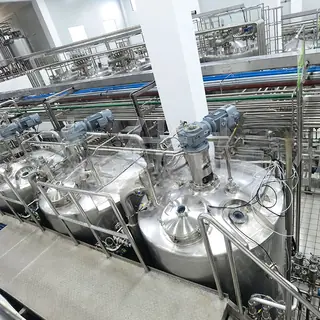
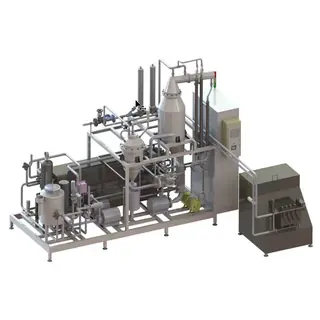
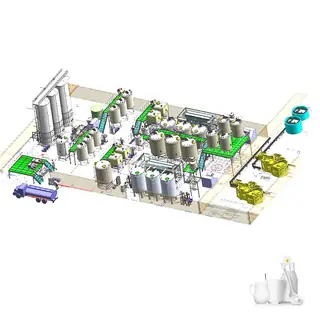
A UHT milk production line contains milk reception and cooling, standardization, a balance tank, preheating and homogenization, the UHT sterilizer with holding tube, cooling, an aseptic buffer tank, an aseptic filler and a CIP station. The sterilizer and filler must be sterilized before production and matched in capacity.
The typical UHT processing sequence for milk is:
- Reception and cooling: raw milk is tested, filtered and chilled to about 4 °C in tanks or silos.
- Separation and standardization: a separator adjusts fat to the target level.
- Balance tank and feed pump: provide a steady flow into the sterilizer.
- Preheating and regeneration: incoming milk is warmed by outgoing hot product.
- Homogenization: upstream in indirect plants, aseptic downstream in direct plants.
- Final heating and holding: the milk reaches sterilizing temperature and passes through a holding tube sized for the required seconds.
- Cooling: regenerative or flash cooling, then water cooling to filling temperature.
- Aseptic tank: a sterile buffer that balances sterilizer and filler output and lets the sterilizer be cleaned without stopping the filler.
- Aseptic filling: cartons, bottles or pouches are sterilized, filled and sealed in a sterile zone.
- CIP and pre-sterilization: before production, the handbook calls for at least 125 °C hot water throughout the aseptic section, held for at least 30 minutes.
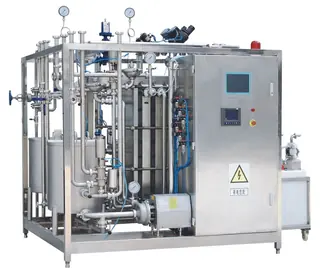
Our UHT long-life milk production line covers this full sequence, while the UHT milk pilot production line suits product development, universities and start-ups testing recipes. Plants that want both chilled and long-life products can use a complete UHT, pasteurized and yogurt milk line. For juice and milk on one skid, a plate UHT pasteurizer for milk and juice is a compact option. Packaging choices, sterilization of cartons and PET, and sterilizer–filler matching are covered in our aseptic processing and filling guide. You can browse all dairy processing lines for other configurations.
Should a new dairy produce pasteurized, ultra-pasteurized or UHT milk?
Choose pasteurized milk if you sell locally with a reliable cold chain, ultra-pasteurized milk if you need weeks of chilled life for wider distribution, and UHT milk if your market lacks refrigeration, spans long distances or targets export. Many plants start with pasteurized milk and add UHT later.
Questions that usually decide the answer:
- Cold chain: in hot climates where retail refrigeration is patchy, UHT milk avoids spoilage and returns.
- Distribution radius: fresh milk suits a city-scale market; UHT reaches rural areas and neighbouring countries.
- Volume: a UHT sterilizer and aseptic filler have a minimum economic throughput, so small volumes often begin with HTST fresh milk and yogurt. A 2,000 L/h fresh milk pasteurization line or a plate type HTST milk pasteurizer is a common first step.
- Packaging supply: aseptic cartons and laminated materials are a recurring cost and must be reliably available in your country.
- Utilities: UHT needs more steam, chilled water and compressed air than HTST; check boiler capacity, water quality, and your local voltage and frequency (50 or 60 Hz) before motors and controls are specified.
To convert daily milk volume into hourly sterilizer capacity, use our line planner, which also helps estimate tank and filler sizes.
What should you check before buying UHT processing equipment?
Check the sterilizing temperature and holding time range, heat-exchanger type, homogenizer position, regeneration rate, aseptic tank size, filler compatibility, pre-sterilization and CIP sequences, and the recording and diversion controls. These points decide product safety, shelf life and real output.
- Sterilization range (for example 135–150 °C) and holding tube sized for your flow and seconds.
- Indirect (plate or tubular) or direct heating, and why it suits your products.
- Homogenizer pressure and position (upstream or aseptic downstream).
- Continuous temperature recording, automatic flow diversion and pressure differential protection in regeneration.
- Pre-sterilization program for the sterilizer, aseptic tank and filler.
- Run length between intermediate cleanings and full CIP time.
- Aseptic tank volume relative to filler speed.
- Product-contact steel grade (AISI 304 or 316L) and gasket materials.
- Electrical supply, voltage and frequency (50 or 60 Hz) and control system language.
- Installation, commissioning, operator training and spare parts.
When we engineer a UHT line, we start from the product, the package and the hours you can run, and then size the sterilizer, aseptic tank and filler as one system, because a mismatch between them is the most common reason a UHT plant underperforms.
What information do you need for a quotation?
Send your daily milk volume, products (plain, flavoured, cream or plant-based), target shelf life, package type and size, available utilities, local voltage and frequency, and site dimensions. With these data our engineers can propose a process flow, equipment list and budget quotation.
- Daily raw milk volume and planned production hours.
- Products: pasteurized, ultra-pasteurized, UHT, flavoured milk, cream or plant-based drinks.
- Milk source: cow, goat, buffalo or camel, and typical fat content.
- Target shelf life and storage conditions in your market.
- Packaging: carton, PET or HDPE bottle, pouch; volumes per pack.
- Utilities: steam or boiler fuel, chilled water, compressed air, water quality.
- Power supply: voltage, frequency (50/60 Hz) and phase.
- Building size or site plan, and any existing equipment to integrate.
Send this information through our quotation request form, by email to [email protected] or by WhatsApp on +86 176 2154 1688.
Frequently asked questions
What does ultra pasteurized milk mean?
Ultra pasteurized milk has been heated to at least 138 °C (280 °F) for at least 2 seconds, as defined in US regulation 21 CFR 131.3. The treatment kills most spoilage bacteria and extends refrigerated shelf life to several weeks, but because the milk is not necessarily packed aseptically, it must still be kept in the fridge.
Is ultra-pasteurized milk the same as UHT milk?
Not exactly. Both use temperatures around 138 °C or higher, but UHT milk is also filled aseptically into pre-sterilized, hermetically sealed packages, so it is shelf-stable at room temperature until opened. Ultra-pasteurized milk is usually filled on clean but non-aseptic fillers and must be refrigerated throughout its shelf life.
What does UHT stand for in milk?
UHT stands for ultra-high temperature, sometimes expanded as ultra-heat treatment. It describes continuous-flow heating of milk to roughly 135–150 °C for a few seconds to reach commercial sterility. Combined with aseptic packaging, UHT treated milk can be stored for months without refrigeration, then refrigerated and used within about a week after opening.
How long does UHT milk last compared with pasteurized milk?
Unopened UHT milk typically lasts several months at room temperature; US dairy industry guidance cites six months or more, and export products are often designed for nine months. Pasteurized milk lasts about 7–10 days at 5–7 °C according to the Tetra Pak Dairy Processing Handbook, while ultra-pasteurized milk keeps roughly 30–90 days refrigerated.
Which is better for a new dairy, direct or indirect UHT?
Indirect UHT, using plate or tubular heat exchangers, is usually the better first investment because it costs less to buy and run and recovers more heat. Direct steam injection or infusion gives a cleaner flavour and suits premium milk, cream and infant products, but needs culinary-quality steam, a vacuum flash vessel and an aseptic homogenizer.
What is aseptically processed milk?
Aseptically processed milk is milk that has been heat-treated to commercial sterility and then filled into pre-sterilized containers in a sterile environment and hermetically sealed. In the US it is regulated under 21 CFR Parts 108, 110 and 113 in addition to the PMO, and the process must be validated by a qualified process authority.
Sources
- eCFR – 21 CFR 131.3 Definitions (pasteurized and ultra-pasteurized)
- IDFA – Pasteurization: definitions and time/temperature table
- Grade "A" Pasteurized Milk Ordinance, Section 1 Definitions (Purdue Extension copy)
- Tetra Pak Dairy Processing Handbook – Long-life dairy products
- Tetra Pak Dairy Processing Handbook – Pasteurized and ESL dairy products
- U.S. Dairy – UHT milk: what is ultra-high temperature milk?
- Virginia Administrative Code 2VAC5-490-40 – Labeling of Grade A milk products
- USDA AMS – Commercial Item Description for UHT milk (2021)