Dairy processing lines · · 10 min read
Dairy Processing Equipment List: Every Machine in a Milk Plant
Dairy processing equipment list for a milk plant: what each machine does, key temperatures and pressures, and what yogurt, cheese, butter and UHT lines add.
By the process engineering team at Shanghai Mars Industrial Co., Ltd.

Key takeaways
- A milk processing plant needs reception and chilling equipment, raw milk silos, a separator with standardization, a homogenizer, a pasteurizer or UHT plant, buffer tanks, fillers, a CIP system and utilities.
- The Tetra Pak Dairy Processing Handbook gives 72–75 °C for 15–20 seconds for homogenized market milk, 90–95 °C for about 5 minutes for yogurt milk and 137–142 °C for 4–6 seconds for UHT milk.
- Homogenizers typically run at 10–25 MPa and 55–80 °C, reducing average fat globules from about 3.5 µm to below 1 µm.
- Yogurt adds fermentation tanks, cheese adds vats and presses, butter adds cream ripening tanks and a churn, and UHT adds an aseptic tank and aseptic filler to the core line.
- In an NDDB model project for a 300,000 L/day dairy, service equipment such as refrigeration, boilers, compressed air and power cost almost as much as the processing equipment.
What equipment does a milk processing plant need?
A milk processing plant needs reception and chilling equipment, raw milk silos, a separator with standardization, a homogenizer, a pasteurizer or UHT plant, process and buffer tanks, product modules for yogurt, cheese or butter, filling machines, a CIP system, and utilities: steam, refrigeration, compressed air, water treatment and effluent treatment.
This dairy processing equipment list follows the milk from the tanker to the cold store and explains what each machine does, which operating figures matter, and which machines each product actually needs. Process parameters are taken from the Tetra Pak Dairy Processing Handbook, the NIFTEM liquid milk manual published under India's PMFME scheme, and a model project report for a 300,000-litre-per-day dairy published by NDDB. If you are planning the plant rather than shopping for machines, start with our dairy plant planning guide, which covers sizing, utilities and layout.
What are the stages of milk processing?
The standard milk processing steps are reception and testing, chilling, raw storage, separation and standardization, homogenization, heat treatment (pasteurization or UHT), cooling, buffer storage, filling and cold storage, with cleaning-in-place between runs. Yogurt, cheese and butter branch off after standardization or pasteurization.
- Farm cooling and collection: the Dairy Processing Handbook says milk should be chilled to 4 °C or below within two hours of milking and kept cold until it reaches the dairy.
- Reception and testing: milk is de-aerated, filtered and metered or weighed, and sampled for fat, protein, bacteria, somatic cells, freezing point and antibiotic residues.
- Chilling and raw storage: a plate cooler brings milk below 4 °C on its way to insulated silos.
- Separation and standardization: a centrifugal separator splits cream from skim milk, and an in-line system recombines them to a set fat content.
- Homogenization: fat globules are broken up so cream does not rise in the package.
- Heat treatment: HTST pasteurization for fresh milk, intense heating for yogurt milk, or UHT for long-life milk.
- Cooling and buffering: milk is cooled to about 4 °C and held in buffer tanks that feed the fillers.
- Filling, packing and cold storage: pouches, bottles, cartons or cups, then the cold room.
- Cleaning-in-place: tanks, pipes and heat exchangers are cleaned automatically after production.
What does each machine in a dairy plant do?
Each machine handles one transformation: reception equipment measures and de-aerates, coolers and silos preserve raw milk, separators split fat, homogenizers stabilize it, pasteurizers and UHT plants make milk safe, fillers package it, and CIP stations clean everything. The table lists the core dairy machinery with its key operating figures.
| Equipment | What it does | Key figures |
|---|---|---|
| Air eliminator, filter, flowmeter or weighing tank | Measures received milk and removes air and debris | Pump runs only while the air eliminator holds its set level |
| Plate milk cooler | Chills milk on reception | Outlet below 4 °C |
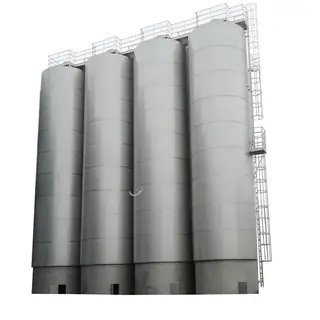
| Raw milk silo | Stores chilled milk with gentle intermittent agitation | Large dairies use roughly 50,000–500,000 L silos |
| Centrifugal separator | Separates cream and skim milk; can clarify | Warm separation at 62–64 °C for cream production |
| Standardization unit | Sets fat content in-line using density and flow transmitters | Common targets 3.0% and 1.5% fat |
| Homogenizer | Reduces fat globule size to stop creaming | 10–25 MPa at 55–80 °C; globules from about 3.5 µm to below 1 µm |
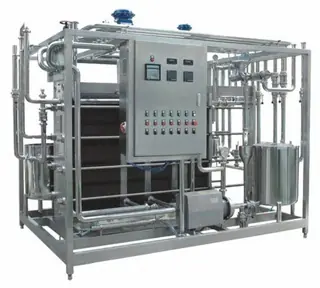
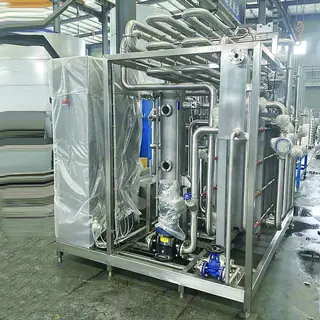
| HTST plate pasteurizer | Heats, holds and cools milk with heat regeneration | 72–75 °C for 15–20 s for homogenized market milk |
| UHT plant | Sterilizes milk for ambient storage | 137–142 °C for 4–6 s in practice |
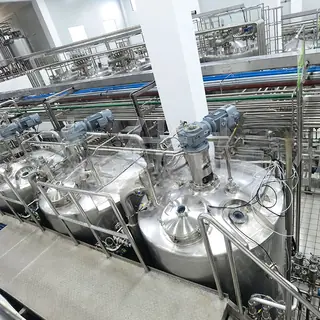
| Process and buffer tanks | Hold milk between steps and feed fillers | Sized to filler speed and run time |
| Filling machines | Pack milk into pouches, bottles, cartons or cups | Pouch fillers in the NDDB model plant: 5,500 pouches per hour each |
| CIP station | Cleans product circuits with rinse, caustic and acid | A full CIP cycle on a UHT plant takes 70–90 min |
Reception, chilling and storage
The handbook describes two ways to measure incoming milk: by volume, pumping it through an air eliminator, strainer and flowmeter, or by weight, using a weighbridge or a weighing tank on load cells. The NIFTEM manual adds that milk arriving at the plant should not be warmer than 6 °C. After testing, milk passes a plate cooler and goes to storage. Small plants and collection centers use milk cooling tanks of a few thousand liters; larger plants use insulated milk cooling silos. The handbook notes that silo agitation should run intermittently and gently to avoid air intrusion and fat damage.
Separator and homogenizer
The milk separator (cream separator) spins milk into cream and skim. In a fresh-milk line, preheated milk is separated warm and then standardized by remixing cream into skim to the target fat. The homogenizer is a high-pressure piston pump with a homogenizing device. The handbook shows that homogenizing only the cream stream, called partial homogenization, can cut homogenizer power use by about 70% for pasteurized milk, while full-stream homogenization is the norm for UHT milk and cultured products. Our cream separator guide covers separator selection and sizing in detail.
Pasteurizer and UHT plant
A plate HTST milk pasteurizer includes a balance tank, regeneration, heating and cooling sections, a holding tube, a flow diversion valve that returns under-heated milk, and a booster pump that keeps pasteurized milk at higher pressure than raw milk. A UHT long-life milk line adds direct or indirect heating to UHT temperature, an aseptic homogenizer or an upstream one, an aseptic buffer tank and an aseptic filler. The handbook notes that milk with pH below 6.65 or alcohol stability below 75% is unsuitable for UHT, so the reception lab matters as much as the sterilizer.
Product modules
Yogurt needs a high-heat treatment section, fermentation or incubation tanks and cup or bottle fillers; cheese needs vats, curd handling, presses and brining; butter needs cream pasteurization, ripening tanks and a churn or continuous buttermaker. The next section compares them product by product.
Fillers and dairy pumps
The NIFTEM manual lists the usual milk filling machines: single- and double-head vertical form-fill-seal pouch machines, rotary or linear bottle fillers, and aseptic packers for UHT milk. Between machines, sanitary centrifugal pumps move liquid milk, while positive-displacement pumps handle viscous products such as stirred yogurt and curd, which must not be over-sheared.
Which dairy equipment do you need for each product?
Fresh milk needs the core line plus pouch or bottle fillers; yogurt adds high-heat treatment and fermentation tanks; cheese adds vats, presses and whey handling; butter adds cream ripening and churning; UHT milk replaces the pasteurizer with a UHT plant and aseptic filling. Most plants share reception, separation, CIP and utilities.
| Product | Heat treatment | Product-specific equipment | Key parameter |
|---|---|---|---|
| Fresh pasteurized milk | 72–75 °C, 15–20 s | HTST pasteurizer, buffer tank, pouch or bottle filler, cold room | 7–10 days shelf life at 5–7 °C from good raw milk |
| Yogurt | 90–95 °C, about 5 min | Holding cell, homogenizer at 200–250 bar, fermentation tanks, plate cooler, cup filler | Ferment at 42–43 °C to pH 4.2–4.5 |
| Cheese | 72–73 °C, 15–20 s (or thermization) | Cheese vat with cutting and stirring frames, curd drainage, moulds, press, brine system | Renneting typically at 31–33 °C, coagulation about 30 min |
| Butter | Cream at 85 °C, 15 s or higher | Cream ripening tanks, batch churn or continuous buttermaker, packer | At least 80% milk fat; ripening usually 12–15 h |
| UHT milk | 137–142 °C, 4–6 s | Direct or indirect UHT plant, aseptic tank, aseptic filler | Commercially sterile, ambient storage |
For yogurt, an automatic yogurt processing line combines the heat treatment, fermentation tanks and cooling. For cheese, a jacketed cheese vat is the heart of a small plant. For butter, the handbook notes that batch churns are filled to only 40–50% of their volume, so a butter churner must be sized well above the cream batch; continuous buttermaking machines handle roughly 200–10,000 kg/h of sweet cream.
How does the dairy processing equipment list change with plant size?
Small dairies use batch or compact plate pasteurizers, cooling tanks, manual or semi-automatic fillers and a simple CIP unit. Large dairies run multiple continuous pasteurizers, silos, high-speed fillers, continuous buttermakers and fully automated CIP and process control. The process steps are the same; capacity, automation and redundancy change.
The NDDB model report for a 300,000-litre-per-day cooperative dairy gives a concrete example of the large end. Its equipment list includes two 10,000 L/h milk pasteurizers plus a 5,000 L/h pasteurizer for curd milk, three pouch fillers of 5,500 pouches per hour, an 800 kg/h continuous butter machine, a 3,000 L/h clarifier for ghee, two 3 t/h boilers, a 500 kVA standby generator and a PLC/DCS automation system with operator screens. Small and mid-sized plants scale down the same blocks: a mini turnkey dairy processing plant combines reception, pasteurization, product tanks and filling on a compact footprint.
The NIFTEM manual also reminds small processors that the equipment list does not stop at process machines: a laboratory with a milk analyzer, Gerber butyrometers, a centrifuge and a water bath, a two-station CIP circuit, and an effluent treatment plant are part of a compliant milk processing plant. To turn your daily milk volume into machine capacities, use our line planner, or ask our engineers to draft a sized equipment list from your figures through our quotation form.
Which cleaning and utility equipment is often forgotten?
Buyers often underbudget the CIP station, piping and valves, refrigeration, steam boiler, air compressor, water treatment, standby generator and effluent treatment. In the NDDB model dairy, service equipment cost about 87% as much as all processing and production equipment, and CIP plus milk and CIP piping cost more than the liquid-milk fillers.
- CIP system: caustic, acid and water tanks, heater, supply and return pumps, and automatic valves. The NIFTEM manual gives a silo cleaning routine of 1–1.5% caustic at 70–75 °C, 0.6–1.0% acid at 60–65 °C and hot water at 80–85 °C, about 20 minutes each.
- Refrigeration: ice-water or chilled-water plant for reception cooling, pasteurizer cooling sections and cold rooms.
- Steam or hot water: for pasteurizers, yogurt heat treatment, cheese vats and CIP heating.
- Compressed air: oil-free and dry, for pneumatic valves and fillers.
- Power: transformer, motor control centers and standby generator matched to local voltage and 50 or 60 Hz frequency.
- Water and effluent: softening for boilers and an effluent treatment plant sized for CIP and washdown water.
Our CIP system guide explains cleaning programs, and you can browse all dairy processing lines to see how these blocks combine in complete plants.
How do you compare dairy equipment suppliers?
Compare dairy equipment suppliers on whether they quote a complete, balanced line, not just machines: matched capacities, hygienic design, CIP coverage, automation scope, utility requirements, installation and commissioning, training and spare parts. A cheaper pasteurizer that bottlenecks the filler costs more over the life of the plant.
- Are all machines sized to the same effective hourly flow, with buffer tanks between them?
- Is product-contact steel specified (AISI 304 or 316L), and are welds and seals hygienic and CIP-cleanable?
- Does the quotation include piping, valves, instrumentation and the CIP system, or only the main machines?
- Are motors, panels and chillers built for your voltage, frequency and ambient temperature, including tropical climates?
- Who handles installation, commissioning, operator training and the first year of spare parts?
- Can the layout accept a later yogurt, cheese or UHT module without major rework?
What information do you need for a quotation?
To quote a dairy processing line accurately, a supplier needs your daily milk intake and shifts, product mix and fat targets, package types and sizes, available utilities, local voltage and frequency, building dimensions or site plan, and the level of automation you want. Missing data leads to quotes that cannot be compared.
- Capacity: liters of milk per day now and in five years, and production hours per day.
- Products: fresh milk, yogurt, cheese type, butter, ghee, UHT milk or flavored milk, with daily volumes for each.
- Milk type: cow, buffalo, goat or camel, and typical fat and protein content.
- Packaging: pouch, bottle, cup, carton or bulk, with pack sizes and target speeds.
- Utilities: steam source and fuel, cooling water, water quality, and whether boiler and chiller are in scope.
- Power: voltage, phase and frequency (50 or 60 Hz).
- Site: building size, ceiling height, ambient temperature range and any existing equipment to reuse.
- Automation: manual, semi-automatic or PLC-controlled line, and CIP automation level.
Send these details through our request-a-quote form and our engineers will return a process flow diagram and an itemized equipment list for your dairy.
Frequently asked questions
What equipment is used in milk processing?
Milk processing equipment includes reception units with air eliminators and flowmeters, plate coolers, raw milk silos, centrifugal separators, standardization units, homogenizers, HTST pasteurizers or UHT plants, buffer tanks, filling machines and a CIP system. Utilities such as refrigeration, steam boilers, compressed air and effluent treatment complete a working dairy plant.
What are the steps of milk processing?
The main steps are reception and testing, chilling to below 4 °C, raw milk storage, separation and standardization, homogenization, pasteurization or UHT treatment, cooling, buffer storage, filling and cold storage. Equipment is cleaned in place after production. Yogurt, cheese and butter branch off after standardization or heat treatment.
What is the minimum equipment for a small dairy plant?
A small dairy can start with a milk cooling tank, a batch or compact plate pasteurizer, a cream separator, a small homogenizer if milk is sold homogenized, product tanks, a pouch or bottle filler, a simple CIP unit, a boiler, an ice-water chiller and a basic milk testing laboratory. Effluent treatment is also needed in most jurisdictions.
What does a milk separator do in a dairy plant?
A milk separator, or cream separator, uses centrifugal force to split whole milk into cream and skim milk. In a fresh-milk line, milk is typically separated warm, at 62–64 °C for cream production according to the Tetra Pak handbook, and then standardized by remixing cream into skim to a set fat content.
Which milk filling machine should a dairy use?
It depends on package and market. Vertical form-fill-seal pouch machines suit low-cost fresh milk; rotary or linear fillers suit bottles; cup fillers suit yogurt; and aseptic carton or bottle fillers are required for UHT milk. Size the filler to the pasteurizer output and plan buffer tanks between them.
Why is the dairy processing equipment list longer than the main machines?
Process machines depend on CIP stations, piping and valves, refrigeration, boilers, compressed air, power distribution, water treatment and effluent treatment. In the NDDB model 300,000 L/day dairy, service equipment cost almost as much as processing equipment, so quotations that leave these out understate the real investment.
Sources
- Tetra Pak Dairy Processing Handbook – Collection and reception of milk
- Tetra Pak Dairy Processing Handbook – Pasteurized and ESL dairy products
- Tetra Pak Dairy Processing Handbook – Homogenizers
- Tetra Pak Dairy Processing Handbook – Long-life dairy products
- Tetra Pak Dairy Processing Handbook – Fermented milk products
- Tetra Pak Dairy Processing Handbook – Cheese
- Tetra Pak Dairy Processing Handbook – Butter and dairy spreads
- NIFTEM (PMFME scheme) – Liquid milk processing manual
- NDDB – Model DPR for end borrowers under the Dairy Processing and Infrastructure Development Fund (2018)