Plant-based milk lines · · 9 min read
Plant-Based Milk Production: How Almond and Oat Milk Are Made
Plant-based milk production explained: almond blanching and grinding, oat enzymatic hydrolysis, homogenization, UHT, equipment choices and water footprint.
By the process engineering team at Shanghai Mars Industrial Co., Ltd.

Key takeaways
- Commercial almond milk is made by soaking, blanching and wet-milling almonds with water (for example at a 1:9 mass ratio), separating the pulp, then formulating, homogenizing and UHT-treating.
- Oat milk production uses amylase enzymes to break down oat starch; one 2024 Massey University study found optimum alpha-amylase hydrolysis at 76 °C on an 8% oat slurry.
- Almond, oat and soy lines differ mainly in their front ends, while homogenization, UHT at 135–150 °C, aseptic filling and CIP can be shared.
- Our World in Data figures based on Poore and Nemecek (2018) give about 371 L of freshwater per litre of almond milk, versus 48 L for oat, 28 L for soy and 628 L for dairy milk.
- A commercial nut milk machine suits cafés and pilot production; retail and export volumes need a continuous plant-based milk production line with decanter, homogenizer and UHT.
How are almond and oat milk made commercially?
Commercial almond milk is made by soaking and blanching almonds, wet-grinding them with water, separating the solids, then formulating, homogenizing and heat-treating the drink. Oat milk replaces blanching with enzymatic hydrolysis, which breaks oat starch into sugars before a decanter removes the fibre. Both finish with homogenization, UHT or pasteurization, and filling.
Plant-based milk production has grown from niche to mainstream, and many dairy and beverage companies now want to bring vegan milk production in-house with their own almond or oat line. This guide explains the front-end steps that make each drink different, the shared back end, when a commercial nut milk machine is enough and when you need a complete plant-based milk production line. Soy has its own guide: see our soy milk production line guide for process detail and yields.
What is considered plant-based milk?
Plant-based milks are drinks made from nuts, seeds, cereals, coconut or legumes and sold as alternatives to cow's milk. The US FDA lists nuts, seeds, rice, coconut, oats and legumes such as soy as sources and accepts names such as "almond milk" as established by common usage, while EU law reserves "milk" for animal products.
Technically, most vegan milks are water extracts or suspensions of plant material, stabilized as an emulsion. Their nutrition depends on the plant, the solids content and the fortification added. For producers, the labelling rules matter as much as the recipe:
- United States: the FDA's 2023 draft guidance on plant-based milk alternatives recommends a voluntary nutrient statement comparing the product with cow's milk when "milk" appears in the name.
- European Union: in case C-422/16 (2017), the EU Court of Justice ruled that purely plant-based products cannot in principle be marketed as "milk", so EU labels typically say "almond drink" or "oat drink".
- Other markets: check local standards before printing packaging, especially when exporting.
What is the process of almond milk production?
The process of almond milk production runs from almond intake and soaking through blanching and peeling, wet milling with water, separation of the almond pulp, formulation, homogenization, heat treatment and filling. A 2023 study in the journal Foods describes milling almonds with water at a 1:9 mass ratio before filtration.
Where does almond milk come from? It is simply almonds and water, with optional sugar, salt, stabilizers, calcium and vitamins. Faraloni and co-authors (Foods, 2023) summarize the conventional industrial route as follows:
- Intake and optional roasting: roasting at about 95–100 °C for 30 minutes is sometimes used to improve flavour and emulsion stability.
- Soaking: almonds are hydrated in water; the paper cites 6 hours at 4 °C.
- Blanching and peeling: hot water at about 90 °C for 3 minutes, or steam at about 85 °C, loosens the skins, which carry bitterness and colour.
- Wet milling: almonds are ground with water, for example at a 1:9 almond-to-water ratio, using colloid mills or high-shear grinders.
- Separation: filters, screens or a decanter remove the insoluble almond pulp.
- Formulation: the base is standardized and blended with sweeteners, salt, hydrocolloids, emulsifiers and fortificants.
- Homogenization and heat treatment: high-pressure homogenization stabilizes the fat, and UHT treatment at about 140 °C for a few seconds gives long shelf life.
- Filling: aseptic cartons or bottles for UHT product, or chilled bottles for pasteurized product.
How much almond goes into almond milk?
Almond content varies widely by brand and price point, and it drives cost more than any other ingredient. Faraloni and colleagues cite around 8% almond material for a high-end commercial product. Lower almond levels reduce cost but need more stabilizer to keep body and mouthfeel, so the ratio is a commercial decision you should fix before sizing the grinder and separator.
How is oat milk made with enzymes?
Oat milk is made by mixing oat flour or flakes with warm water, adding amylase enzymes to break starch into shorter sugars so the drink does not gel, inactivating the enzymes by heat, then removing the insoluble fibre with a decanter before formulation, homogenization and UHT. Enzyme choice decides sweetness and viscosity.
Without hydrolysis, oat starch thickens into porridge when heated. Enzymes reduce viscosity and create natural sweetness. A 2024 Massey University study using food-grade alpha-amylase found optimum hydrolysis at 76 °C for 20–30 minutes on an 8% oat slurry, followed by enzyme inactivation at 100 °C for 10 minutes, homogenization at 180 bar and pilot UHT at 135 °C for 6 seconds. Industrial recipes differ, but the sequence is similar.
According to Anuga FoodTec's 2022 overview of oat drink production, manufacturers follow three main routes:
- Bought-in oat base: a liquid base is only blended with oil, stabilizers and flavours in process tanks; lowest capital cost.
- Oat flour route: flour is dispersed in water with a vacuum mixer, enzymes are added, and a decanter separates solids before blending.
- On-site milling: oats are milled in the plant and hydrolysed in mash vessels similar to brewing technology, giving the most control over flavour.
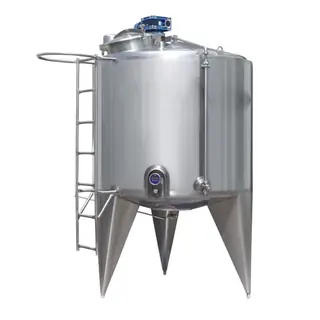
Hydrolysis vessels need accurate temperature control, gentle agitation and enough holding time; a jacketed double-layer tank with side agitator is the usual starting point. Decanting is the yield step, because liquid left in the oat fibre carries dissolved sugars and protein.
How do almond, oat and soy lines differ?
The lines differ mainly at the front end: almond needs soaking, blanching and fine grinding; oat needs milling and enzymatic hydrolysis; soy needs soaking, hot grinding, okara separation and cooking to inactivate anti-nutrients. Homogenization, heat treatment, filling and CIP are largely shared.
| Step | Almond | Oat | Soy |
|---|---|---|---|
| Raw material preparation | Soaking, blanching, peeling | Dry milling or flour dispersion | Cleaning, dehulling, soaking |
| Key transformation | Fine wet milling | Enzymatic hydrolysis of starch | Hot grinding and cooking |
| Separation | Filter, screen or decanter | Decanter centrifuge | Decanter, screw press or screen (okara) |
| By-product | Almond pulp | Oat fibre | Okara |
| Main quality risk | Sedimentation, cost of almonds | Viscosity, gelling, sweetness control | Beany flavour, trypsin inhibitors |
| Back end | Shared: formulation, homogenization, heat treatment, filling, CIP | Shared | Shared |
Because the back end is common, many producers plan one plant with interchangeable front ends. A turnkey industrial soy milk production plant can be specified with an almond or oat module, and a coconut milk processing line shares much of the same downstream equipment.
How are plant-based milks homogenized, heat-treated and filled?
Plant-based milks are homogenized at high pressure to reduce fat and particle size and prevent creaming and sedimentation, then pasteurized for chilled sale or UHT-treated at 135–150 °C for a few seconds and filled aseptically for months of ambient shelf life.
Homogenization matters more for plant drinks than for cow's milk because they contain insoluble particles as well as oil droplets. Some lines homogenize twice: once before heat treatment and once aseptically afterwards, or use a two-stage valve. The Tetra Pak Dairy Processing Handbook describes UHT treatment of low-acid products at 135–150 °C for a few seconds, and stresses that commercial sterility only holds if the product is filled into pre-sterilized packaging under aseptic conditions.
- Pasteurized, chilled: lower investment, short shelf life, suits local cafés and retailers.
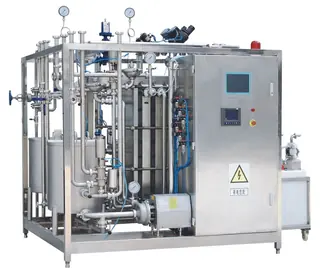
- UHT, ambient: a plate UHT pasteurizer or tubular system plus aseptic filler; enables national distribution and export. See our aseptic processing and filling guide.
- Fouling and CIP: protein and starch foul heated surfaces, so plan CIP between runs and after recipe changes.
Commercial nut milk machine or plant-based milk production line?
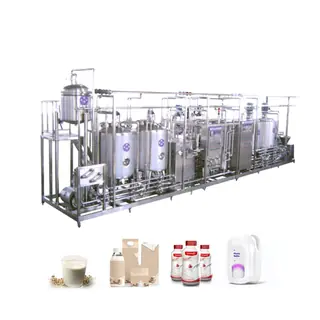
A commercial almond milk machine or nut milk machine grinds, separates and sometimes heats in one compact unit, and suits cafés, juice bars and small brands selling chilled product. A plant-based milk production line adds enzymatic tanks, decanters, homogenizers, UHT and aseptic filling for continuous, ambient-stable output.
| Factor | Commercial nut milk machine | Plant-based milk production line |
|---|---|---|
| Operation | Batch, manual loading | Continuous, PLC-controlled |
| Typical output | Chilled, short shelf-life drinks | Pasteurized or UHT drinks, often aseptic |
| Raw materials | Almond, cashew, soy; oat only with separate hydrolysis | Almond, oat, soy, coconut with dedicated front ends |
| Separation | Built-in filter or screen | Decanter centrifuge, multi-stage screens |
| Homogenization | Often none or small homogenizer | High-pressure homogenizers, sometimes aseptic |
| Cleaning | Manual | Automated CIP |
| Best for | Cafés, pilot runs, recipe development | Brands supplying retail chains and export |
An electric bean and nut milk machine of the type sold for food service is a good way to test recipes and local demand. Once orders justify continuous production, the step to a line is large, so plan building space, steam and cooling early. Our guide to choosing a commercial soy milk machine covers the same decision for soy, including capacity tiers. For a compact all-in-one option, see our automatic soy milk processing machine.
If you are unsure which route fits your volumes, our engineers can size this for you; send us your product idea and target output.
How much water does it take to make almond milk?
Life-cycle data compiled by Our World in Data from Poore and Nemecek (2018) put freshwater use at about 371 litres per litre of almond milk, against about 48 L for oat milk, 28 L for soy milk and 628 L for dairy milk. Most of the almond figure comes from irrigated orchards, not from the factory.
| Milk | Freshwater use (L per L) |
|---|---|
| Dairy milk | About 628 |
| Almond milk | About 371 |
| Rice milk | About 270 |
| Oat milk | About 48 |
| Soy milk | About 28 |
Our World in Data also reports that cow's milk causes around three times the greenhouse gas emissions and uses around ten times the land of plant-based alternatives. For almond milk sustainability claims, the main lever is therefore almond sourcing. Inside the plant, water use is dominated by the product water itself, soaking, blanching and CIP; recovering final rinse water for the next pre-rinse and reusing cooling water reduce it further.
How do you size an almond or oat milk line?
Size the line from the finished litres you plan to sell per day, divided by effective hours after cleaning, then work back to raw material using your recipe. For example, 1,000 L/h of a drink containing about 8% almonds needs roughly 80 kg of almonds per hour before process losses.
- Set daily output and the split between chilled and ambient products.
- Fix the recipe: almond or oat content, added oil, sugar and stabilizers.
- Calculate effective hours after CIP and product changeovers.
- Size the bottleneck, usually the decanter, homogenizer or UHT unit, with 10–20% margin.
- Plan by-product handling for almond pulp or oat fibre, which can be sold for feed or bakery use.
Our line planner converts these inputs into a first equipment list, and the full range is under plant-based milk lines.
What information do you need for a quotation?
To quote an almond or oat milk line, we need the drinks you plan to make, recipes or target solids, hourly or daily output, chilled or ambient shelf life, packaging format, available utilities and voltage, and your site details. With this, our engineers prepare a process flow, equipment list and layout.
- Products: almond, oat, soy, coconut or blends; plain, sweetened or flavoured.
- Recipe targets: nut or oat content, protein, fat, sugar, stabilizers.
- Capacity in L/h or L/day and planned operating hours.
- Heat treatment and shelf life: pasteurized chilled or UHT ambient.
- Packaging: aseptic cartons, PET or glass bottles, pouches, pack sizes.
- Utilities: steam or electric heating, water quality, voltage and frequency (50/60 Hz).
- Site: building size, climate and existing dairy or juice equipment.
When we engineer a plant-based milk line, we design the back end once and add front-end modules for each base, so a soy plant can add oat or almond later. Request a quotation to start.
Frequently asked questions
How is almond milk made commercially?
Almonds are soaked, blanched to remove the skins and wet-ground with water, often around a 1:9 almond-to-water ratio. The insoluble pulp is separated by screens or a decanter, and the base is blended with sweeteners, stabilizers and fortificants. It is then homogenized, UHT-treated at about 140 °C for a few seconds and filled aseptically or pasteurized for chilled sale.
Why do oat milk producers use enzymes?
Oat starch gelatinizes when heated, making the drink thick like porridge. Amylase enzymes break the starch into shorter sugars, which lowers viscosity and adds natural sweetness without added sugar. The enzymes are then inactivated by heat, and a decanter removes the insoluble oat fibre before homogenization and heat treatment.
What is the difference between a commercial almond milk machine and a production line?
A commercial almond milk machine is a compact batch unit that grinds and filters nuts, suited to cafés, juice bars and small brands selling chilled drinks. A production line runs continuously with soaking and blanching equipment, decanters, high-pressure homogenizers, UHT and aseptic filling, and automated CIP, making ambient-stable products for retail and export.
Can one plant-based milk production line make almond, oat and soy drinks?
Yes, if it is designed for it. The back end, including formulation tanks, homogenizer, pasteurizer or UHT unit, filler and CIP, can be shared. Each base needs its own front end: blanching and fine grinding for almonds, milling and enzymatic hydrolysis tanks for oats, and soaking, hot grinding and cooking for soy.
How much water does it take to make almond milk?
Based on Poore and Nemecek (2018), as compiled by Our World in Data, about 371 litres of freshwater are used per litre of almond milk, mostly for orchard irrigation. That is less than dairy milk at about 628 litres, but far more than oat milk at about 48 litres or soy milk at about 28 litres.
What is considered plant based milk?
Plant-based milk is a drink made from nuts, seeds, cereals, coconut or legumes and sold as an alternative to cow's milk. The US FDA lists nuts, seeds, rice, coconuts, oats and legumes, including soy, as typical sources. In the EU, such products cannot in principle be sold as milk, so they are usually labelled as drinks.
Sources
- Faraloni et al. (2023) New Route to the Production of Almond Beverages Using Hydrodynamic Cavitation, Foods 12(5):935
- Zhou (2024) Optimising the extraction of plant milk from oats, Massey University research report
- Anuga FoodTec – Drinks made from oats (Quarterly News, December 2022)
- US FDA – Plant-Based Milk and Animal Food Alternatives
- Court of Justice of the EU – Press release 63/17, Case C-422/16 TofuTown
- Our World in Data – Environmental footprints of dairy and plant-based milks (data from Poore and Nemecek 2018)
- Our World in Data – Dairy vs. plant-based milk: what are the environmental impacts?
- Tetra Pak Dairy Processing Handbook – Long-life dairy products