Plant-based milk lines · · 9 min read
Soy Milk vs Soya Milk: Choosing a Commercial Soy Milk Machine
Soy milk and soya milk are the same drink. Learn what soy milk is made of, how it is produced, and how to choose a commercial soy milk machine or full line.
By the process engineering team at Shanghai Mars Industrial Co., Ltd.

Key takeaways
- Soy milk and soya milk are the same product made from soybeans and water; 'soy' is the American form and 'soya' is chiefly British.
- Under the EU Court of Justice ruling in case C-422/16 (2017), plant-based products cannot in principle be sold as 'milk' in the EU, so soy milk is usually labelled 'soya drink'.
- Plain soy milk typically contains about 3–3.5 g protein, 2–2.25 g fat and no cholesterol per 100 g, according to India's NIFTEM processing guide.
- With 8–10 kg of soy milk per kg of dry beans, a 1,000 L/h line running 20 hours needs roughly 2–2.5 t of soybeans a day.
- Soy milk production leaves about 1.1–2 kg of wet okara per kg of dry beans at 70–80% moisture, which spoils within 24–48 hours at ambient temperature.
Are soy milk and soya milk the same?
Yes. Soy milk and soya milk are the same product: a drink made from soybeans and water. "Soy" is the usual American English form and "soya" is chiefly British, as Merriam-Webster notes. In the EU, plant drinks cannot in principle be sold as "milk", so labels often read "soya drink".
The naming question matters for labels, export markets and search, but the product is identical: soybeans are soaked, ground with water, separated from their fibre and heated. This guide answers the common questions about soy milk and soya milk, including how to make soy milk from soybeans, then turns to the business decision behind them: whether a commercial soy milk machine is enough, or whether you need a complete production line. For step-by-step process detail and yields, see our soy milk production line guide.
How should soy milk be named on labels in different markets?
In the United States, the FDA accepts "soy milk" as a name established by common usage. In the European Union, the Court of Justice ruled in 2017 that purely plant-based products cannot in principle use "milk", and soya is not on the exception list, so EU products are usually sold as "soya drink".
- United States: the FDA's 2023 draft guidance on plant-based milk alternatives recommends an optional nutrient comparison with cow's milk when "milk" is in the name.
- European Union: case C-422/16 reserves "milk" and dairy terms such as butter, cheese and yoghurt for animal products, with listed exceptions that do not cover soya or tofu.
- Other markets: names such as soybean milk, soyabean milk, soy drink and soy beverage are used; check your national standard before printing packaging.
What is soy milk made of?
Soy milk is made from soybeans and water, often with added sugar, salt, flavourings, stabilizers, calcium and vitamins. Plain soy milk typically contains about 3–3.5 g of protein, 2–2.25 g of fat and 2.75–3 g of carbohydrate per 100 g, with no cholesterol, according to India's NIFTEM processing guide.
| Component | Amount per 100 g |
|---|---|
| Water | 90–91 g |
| Protein | 3–3.5 g |
| Fat | 2–2.25 g |
| Carbohydrates | 2.75–3.0 g |
| Calcium (unfortified) | 15–17 mg |
| Cholesterol | 0 mg |
Is soy milk made from soybeans? Yes, always: whole soybean milk uses the whole bean, while conventional soybean milk separates the insoluble fibre, called okara. Commercial soy milk drinks are then standardized for protein or solids, and many are fortified with calcium to approach the level in cow's milk.
Where does soy milk come from?
Soy milk comes from China, where it began as a traditional food linked to tofu making. A 2019 review in Today's Dietitian, drawing on the Shurtleff and Aoyagi history, cites a Chinese record from 1365 and notes the word "soymilk" first appeared in English in 1704. Commercial production in the United States began in 1917.
The same review says soy milk was probably in regular use as a beverage in China by the 1600s, that bottled soymilk was widely available there by 1929, and that the arrival of aseptic cartons in the 1960s removed the need for refrigeration. Today, fresh soy milk is still sold daily in many Asian cities, while UHT soy drinks in cartons dominate supermarket shelves elsewhere.
How do you make soy milk from soybeans?
To make soy milk from soybeans, clean and soak the beans, grind them with hot water, separate the liquid from the okara, then cook the raw soy milk thoroughly, formulate, homogenize and pasteurize or UHT-treat it before filling. Cooking is essential, because raw soy milk contains trypsin inhibitors and has a beany flavour.
- Clean and soak: remove stones and damaged beans, then soak; Today's Dietitian describes modern soaking for about 12 hours before dehulling.
- Grind hot: NIFTEM notes that blanching beans in 70 °C water for 5 minutes before grinding cut n-hexanal, a main off-flavour compound, to about 1% of untreated levels.
- Separate okara: a screen, screw press or decanter removes the insoluble fibre.
- Cook: heat the raw soy milk to inactivate anti-nutritional factors and improve flavour.
- Formulate and homogenize: add sugar, salt, flavours and calcium, then homogenize for a smooth texture.
- Heat-treat and fill: pasteurize for fresh soy milk, or UHT-treat and fill aseptically for ambient shelf life; this is where soymilk processing at scale differs most from home methods.
Shelf life follows the heat treatment. In a 2017 study in the CIGR Journal, a small Nigerian-designed plant pasteurized soy milk at 84 °C for 30 seconds, extending shelf life from 1 day to 2 days at room temperature and to 6 days refrigerated. Long-life soy drinks need UHT and aseptic filling. Making soya bean milk at home follows the same logic, but commercial soybean milk production adds controlled cooking, deodorization and hygienic filling. Our production line guide covers yields, trypsin inhibitor inactivation and beany flavour control in depth.
Should you buy a commercial soy milk machine or a complete production line?
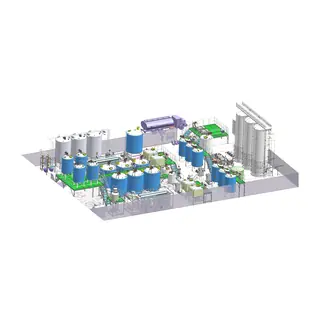
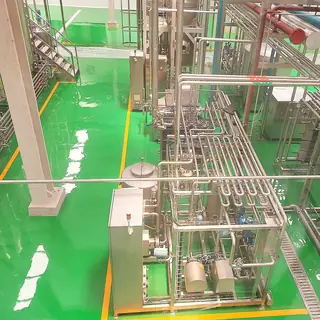
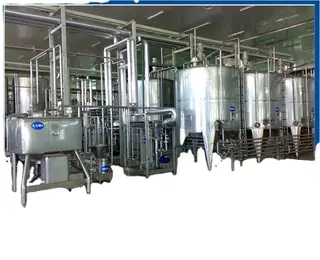
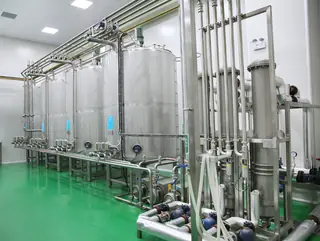
A commercial soy milk machine combines grinding, separation and cooking in one compact unit and suits shops, school-feeding schemes and small brands selling fresh soy milk locally. A complete soy milk production line adds automated soaking, decanting, deodorization, homogenization, UHT, aseptic filling and CIP for continuous, long-life output.
The choice depends on daily volume, shelf life and sales channel. The capacity classes below are the illustrative ranges our engineers use when scoping projects; bean intake is calculated from a yield of about 8–10 kg of soy milk per kg of dry soybeans, based on the Northern Crops Institute method summarized in our production guide and on Tetra Pak's figure of about 10 kg of beverage per kg of beans.
| Class | Soy milk output | Operating day | Soy milk per day | Dry beans per day | Typical equipment |
|---|---|---|---|---|---|
| Commercial soy milk machine | 50–200 L/h | 8 h | 400–1,600 L | About 40–200 kg | Grinder-separator, cooking kettle, pasteurizer, simple filler |
| Compact production line | 300–1,000 L/h | 16 h | 4,800–16,000 L | About 0.5–2 t | Soaking tanks, mills, decanter, cooking, homogenizer, plate pasteurizer |
| Complete industrial line | 1,000 L/h and above | 20 h | 20,000 L and above | About 2 t and above | Automated soaking, hot grinding, deodorizer, UHT, aseptic filling, CIP |
At the small end, an automatic soy milk processing machine or a small-scale sweet soy milk processing line is the usual starting point. Mid-size producers often choose a compact soy milk pasteurization plant for chilled products or a small UHT soy milk processing plant for ambient products. Industrial projects move to a 1500 L/H flavored soy milk plant or a soy milk processing and packaging line rated at 20,000 bottles per hour. Use our line planner to convert your target output into bean intake and equipment.
What drives the cost of a soy milk machine or line?
Cost is driven by capacity, degree of automation, the grinding and okara separation method, whether the product is pasteurized or UHT, the packaging format, CIP, and the utilities needed. Packaging and UHT with aseptic filling usually add more cost than the grinding section itself.
- Capacity and automation: manual batch machines cost far less than PLC-controlled continuous lines but need more labour per litre.
- Separation: screens and screw presses are cheap; decanter centrifuges cost more but recover more solids and produce drier okara.
- Heat treatment: plate pasteurizers are modest; UHT with aseptic filling is the largest single investment.
- Packaging: pouches and cups are inexpensive; PET bottles and aseptic cartons need more expensive fillers.
- Utilities: steam boiler, chilled water, water treatment and power at the local voltage and frequency (50 or 60 Hz).
- Hygiene: soy protein fouls hot surfaces quickly, so an automatic CIP system is worth budgeting; see our CIP system guide.
For an indicative public reference at the very small end, a model project report from India's NIFTEM for a small soy milk unit (about 100 kg per day in the report's assumptions) lists machinery at about INR 14.9 lakh excluding GST and transport, a total project cost of about INR 18.77 lakh, a 15 kW connected load and seven staff. These figures are indicative, India-specific and not a quotation.
Not sure which class fits your plan? Our engineers can size this for you from your target market and daily volume; share your project details.
What should you plan for tofu and okara by-products?
Every kilogram of dry soybeans leaves roughly 1.1–2 kg of wet okara at about 70–80% moisture, which spoils within one to two days at ambient temperature. Plan collection, sale as feed or food ingredient, or drying from day one, and consider a tofu line to add a second product.
A 2021 AURI report for the Minnesota Soybean Research and Promotion Council found tofu producers generate about 1.1 kg of fresh, wet okara per kg of soybeans, with about 80% moisture from centrifuge separation and noticeable spoilage within 24–48 hours at ambient temperature. Tetra Pak gives a higher figure of about 2 kg of okara per kg of dry beans in conventional soy beverage production. Either way, a 2 t/day bean intake creates several tonnes of perishable okara daily.
- Sell as feed: dairy, pig and poultry farms nearby are the simplest outlet.
- Food uses: AURI found okara usable at about 5% or less of flour in bread; it is also used in snacks and meat analogues.
- Dry it: drying gives a stable fibre-protein ingredient but needs significant heat.
- Make tofu: soy milk coagulated with salts or acids becomes tofu, a higher-value product that uses the same front end.
Which soy milk option fits your business?
Match the option to your sales channel: a commercial soy milk machine for fresh local sales, a compact pasteurization line for chilled regional distribution, and a complete UHT line with aseptic filling for national retail and export. Upgrade in steps if demand is uncertain, keeping building space for the next stage.
| Your situation | Recommended option | Why |
|---|---|---|
| Shop, café or school-feeding programme, daily fresh sales | Commercial soy milk machine | Low investment, simple operation, product sold within days |
| Small brand supplying local shops with chilled bottles | Small-scale line with plate pasteurizer and bottle filler | Consistent quality, moderate cost, short cold chain |
| Regional brand, several hundred to a few thousand litres per hour | Compact production line with homogenizer, optional UHT | Better yield with decanter, stable texture, wider reach |
| National retail or export, ambient shelf life required | Complete line with UHT, aseptic filling and CIP | Removes cold chain, meets retailer and export expectations |
| Also planning tofu, almond or oat drinks | Line with modular front end | Shared back end lowers the cost of adding products |
If you plan to add other bases later, our guide to almond and oat milk production explains which modules change. The full range is listed under plant-based milk lines.
What information do you need for a quotation?
To quote a soy milk machine or line, we need your target output, product type (fresh, pasteurized or UHT; plain or flavoured), packaging, plans for okara and tofu, available utilities and voltage, and site details. With this, our engineers prepare a process flow, equipment list and layout.
- Target output in L/h or L/day, and operating hours.
- Products: plain, sweetened, flavoured soy milk, tofu, other plant drinks.
- Shelf life and heat treatment: fresh, pasteurized chilled or UHT ambient.
- Packaging: pouches, cups, PET or glass bottles, aseptic cartons, and pack sizes.
- Okara handling: sale as feed, drying or other use.
- Utilities: steam or electric heating, water quality, voltage and frequency (50/60 Hz).
- Site: building size, climate, and existing equipment.
When we engineer a soy milk line, we size each module from the bean intake and target protein, and leave space to grow from machine to line. Request a quotation to get started.
Frequently asked questions
Is soy milk the same as soya milk?
Yes. Soy milk and soya milk are identical products made from soybeans and water. The difference is only regional spelling: 'soy' is standard in American English and 'soya' is chiefly British. In the European Union, these drinks are usually labelled 'soya drink' because a 2017 court ruling restricts the word 'milk' to animal products.
What is soy milk made of?
Soy milk is made of soybeans and water. Commercial products often add sugar, salt, flavourings, stabilizers, calcium and vitamins. Plain soy milk typically contains about 3–3.5 g of protein, 2–2.25 g of fat and 2.75–3 g of carbohydrates per 100 g, with no cholesterol, making its protein level comparable to cow's milk.
How is commercial soy milk made?
Commercial soy milk is made by cleaning and soaking soybeans, grinding them with hot water, separating the okara fibre with a decanter or press, cooking the raw soy milk to inactivate anti-nutritional factors, deodorizing, formulating and homogenizing. It is then pasteurized for chilled sale or UHT-treated and filled aseptically for ambient shelf life.
What capacity soy milk machine do I need?
Divide your planned daily sales by operating hours. A commercial soy milk machine of 50–200 L/h running 8 hours gives 400–1,600 L per day, suitable for shops and small brands. Above a few thousand litres per day, or when you need long shelf life, a compact or complete production line with homogenizer and UHT is usually more economical.
What can be done with okara from soy milk production?
Okara, the wet fibre left after separation, can be sold to nearby livestock farms as feed, used in bakery products, snacks and meat analogues, or dried into a stable ingredient. Because it is about 70–80% water and spoils within one to two days at ambient temperature, plan daily collection or drying before production starts.
Can a soy milk machine also make tofu?
Yes. Tofu is made by coagulating cooked soy milk with salts or acids and pressing the curd. The soaking, grinding, separation and cooking stages are shared, so adding a coagulation tank, moulds and a press turns a soy milk machine or line into a soy milk and tofu operation.
Sources
- Merriam-Webster – soy (variant: chiefly British soya)
- Court of Justice of the EU – Press release 63/17, Case C-422/16 TofuTown
- US FDA – Plant-Based Milk and Animal Food Alternatives
- NIFTEM – Processing of Soya Milk (PMFME)
- Palmer, S. (2019) Soymilk's Reign, Today's Dietitian 21(4)
- Gana, I.M. (2017) Design, fabrication and testing of soya milk production and pasteurization mini plant, CIGR Journal 19(4)
- AURI / Minnesota Soybean Research and Promotion Council – Soy Milk and Tofu Okara: Baking Industry Demonstration (2021)
- Tetra Pak – Everything you need to know about okara
- NIFTEM – Model Detailed Project Report: Soya Milk Unit (PMFME)