Specialty food plants · · 12 min read
Pet Food Production Line: How Wet and Dry Dog Food Is Made
Pet food production line explained: wet canned and dry kibble steps, retort F0 and 21 CFR 113 rules, extruders, capacity sizing and a start-up checklist.
By the process engineering team at Shanghai Mars Industrial Co., Ltd.

Key takeaways
- Wet pet food is ground, mixed or emulsified, filled into cans, trays or pouches, sealed and retort-sterilized; dry kibble is ground, mixed, preconditioned, extruded, dried, coated and cooled.
- FDA requires canned pet foods to be processed under the low-acid canned food regulations in 21 CFR Part 113; the EU requires canned petfood to reach a minimum Fc value of 3.
- Thermal lethality is measured as F0 at 121.1 °C with a z-value of 10 °C, and an F0 of about 3 minutes is the classic minimum botulinum cook.
- Extruded kibble leaves the extruder at roughly 25–30% moisture and is dried to below about 10–12% to prevent mold growth.
- A pet food can claim to be complete and balanced in the US by meeting an AAFCO nutrient profile or passing an AAFCO feeding trial; FEDIAF guidelines are the European reference.
How is dog food made on an industrial pet food production line?
Industrial dog food is made in two main ways. Wet food is ground, mixed or emulsified, filled into cans, trays or pouches, sealed and retort-sterilized to commercial sterility. Dry kibble is ground, mixed, preconditioned with steam, cooked in an extruder, dried, coated with fat and palatants, cooled and bagged.
Pet food manufacturing borrows heavily from human food processing: meat grinding and emulsifying from the sausage industry, canning and retorting from low-acid canned foods, and extrusion from breakfast cereals and snacks. What differs is the recipe logic (complete and balanced nutrition for a species and life stage) and the regulatory framework. This guide walks through both wet and dry pet food production lines step by step, explains the food-safety controls that matter, and sets out what you need to decide before you buy pet food processing equipment or start a dog food business.
What is the difference between wet and dry pet food production?
Wet pet food is made shelf-stable by sealing it in a hermetic container and heat-sterilizing it in a retort, so the key equipment is grinding, mixing, filling, seaming and sterilizing. Dry pet food is made shelf-stable by cooking in an extruder and drying to low moisture, so the key equipment is the extruder and dryer.
| Criterion | Wet pet food line | Dry pet food line |
|---|---|---|
| Main raw materials | Fresh or frozen meat, offal and bone, plus cereals, gravy ingredients, vitamins and minerals | Dry meals and grains, plus some fresh meat in many recipes, fats and palatants |
| Core cooking step | Retort sterilization in the sealed container (chunks may be pre-cooked in a steam oven) | Steam preconditioning and extrusion cooking |
| Shelf-stability mechanism | Commercial sterility in a hermetically sealed can, tray or pouch | Low moisture and low water activity after drying |
| Key regulation (US) | Low-acid canned food rules, 21 CFR Part 113 | FSMA preventive controls for animal food, 21 CFR Part 507 |
| Key regulation (EU) | Canned petfood heat-treated to a minimum Fc value of 3 | Processed petfood heated to at least 90 °C throughout |
| Typical packaging | Metal cans, plastic or aluminum trays, retort pouches | Multi-layer bags and sacks |
| Main capital items | Bone and meat grinders, emulsifier, mixers, filler, seamer or sealer, retort | Grinder, mixer, preconditioner, extruder, dryer, coater, cooler, bagging machine |
Both lines require the same groundwork: a nutritionally complete recipe, controlled raw-material handling, a documented food safety plan and a cleaning regime.
How is wet (canned) dog food made, step by step?
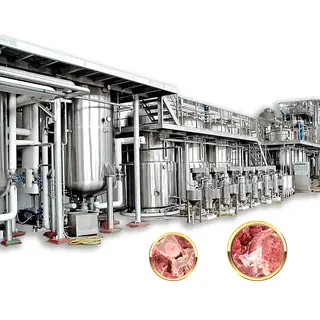
A wet pet food production line receives and grinds frozen or chilled meat, mixes it with other ingredients, optionally forms chunks in a steam oven, fills cans or pouches, seals them, and retort-sterilizes the sealed containers before cooling, labeling and casing. The retort step is what makes the product safe at ambient temperature.
The trade journal Petfood Industry describes the industrial wet petfood sequence in detail. Our summary of the main stages:
- Raw material storage. Frozen meat blocks are held at -18 °C; larger plants may receive chilled meat at 0–2 °C and process it quickly.
- Pre-breaking and coarse grinding. Frozen blocks are broken into pieces and fed to a coarse grinder with a hole plate and rotating knife. A heavy-duty bone grinder machine reduces carcass bones and frames so they can be incorporated as a natural calcium source.
- Fine grinding and emulsifying. Fine grinders reduce bone and fiber further. Meat, salts and flour are mixed in twin-shaft paddle mixers and allowed to stand so soluble proteins are extracted. Petfood Industry notes the final fine grind raises emulsion temperature to about 15–20 °C and that the emulsion must be free of ice.
- Chunk forming (for chunks-in-gravy or jelly). The emulsion is spread on a belt and heat-set in a steam oven. According to the same source, the product must reach at least 85 °C so meat proteins coagulate and starch gelatinizes, and chunks are then cooled below 20 °C. Alternatively, chunks are cold-set with alginate and calcium salts.
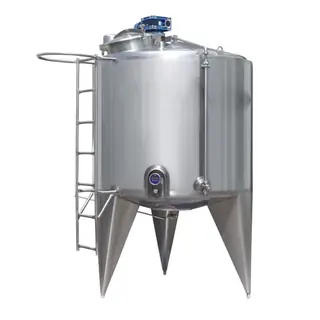
- Gravy or jelly preparation. Thickeners and gels are dispersed in water with a high-speed mixer to avoid lumps, then vitamins, minerals, colors and flavors are added. Gravy is usually prepared and held in a jacketed tank with an agitator, such as our double-layer tank with side agitator; broth-based gravies can be cooked in an industrial bone broth cooking kettle.
- Filling. Loaf-type products are pumped with lobe pumps and filled by volumetric piston fillers; chunks are filled by pocket or weigh fillers, with gravy topped up afterwards. Industrial rotary fillers reach several hundred to about 1,000 containers per minute, but small plants use far slower semi-automatic fillers.
- Seaming or sealing. Cans are double-seamed; trays receive heat-sealed peelable lids; pouches are heat-sealed with heated jaws, often after a steam flush.
- Retort sterilization. Sealed containers are heat-processed in batch steam or water retorts or continuous hydrostatic sterilizers. Trays and pouches need over-pressure retorting so the packs do not burst.
- Cooling, drying, coding, labeling and casing. Containers are cooled, dried, date-coded, labeled and packed for storage.
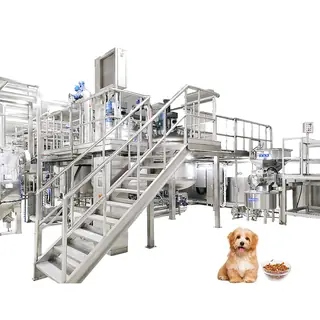
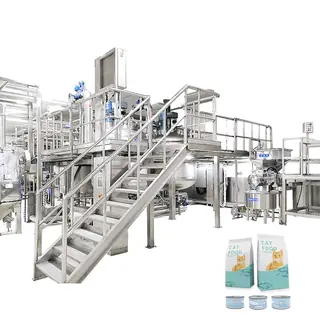
Our wet pet food production line follows this grind–mix–cook–fill–seal–sterilize sequence for dog, cat, bird and fish food, with SUS304 or SUS316L product-contact parts and capacities from 500 kg/h to 10 t/h. For plants that start with cans or trays, the dog food processing plant configuration covers grinding, mixing, cooking, filling and sterilizing as one turnkey package.
What sterilization standard does canned pet food have to meet?
In the United States, FDA states that canned pet foods must be processed under the low-acid canned food regulations, 21 CFR Part 113. In the EU, canned petfood must reach a minimum Fc value of 3. Both aim at commercial sterility, with the lethal effect measured against Clostridium botulinum spores.
Under 21 CFR 113.3, a low-acid food has a finished equilibrium pH above 4.6 and a water activity above 0.85, which describes almost all meat-based wet pet food. The regulation requires a scheduled process established by a competent processing authority, an accurate temperature-recording device on each retort, and double-seam teardown examinations at intervals not exceeding four hours.
Thermal lethality is expressed as an F0 (or Fc) value: the equivalent minutes at a reference temperature of 121.1 °C, using a z-value of 10 °C for C. botulinum. As Lab Manager's summary of retort validation explains, a minimum F0 of about 3 minutes corresponds to the classic 12-log "botulinum cook", and commercial processes are usually designed well above that minimum to cover product and loading variability. The actual retort temperature and time depend on container size, fill weight, product consistency and retort type, and must be established by heat-penetration studies, never copied from another product.
| Parameter | Value | Source |
|---|---|---|
| Low-acid food definition | pH > 4.6 and water activity > 0.85 | 21 CFR 113.3 |
| F0 reference temperature | 121.1 °C (250 °F) | Thermal process convention |
| z-value for C. botulinum | 10 °C | Thermal process convention |
| Minimum botulinum cook | F0 ≈ 3 minutes (12-log reduction) | Industry convention; EU minimum Fc 3 for canned petfood |
| Double-seam teardown checks (US) | At intervals not exceeding 4 hours | 21 CFR 113.60 |
| Chunk heat-setting | Product exits oven at 85 °C or more | Petfood Industry, wet petfood processing |
How is dried dog food made?
Dry dog food is made by extrusion. Ingredients are ground and mixed, conditioned with steam and water, cooked under pressure in an extruder, cut at the die into kibbles, dried to below about 10–12% moisture, coated with fat and palatants, cooled and packed. Extrusion gelatinizes starch, sets the kibble shape and destroys pathogens.
- Grinding. Grains, meals and other dry ingredients are ground in a mill and sieved where required so the mash is uniform and cooks evenly.
- Batching and mixing. Ingredients are weighed and mixed in a batch mixer, often a ribbon or paddle type. Minor ingredients such as vitamin and mineral premixes need accurate dosing and enough mixing time; see our guide to ribbon blenders and powder mixers.
- Preconditioning. Steam and water are added to the mash in a preconditioner so particles hydrate and heat before entering the extruder.
- Extrusion. A single- or twin-screw food extruder machine cooks the dough under heat, pressure and shear. At the die, the pressure drop expands the product and a rotating knife cuts it into kibbles.
- Drying. According to Petfood Industry, kibble leaves the extruder at roughly 25–30% moisture and must be dried to below 10–12%, with residence times up to 25–30 minutes, to reach a water activity that prevents mold growth.
- Coating. Fats, oils and palatability enhancers are applied in a coating drum, usually after drying.
- Cooling and packaging. Kibbles are cooled with ambient air, screened for fines, and filled into bags.
In the EU, Regulation (EU) No 142/2011 requires processed petfood other than canned to be heat-treated to at least 90 °C throughout the product, or to use an equivalent authorized route. The extruder is normally where this kill step happens, so its temperature profile is a critical control point in the hazard analysis.
Our standard pet food lines are built around the wet process. For dry kibble projects, we help clients plan the meat preparation, mixing, tank and CIP sections and coordinate the interface with the extrusion section.
What nutrition and regulatory standards apply to pet food factories?
In the US, FDA regulates pet food, and most states base their rules on AAFCO model regulations. A food can be labeled "complete and balanced" by meeting an AAFCO nutrient profile or passing an AAFCO feeding trial. In Europe, the FEDIAF Nutritional Guidelines are the industry reference for nutrient levels.
- AAFCO. AAFCO publishes model laws and nutrient profiles but does not itself regulate, test, approve or certify pet food. FDA explains that each species has two AAFCO profiles: growth and reproduction, and adult maintenance.
- FEDIAF. The FEDIAF Nutritional Guidelines for complete and complementary pet food for cats and dogs (2025 edition) are peer-reviewed by independent European veterinary nutritionists and used by manufacturers to check nutritional adequacy.
- Labeling. FDA notes that pet food labels are regulated at both federal and state level and must show product identity, net quantity, the manufacturer or distributor, and ingredients in descending order of weight.
- Food safety plan. FDA's FSMA rule on Preventive Controls for Animal Food requires covered facilities to follow animal food CGMPs and keep a written food safety plan with a hazard analysis and preventive controls.
- Raw materials (EU). Pet food is made from animal by-products, which Regulation (EU) No 142/2011 restricts to specified Category 3 material, and raw petfood must meet Salmonella and Enterobacteriaceae criteria.
Accurate premix dosing, validated cooking steps and traceable batch records are where machinery and compliance meet.
How big should a pet food plant be?
Size a pet food plant from the packed output you can sell per day, divided by realistic running hours after cleaning, changeovers and retort cycles. Wet lines are often limited by the retort and seamer; dry lines are limited by extruder and dryer throughput. Start with a capacity that matches proven demand and leave space to add a second shift or line.
| Scale | Typical situation | Equipment emphasis |
|---|---|---|
| Start-up, around 500 kg/h | New brand, regional distribution, frequent recipe changes | Batch mixing and cooking, semi-automatic filling, one batch retort |
| Mid-size, 1–5 t/h | Established brand, contract packing, several SKUs | Continuous grinding and emulsifying, automatic filling and seaming, multiple retorts or a continuous sterilizer |
| Large, up to about 10 t/h | National supply, export | Automated batching, high-speed filling, automated retort loading, centralized CIP |
A practical sizing sequence is:
- Fix the product range: loaf, chunks in gravy, jelly, dry kibble, treats.
- Fix container formats and sizes, because retort cycle time depends on container geometry.
- Estimate daily output and effective production hours.
- Size the bottleneck first (retort or extruder and dryer), then match grinding, mixing and filling around it.
- Check utilities: steam, compressed air, chilled water, power at your local voltage and 50 or 60 Hz.
You can run the first pass yourself with our line planner, or our engineers can size the line for you from your recipe and packaging plan. Ask for a sizing review.
What do you need to start a pet food manufacturing business?
To start a dog food business you need a validated recipe that meets AAFCO or FEDIAF nutrient levels, a registered or approved facility, a food safety plan, reliable meat and grain supply, and equipment sized for your first two to three years of sales. Packaging choice drives much of the line design.
Use this checklist before you commit capital:
- Recipe developed or reviewed by a qualified animal nutritionist, with the life stage defined.
- Regulatory route confirmed with your national or state authority, including facility registration and product labeling.
- Raw material plan: frozen or chilled meat, bone, offal, cereals, premixes; cold storage capacity.
- Packaging format chosen: cans, trays, retort pouches or bags, and the packaging machine to match.
- Thermal process authority engaged early for wet products.
- Utilities assessed: boiler capacity, water treatment, wastewater handling, power supply.
- Building layout separating raw meat handling from cooked and packed product.
- Cleaning plan, including CIP for tanks and pipework; see our CIP system guide.
- Plan for installation, operator training and spare parts.
In tropical climates, plan extra cold storage for raw meat and air-conditioned packaging areas, because high humidity can affect dry product and labels. For the building, installation and commissioning side, see our guide to food plant design and installation.
Which packaging machines are used for pet food?
Wet pet food is packed in cans using fillers and double seamers, in trays using fill-and-seal machines with peelable lids, or in retort pouches using pouch fillers and heat sealers. Dry kibble is packed in bags using weighing and bagging machines. The packaging must survive retorting for wet food and protect against moisture and fat migration for dry food.
For wet food, the packaging and the retort must be specified together, because pouch and tray formats need over-pressure retorting and the container shape determines heat penetration. For dry food, multi-layer bags with good grease and moisture barriers protect fat-coated kibble. When you compare suppliers, ask which container sizes the filler handles, changeover time between formats, and whether the seamer or sealer includes seam inspection tools. Our guide on how to choose a food processing equipment manufacturer lists further points to check.
What information do you need for a pet food line quotation?
Send the product types and recipes, target output in kg/h or containers per hour, packaging format and sizes, raw material form, utilities and local voltage, and site layout. With this, our engineers can propose a line configuration, footprint and utility list that you can compare like for like.
- Products: wet loaf, chunks in gravy or jelly, dry kibble, treats; dog, cat or other species.
- Capacity: kg/h or containers per hour, shifts per day, growth plans.
- Raw materials: frozen or fresh meat, bone content, cereals and premixes.
- Packaging: cans, trays, pouches or bags; container sizes and fill weights.
- Sterilization: existing thermal process requirements, retort type preferences.
- Utilities: steam, water, compressed air, voltage, 50 or 60 Hz.
- Site: building dimensions, ceiling height, floor drains, climate.
- Automation level and the language required for HMI and manuals.
Browse our specialty food plants, then send your data for a pet food line quotation. We build and test lines in Shanghai and send engineers for installation and training on site.
Frequently asked questions
How is dry dog food made?
Dry dog food is made by extrusion. Ground ingredients are mixed, conditioned with steam and water, then cooked under pressure in an extruder and cut into kibbles at the die. The kibbles are dried from roughly 25–30% moisture to below about 10–12%, coated with fats and palatants, cooled and bagged. Extrusion cooks the starch and acts as the main pathogen kill step.
Do canned pet foods have to follow low-acid canned food rules?
Yes, in the United States. FDA states that canned pet foods must be processed according to the low-acid canned food regulations in 21 CFR Part 113, so that the sealed product is commercially sterile. That means a scheduled process set by a competent processing authority, recorded retort temperatures, and regular container seam examinations. In the EU, canned petfood must reach a minimum Fc value of 3.
What does a bone grinder do in a dog food factory?
A bone grinder breaks down carcass bones, frames and frozen meat blocks so they can be included in wet pet food as a source of calcium and phosphorus. Coarse grinders with hole plates and rotating knives do the first reduction, and fine grinders reduce bone particles further before mixing or emulsifying. Grinders must avoid local overheating, which can damage protein and promote microbial growth.
What is the difference between AAFCO and FEDIAF?
AAFCO is a US association of state and federal feed officials that publishes model regulations and nutrient profiles for dog and cat food; it does not approve or certify products. FEDIAF is the European pet food industry federation and publishes peer-reviewed Nutritional Guidelines for complete and complementary pet food. Exporters often check recipes against both references, depending on the target market.
What capacity pet food production line should a start-up buy?
Size the line from the volume you can realistically sell in the first two to three years, divided by effective running hours after cleaning and retort cycles. Many start-ups begin around 500 kg/h with batch mixing and one retort, then add filling speed or retorts as demand grows. Leave building space and utility capacity for a second line rather than buying an oversized first line.
What pet food processing equipment is needed for wet food?
A wet pet food line typically needs frozen-block breakers, meat and bone grinders, a mixer or emulsifier, an optional steam oven for chunks, a gravy preparation tank, a filler, a can seamer or pouch and tray sealer, a retort or continuous sterilizer, and cooling, coding and labeling equipment. CIP for tanks and pipework and a steam boiler complete the utility side.
Sources
- FDA – Pet Food (regulation, labeling, low-acid canned food requirement)
- FDA – "Complete and Balanced" Pet Food
- eCFR – 21 CFR Part 113, Thermally Processed Low-Acid Foods Packaged in Hermetically Sealed Containers
- FDA – FSMA Final Rule for Preventive Controls for Animal Food
- Regulation (EU) No 142/2011, Annex XIII Chapter II – Petfood requirements
- FEDIAF – Nutritional Guidelines for Complete and Complementary Pet Food for Cats and Dogs
- Petfood Industry – Wet petfood processing
- Petfood Industry – How processing affects pet food products, Part 2
- Lab Manager – Retort process validation for shelf-stable and canned products