Dairy processing lines · · 10 min read
Food Processing Plant Design, Automation and Installation
Food processing plant design roadmap: process flow, hygienic layout, utilities, automation, FAT/SAT, installation, commissioning, training and timeline.
By the process engineering team at Shanghai Mars Industrial Co., Ltd.

Key takeaways
- A food processing plant project runs through concept, process design, layout and utilities, detailed engineering, manufacturing with FAT, installation with SAT, commissioning and training, and handover.
- The process flow diagram and mass balance must be agreed first, because equipment size, utility demand, building area and cost all follow from it; ISO 10628-1:2014 sets flow diagram rules for the chemical and petrochemical industry.
- US rule 21 CFR 117.20 requires food plants to have cleanable floors, walls and ceilings, enough space around equipment, and separation of operations where contamination is possible.
- IEC 62381:2024 defines requirements and checklists for factory acceptance tests (FAT), site acceptance tests (SAT) and site integration tests of process automation systems.
- An NDDB model report planned about two years from construction start to production for a 300,000 L/day greenfield dairy, with service equipment about a quarter of project cost.
What are the stages of a food processing plant project?
Food processing plant design follows a fixed roadmap: define products and capacity, draw the process flow diagram and mass balance, size equipment and utilities, develop a hygienic layout, choose the automation level, manufacture and factory-test the equipment, install and commission it on site, train operators and hand over. Each stage freezes inputs for the next.
Skipping or rushing a stage is what usually causes late starts and lines that never reach rated output: a layout drawn before the mass balance, utilities sized after the equipment is ordered, or software tested for the first time on site. This guide walks through each phase of a food processing plant project, from concept to handover, with the standards that apply and the decisions the owner must make. It uses dairy as the main example, but the same roadmap applies to juice, tomato paste, plant-based milk and powder plants.
| Phase | Main deliverables | Owner decisions |
|---|---|---|
| 1. Concept and capacity | Product list, volumes, pack formats, growth plan | Which products, which markets, how much to invest |
| 2. Process design | Process flow diagram, mass and energy balance, equipment list | Process route, heat treatment, shelf-life target |
| 3. Layout and utilities | Layout drawing with hygiene zones, utility schedule | Building (new or existing), expansion space |
| 4. Detailed engineering | P&IDs, electrical and automation design, foundation and service drawings | Automation level, preferred component brands, documentation language |
| 5. Manufacturing and FAT | Fabricated equipment, factory acceptance test report | Witness FAT in person or remotely |
| 6. Installation and SAT | Installed, piped and wired line; site acceptance test | Site readiness, local contractors, permits |
| 7. Commissioning and training | Water runs, CIP validation, product trials, trained operators | Raw material for trials, staff availability |
| 8. Handover and support | Manuals, as-built drawings, spare parts, warranty | Service agreement, spare-parts stock |
Why does food processing plant design start with a process flow diagram?
The process flow diagram and mass balance turn a product idea into flows, temperatures and quantities at every step. Equipment size, utility demand, building area and cost all follow from it, so errors here multiply through the whole project. It should be agreed before any layout or equipment order.
A process flow diagram shows the main process steps and streams; a piping and instrumentation diagram (P&ID) later adds every valve, pump, instrument and control loop. ISO 10628-1:2014 sets out the classification, content and drafting rules for flow diagrams in the chemical and petrochemical industry, and its conventions give food plant teams and suppliers a useful common drawing language. For a food plant, the process design stage should fix:
- Daily and hourly throughput for each product, after deducting cleaning and changeover time.
- Heat treatment conditions and holding times, for example 72–75 °C for 15–20 seconds for homogenized market milk according to the Tetra Pak Dairy Processing Handbook.
- Buffer tank volumes between continuous equipment and batch steps or fillers.
- Yields and by-products (whey, pulp, okara, wastewater) that need handling.
- Peak utility loads: steam, refrigeration, compressed air, water and power.
Our line planner performs the first step of this calculation, converting daily volume into hourly equipment capacity. For dairy specifically, our dairy plant planning guide gives worked sizing examples.
How should a food processing factory layout and hygienic zoning be designed?
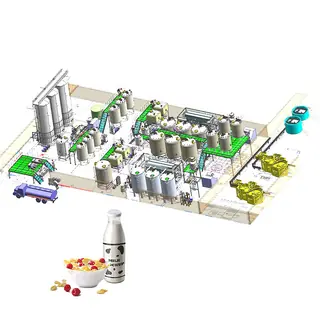
Arrange the food processing factory so raw materials, product, packaging, people and waste each follow defined routes, with product moving in one direction from raw intake to dispatch. Separate raw and finished-product areas physically or by airflow, keep utilities and chemicals in their own rooms, and make every surface cleanable.
US food safety rules in 21 CFR 117.20 require plants to be suitable in size, construction and design for maintenance, sanitation and food production. They call for enough space around equipment for cleaning, for separation of operations by location, time, partitions, airflow or enclosed systems where contamination is possible, and for floors, walls and ceilings that can be cleaned and kept in good repair. Drips and condensate must not fall on food or food-contact surfaces. EHEDG Guideline 44, Hygienic Design Principles for Food Factories, gives best-practice guidance for designing and constructing food buildings. A practical zoning plan for most liquid-food plants includes:
- Raw zone: intake, raw material testing and raw storage.
- Process zone: heat treatment, separation, mixing and process tanks.
- High-care zone: filling and packing of heat-treated product, with hygiene entry for staff.
- Cold and dry storage: finished goods, packaging materials and ingredients, kept apart.
- Technical zone: boilers, chillers, compressors, CIP station, electrical room and effluent treatment.
Leave access space for maintenance and future modules, and route pipe bridges and cable trays so they do not pass over open product.
Which utilities must be designed with the process?
A food plant needs steam or hot water, refrigeration or chilled water, compressed air, potable and treated water, electrical power and effluent treatment. Size them from the peak simultaneous load, including CIP running alongside production, and design them with the process rather than after the equipment is ordered.
Utilities are a large part of the investment. In an NDDB-hosted model detailed project report for a 300,000-liter-per-day dairy, service equipment (refrigeration, steam generation, water handling, compressed air and electrical systems) accounts for about a quarter of total project cost, and refrigeration alone is the largest single service item. For international projects, utility design must also reflect local conditions: supply voltage and 50 or 60 Hz frequency, grid stability and the need for a standby generator, water hardness, and the extra refrigeration load of tropical climates. Our milk processing plant cost guide breaks these shares down further.
What level of production line automation do you need?
Choose automation by risk and labor cost: automate food-safety-critical functions such as pasteurization temperature recording, flow diversion and CIP first, then add PLC sequence control, recipe management and SCADA as volumes and product numbers grow. Full plant-wide control suits large plants; small plants can start semi-automatic.
| Level | What it does | Typical fit | Trade-offs |
|---|---|---|---|
| Manual with local instruments | Operators open valves and start pumps; thermometers and recorders on critical points | Mini plants, pilot lines | Low cost; depends on operator discipline; limited records |
| Semi-automatic (PLC per machine) | Each machine runs its own sequence on a touch screen; manual transfers between machines | Small-to-mid plants with few products | Good value; data scattered across machines |
| Line PLC with HMI and automatic CIP | One control system sequences the line, valves and cleaning; alarms and trend records | Mid-size plants, several products | Higher cost; fewer operators; consistent cleaning |
| Plant-wide SCADA or DCS | Central control of all lines and utilities; batch records, reporting and traceability | Large plants, multi-line sites | Highest cost; needs trained automation staff |
Whatever the level, some functions are non-negotiable. The Tetra Pak handbook describes continuous temperature logging at the end of the holding tube, a flow diversion valve that returns under-heated product, and a booster pump keeping pasteurized product at higher pressure than raw product. The NDDB model dairy specifies a PLC/DCS central automation system with operator screens and expects to run its 300,000 L/day plant with about 20 officers and staff, which shows the labor effect of automation at scale. Examples of automated lines include the yogurt production line with full-auto CIP, the soy milk processing line with automatic CIP and the PLC fruit juice line with PET bottle filling.
What are FAT and SAT, and why do they matter?
A factory acceptance test (FAT) proves at the supplier's works that equipment and control software meet the specification before shipping; a site acceptance test (SAT) proves the installed system works on site. IEC 62381:2024 defines requirements and checklists for FAT, SAT and site integration testing of process-industry automation systems.
Fixing a software sequence or a wrong instrument range at the factory takes hours; fixing it on site, with an installation team waiting, can take weeks. A good FAT protocol, agreed in the contract, typically covers:
- Dimensional and material checks against approved drawings and material certificates.
- Weld and surface finish inspection on product-contact parts.
- Pressure or leak tests on vessels, heat exchangers and piping spools.
- Motor rotation, interlocks and emergency stops at the specified voltage and frequency.
- Simulated operation of every PLC sequence, alarm and recipe, including CIP programs.
- Instrument calibration certificates and a punch list of open items with owners and dates.
The SAT then repeats the functional tests with real utilities, and the site integration test checks that the line communicates correctly with other systems such as utilities and plant SCADA.
How are food processing plant equipment installation and commissioning done?
Installation starts once the building, foundations, drains and utilities are ready. Equipment is set and leveled, then piped, wired and insulated; commissioning follows with water runs, CIP tests, hot runs and product trials, ending in a performance test at rated capacity. Each step needs signed checklists.
- Site readiness check: floors and drains finished, openings large enough for equipment, utilities connected to the battery limit, power available.
- Setting and leveling: heavy equipment such as silos, evaporators and homogenizers is lifted, positioned and anchored to the approved layout.
- Piping and electrical installation: sanitary piping welded and supported with slope for drainage; cables, panels and instruments installed and checked.
- Cold commissioning: water runs to test pumps, valves, flow rates, level control and interlocks without product.
- CIP verification: every circuit is cleaned with the real program to confirm coverage, temperature and flow. The Tetra Pak handbook notes that a full CIP cycle on a UHT plant takes 70–90 minutes, which must fit the production schedule.
- Hot commissioning and sterilization: heat treatment equipment is brought to temperature; UHT plants are pre-sterilized, which the handbook describes as hot water at no less than 125 °C for at least 30 minutes.
- Product trials and performance test: trial batches confirm product quality, yield and capacity against the contract.
On international projects, a practical model is supervision by the supplier's engineers working alongside local mechanical and electrical contractors, which keeps travel costs down and leaves the plant team familiar with every connection.
How should operator training and handover be organized?
Train operators, maintenance and quality staff during commissioning on the real equipment, not only in a classroom, and recruit them early enough to take part. Hand over operating and maintenance manuals, as-built drawings, PLC backups, calibration records and a recommended spare-parts list.
The NDDB model project report for a cooperative dairy plans to prepare a recruitment and training schedule so trained staff are deployed well before the plant is handed over. That is good practice for any size of plant. Training should cover normal operation, CIP, food-safety controls and records, alarm handling, routine maintenance and safe shutdown. Agree how remote support, spare-parts supply and follow-up visits will work after the warranty period.
What does a turnkey supplier do, and how long does a project take?
A turnkey supplier takes responsibility from process design to a running line: engineering, equipment manufacture, FAT, shipment, installation supervision, commissioning, training and after-sales support. Project duration depends on scope; the NDDB model report planned about two years from consultant appointment and construction start to production for a 300,000 L/day greenfield dairy.
The same report states that the cooperative would hire a technical consultant to execute the plant on a turnkey basis, because it lacked in-house expertise for a plant of that size. Smaller projects using standard skids in an existing building move much faster than greenfield sites. The main schedule drivers are:
- How quickly products, capacities and layout are frozen.
- Building permits and civil construction for new sites.
- Equipment manufacturing time for custom vessels and lines.
- Sea freight, customs clearance and inland transport.
- Availability of utilities, local contractors and trained staff on site.
Our engineering and installation services cover process design, layout, automation, installation supervision, commissioning and training. Typical turnkey scopes include the mini turnkey dairy processing plant, the automatic tomato paste production line and the turnkey seasoning powder production line; browse all dairy processing lines for more. If you want a second opinion on a layout or schedule, our engineers can review your drawings through our quotation form. Our CIP system guide covers the cleaning design that commissioning will test.
What information do you need for a quotation?
For a food plant design and installation quotation, send your products and capacities, pack formats, raw material, site and building details, utilities and local power supply, required automation level, the scope of services you want, and your target start date. With this, a supplier can return a layout, equipment list, schedule and price.
- Products and capacity: each product with daily volume, working hours and growth plan.
- Raw materials: type, quality and seasonality (milk, fruit, soybeans, powders).
- Packaging: formats, pack sizes and target speeds.
- Site: existing building drawings or plot plan, ceiling height, floor loading, ambient temperature range.
- Utilities and power: steam source, cooling water, water quality, voltage, phase and 50 or 60 Hz.
- Automation: manual, semi-automatic, line PLC or plant SCADA; preferred control brands if any.
- Services: design only, equipment supply, installation supervision, full turnkey, training, spare parts.
- Standards and timing: applicable food safety rules, required certificates and target production date.
Send these details through our request-a-quote form, and our engineers will prepare a preliminary process flow diagram, layout and project schedule for your food processing plant.
Frequently asked questions
What is food processing plant design?
Food processing plant design is the engineering work that turns a product plan into a buildable factory: process flow diagram and mass balance, equipment sizing, utility design, hygienic layout and zoning, automation and electrical design, and installation planning. It ensures the plant produces safe food at the intended capacity and can be cleaned and expanded.
What is the difference between FAT and SAT?
A factory acceptance test is carried out at the supplier's works before shipment to prove that equipment and software meet the specification. A site acceptance test is carried out after installation, with real utilities, to prove the system works in the plant. IEC 62381:2024 sets out requirements and checklists for both.
How long does it take to build a food processing plant?
It depends on scope. Standard skids installed in an existing building take far less time than a greenfield site with new civil works. As one public example, an NDDB model report for a 300,000 L/day dairy planned about two years from construction start to production.
What does a turnkey food plant supplier provide?
A turnkey supplier delivers a working line rather than separate machines: process design, layout, equipment manufacture, factory testing, shipment, installation supervision, commissioning, operator training, documentation and after-sales support. The owner usually provides the building, utilities connections, local labor, permits and raw materials for trials.
How much automation does a small food plant need?
A small plant can run semi-automatic machines with local PLCs, but food-safety-critical functions should be automated from the start: heat-treatment temperature recording, automatic flow diversion and repeatable CIP. Line-wide PLC control and SCADA become worthwhile as volumes, product numbers and labor costs grow.
What is included in food processing equipment installation?
Installation covers site readiness checks, setting and leveling equipment, sanitary piping, electrical and instrument wiring, insulation, then cold commissioning with water, CIP verification, hot commissioning, product trials and a performance test at rated capacity. Each step should close with signed checklists and a punch list.
Sources
- IEC 62381:2024 – Automation systems in the process industry: FAT, SAT and SIT
- ISO 10628-1:2014 – Diagrams for the chemical and petrochemical industry: Specification of diagrams
- eCFR – 21 CFR 117.20 Plant and grounds
- EHEDG – Guideline 44: Hygienic Design Principles for Food Factories
- Tetra Pak Dairy Processing Handbook – Pasteurized and ESL dairy products
- Tetra Pak Dairy Processing Handbook – Long-life dairy products
- NDDB – Model DPR for end borrowers under the Dairy Processing and Infrastructure Development Fund (January 2018)