Dairy processing lines · · 10 min read
Food Processing Equipment Manufacturer: How to Choose One
How to choose a food processing equipment manufacturer: hygienic design, 316L certificates, welds, CE, ISO 9001, FAT, warranty, Incoterms and red flags.
By the process engineering team at Shanghai Mars Industrial Co., Ltd.

Key takeaways
- EHEDG certification applies to individual components such as pumps and valves, not to complete processing lines, and certificates are valid for five years.
- 3-A design guidance calls for product-contact surfaces at least as smooth as 0.8 µm Ra, including welds, and continuous welds without skips or stitches.
- ISO does not issue certificates itself; ISO 9001 certifies a quality management system, and accredited certificates can be checked in the IAF CertSearch database.
- The EU Machinery Regulation (EU) 2023/1230 replaces Directive 2006/42/EC and applies from 20 January 2027; CE marking follows an EU declaration of conformity.
- A written factory acceptance test, milestone payments, a defined Incoterm and contractual spare parts, training and warranty terms are the main protections when buying equipment abroad.
How do you choose a food processing equipment manufacturer?
Choose a food processing equipment manufacturer by evidence, not by brochure: verify hygienic design and material certificates, inspect weld quality, confirm CE marking and an accredited ISO 9001 certificate, insist on a factory acceptance test, and agree documentation, spare parts, installation, training, warranty, Incoterms and payment terms in the contract.
Food processing equipment is a long-lived asset. A pasteurizer, tank or complete food processing line will run for many years, and its hygiene, reliability and support matter more than the purchase price. That is true whether you buy from Europe, the US or China. This guide sets out the checks experienced buyers make, explains the standards behind them, and is candid about the red flags. We are a Chinese manufacturer ourselves, so we also explain what to verify specifically when sourcing food processing machinery from China.
What should you check before buying food processing machinery?
Check seven areas: hygienic design, materials, fabrication quality, compliance marks, testing, documentation and after-sales support. For each one, ask for evidence you can verify, such as certificate numbers, mill certificates, weld photos, FAT protocols and named references, rather than accepting a statement in a quotation.
| Area | What to ask | Evidence to request |
|---|---|---|
| Hygienic design | Which hygienic design guidelines does the design follow? | Drawings showing drainable pipework, radii, seals; any EHEDG or 3-A certified components with certificate numbers |
| Materials | Which grade is used for each product-contact part? | Material list (304, 316L, gasket elastomers) and mill certificates, ideally EN 10204 type 3.1 |
| Welding and finish | How are product-contact welds made and inspected? | Weld procedure, photos or borescope images of internal welds, surface roughness values |
| Compliance | Which directives or regulations does the CE marking cover? | EU declaration of conformity, ISO 9001 certificate verifiable through the issuing body |
| Testing | What will be tested before shipment, and can we witness it? | Written FAT protocol, test report, video of the running machine |
| Documentation | What manuals and drawings come with the equipment? | Sample manual, P&ID, electrical drawings, spare parts list |
| Support | Who installs, trains and supplies parts, and how fast? | Installation plan, training scope, spare parts lead times, warranty terms |
What hygienic design standards should food grade equipment meet?
The two main hygienic design references are EHEDG guidelines in Europe and 3-A Sanitary Standards in the US. EHEDG certifies individual components such as pumps and valves, not complete lines; 3-A authorizes a symbol after third-party verification. Neither is legally required everywhere, but both define what cleanable design looks like.
- EHEDG. According to EHEDG, certification applies to individual components rather than large, complex machines or processing systems, and certificates are valid for five years. You can check a claimed certificate in EHEDG's online list of certified equipment.
- 3-A. The 3-A Symbol identifies dairy and food equipment built to 3-A Sanitary Standards. Its use is voluntary, but licensees must pass Third Party Verification by a Certified Conformance Evaluator.
- Surface finish and geometry. 3-A design guidance calls for product-contact surfaces at least as smooth as 0.8 µm Ra (32 µin), including welds, and radii of at least 1/4 inch in internal angles under 135°.
Be wary of the phrase "EHEDG standard" or "3-A standard" applied to a whole line without certificate numbers. A supplier may legitimately design to these guidelines and use certified components, but a complete line cannot be EHEDG certified.
How do you verify stainless steel grade and weld quality?
Ask for a bill of materials naming the grade of every product-contact part, mill certificates traceable to those parts, and photos of internal welds. Use 316L where products are salty, acidic or cleaned with aggressive chemicals; 304 is common for milk and many neutral products. Check for continuous, full-penetration, smooth welds.
The International Molybdenum Association explains that molybdenum strongly increases a stainless steel's resistance to chloride pitting, which is why molybdenum-bearing 316L is chosen for brines, tomato products and high-salt seasonings. The "L" means low carbon, which improves corrosion resistance at welds. A handheld alloy analyzer at inspection can confirm molybdenum is present.
Mill certificates come in several types under EN 10204. A type 2.1 is only a declaration of compliance; a type 3.1 reports specific test results certified by the steel producer's inspection representative, independent of production; a type 3.2 adds a third-party inspector.
For welds, EHEDG Guideline 35 on hygienic welding of stainless steel tubing identifies orbital TIG welding as the best technique for consistent hygienic welds and prefers mechanized over manual welding for repeatability and traceability. 3-A guidance requires continuous welds without skips or stitch welds, and sanitary tubing welds free of pits, cracks and crevices.
Which certifications matter: CE, ISO 9001 and others?
CE marking shows the manufacturer declares the machine meets EU safety requirements and is required to sell machinery in the EU. ISO 9001 certifies the supplier's quality management system, not the machine. Both should be verifiable: request the EU declaration of conformity and check the ISO 9001 certificate with the accredited certification body.
- CE marking. EU-OSHA notes that the new Machinery Regulation (EU) 2023/1230 replaces Directive 2006/42/EC and applies from 20 January 2027. Manufacturers must complete the conformity assessment, draw up an EU declaration of conformity and affix the CE marking. Instructions may be supplied in digital format.
- ISO 9001. ISO's own guidance states that ISO itself does not perform certification. Certificates are issued by certification bodies, and accredited certificates can be checked in the International Accreditation Forum's CertSearch database or with the certification body.
- Local approvals. Electrical approvals, pressure vessel registration and food authority requirements differ by country. Ask early which documents your inspector will want.
Mars Industrial holds CE marking and ISO 9001 certification. Hygienic design standards are a separate topic, and we discuss component choices for each project rather than claiming whole-line certification.
What should a factory acceptance test (FAT) include?
A FAT proves, before shipment, that the equipment meets the agreed specification. It should follow a written protocol covering visual and dimensional checks, material documents, pressure or leak tests, motor rotation, instrument calibration, PLC logic and alarms, and a water run or product trial where practical, with results signed by both sides.
IEC 62381 sets out requirements and checklists for FAT, site acceptance tests (SAT) and site integration tests for automation systems in the process industry, and it is a useful template for the control part of a food line. A practical FAT sequence is:
- Agree the FAT protocol and acceptance criteria when the order is placed.
- Check dimensions, materials, welds and surface finish against drawings.
- Pressure-test vessels, heat exchangers and pipework.
- Power up, check motor rotation, instruments and safety interlocks.
- Run the PLC sequences, including CIP steps, alarms and recipe changes.
- Run with water, or with product if possible, and record capacity and temperatures.
- List open points, agree corrective actions and sign the report.
If you cannot travel, a live video FAT with a written report is a reasonable alternative. Our lines are built and tested in Shanghai, and we provide video outgoing inspection and a machinery test report before shipment.
What documentation, spare parts and after-sales support should you expect?
Expect an operation and maintenance manual in your language, P&IDs, electrical drawings, PLC program backup, material certificates, the FAT report and a recommended spare parts list. Agree installation supervision, operator training, warranty length and spare parts lead times in the contract, not in emails.
- Documentation: layout and foundation drawings, utility list, P&ID, wiring diagrams, component data sheets, CE declaration, manuals.
- Spare parts: a two-year list of wear parts such as gaskets, seals, pump impellers and sensors, with part numbers for standard components so you can source locally.
- Installation and training: who supervises installation, how many days, what the buyer provides (cranes, labor, utilities), and what training is given to operators and maintenance staff.
- Warranty: length, start date (shipment or commissioning), exclusions such as wear parts, and response times.
- Remote support: video calls and remote PLC access shorten troubleshooting, especially across time zones.
For our turnkey projects, our engineers travel abroad for installation, commissioning and training, we offer video support after start-up, and we supply spare parts. Our standard warranty is one year. Read more on our services page and in our guide to food plant design and installation.
Should you buy a turnkey line or individual machines?
Buy a turnkey food processing line when you lack in-house process engineering or need one party responsible for overall performance. Buy individual machines when you already have a working plant, an engineering team that can integrate equipment, or a clear bottleneck to fix. Turnkey simplifies accountability; single machines give more choice per item.
| Factor | Turnkey line | Individual machines |
|---|---|---|
| Responsibility for line output | One supplier | Buyer or their engineer |
| Process design and layout | Included | Buyer must provide |
| Interfaces (pipework, controls, CIP) | Designed together | Risk of mismatched capacities and signals |
| Flexibility in choosing each item | Lower | Higher |
| Best for | New plants, start-ups, new product categories | Expansions, replacements, debottlenecking |
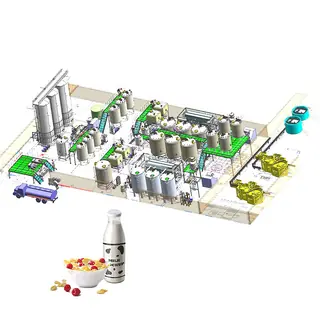
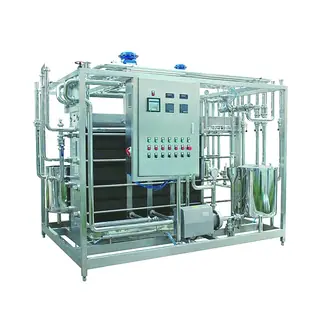
As an example of the turnkey approach, our mini turnkey dairy processing plant and multi-functional small-scale dairy processing line are engineered as complete systems, while a single milk pasteurizer with balance tank or a yogurt line with full-auto CIP can be added to an existing plant. Browse all dairy processing lines or our full product range. If you are planning a new dairy, our dairy plant planning guide and line planner help you size the first pass. Our engineers can also review your process flow and tell you honestly whether turnkey or single machines fit better; contact us for a review.
What should you check when sourcing food processing equipment from China?
When sourcing from China, confirm you are dealing with the actual manufacturer, specify your local voltage and frequency, agree the Incoterm and who handles inland transport, use staged payments tied to milestones such as FAT, and plan how installation and spare parts will reach your site.
- Manufacturer or trader? Ask for a video tour of the workshop, current production photos and the business license. Traders can be useful, but you should know who builds and supports the equipment.
- Electrical specification. State your supply voltage and 50 or 60 Hz, and the brands of electrical components you can service locally.
- Climate. In hot, humid regions, ask for cooling capacity and control panel protection sized for your conditions.
- Incoterms. Incoterms 2020 contains 11 rules. FAS, FOB, CFR and CIF are for sea and inland waterway transport only; EXW, FCA, CPT, CIP, DAP, DPU and DDP work for any mode. For containerized equipment, agree exactly where risk passes.
- Payment terms. A deposit, a payment after FAT and a balance before shipment or against documents are common. A letter of credit under the ICC's UCP 600 rules pays against complying documents, so define them carefully.
- Packing and shipping. Ask how tanks and skids are protected and fixed, and whether oversized items need special containers.
- Language. Specify the language of manuals and HMI screens in the contract.
What are the red flags when choosing a food equipment supplier?
The biggest red flags are vague material specifications, certificates that cannot be verified, refusal to allow a FAT or video inspection, prices far below other quotes without explanation, no named references, and contracts that leave out installation, training, warranty and spare parts.
- "Stainless steel" without a grade, or 316L promised only for parts you cannot see.
- Photos of other companies' equipment or no current workshop photos.
- Claims of whole-line EHEDG or 3-A certification without certificate numbers.
- Capacity stated without the product, temperature or running hours it applies to.
- No utility list, so steam, water and power needs are unknown until delivery.
- Full payment demanded before any test.
- No references you can call in a similar product category.
If cost is the main question, our guide to milk processing plant cost explains what drives the price of a dairy line.
What information do you need for a quotation?
To get comparable quotations from food processing equipment suppliers, send the same data package to each: product and recipe, capacity per hour and per day, packaging, raw material, utilities, voltage and frequency, site layout, automation level and the Incoterm you want.
- Product(s) and target shelf life.
- Capacity in kg/h or L/h, shifts per day and expansion plans.
- Packaging format and sizes.
- Raw material quality and how it arrives.
- Utilities: steam, water, compressed air; voltage and 50 or 60 Hz.
- Building drawings, ceiling height and climate.
- Automation level and language for HMI and manuals.
- Delivery destination and preferred Incoterm.
Send this to our engineers via our quotation form; you can learn more about Mars Industrial before you do.
Frequently asked questions
How do I choose a food processing equipment manufacturer?
Compare manufacturers on verifiable evidence: material grades and mill certificates, internal weld quality, hygienic design, CE declaration of conformity, an ISO 9001 certificate you can check with the issuing body, a written factory acceptance test, documentation, spare parts and after-sales support. Send every supplier the same specification so quotations can be compared like for like, and speak to references in your product category.
Is ISO 9001 a product certification for machines?
No. ISO 9001 specifies requirements for a quality management system, so it certifies how a company manages quality, not that a particular machine meets a standard. ISO itself does not issue certificates; accredited certification bodies do. You can check an accredited certificate through the International Accreditation Forum's CertSearch database or by contacting the certification body named on it.
Can a complete food processing line be EHEDG certified?
No. EHEDG states that its certification applies to individual components such as pumps, valves and sensors, not large complex machines or processing systems. A complete line can be designed according to EHEDG guidelines and built with certified components, but any claim of a fully certified line should be questioned. Certified components are listed in EHEDG's online database.
What is a factory acceptance test for food equipment?
A factory acceptance test (FAT) checks equipment at the manufacturer's site before shipment against an agreed protocol. It typically covers dimensions, materials, pressure tests, motors, instruments, PLC sequences, alarms and a water or product run. IEC 62381 gives a framework for FAT and site acceptance tests for process automation systems. Remote video FATs are common for overseas buyers.
Is it safe to buy food processing machinery from China?
It can be, if you manage the same risks you would with any supplier. Confirm you are dealing with the actual manufacturer, verify materials and certificates, require a documented FAT, tie payments to milestones, specify voltage, frequency and manual language, and agree installation, training, warranty and spare parts in the contract. Speaking to existing customers is the best single check.
What is the difference between 304 and 316L stainless steel in food equipment?
Both are austenitic stainless steels widely used for food contact. 316L contains molybdenum, which significantly improves resistance to chloride pitting, and its low carbon content helps corrosion resistance at welds. It is preferred for salty, acidic or aggressively cleaned products. 304 is common for milk, water and many neutral products where chlorides are low.
Sources
- EHEDG – Frequently asked questions on certification
- EHEDG – Guideline 35: Hygienic welding of stainless steel tubing in the food processing industry
- 3-A Sanitary Standards Inc. – About 3-A and the 3-A Symbol
- 3-A SSI – Hygienic design considerations and techniques (presentation)
- EU-OSHA – Regulation (EU) 2023/1230 on machinery
- International Molybdenum Association – Molybdenum grade stainless steels
- ISO – How to verify an accredited certification
- IEC 62381:2024 – Automation systems in the process industry: FAT, SAT and SIT
- nibusinessinfo.co.uk – Incoterms 2020